


A deficit in body corporate funds deserves attention. It is a red flag, an indicator that further investigation is needed.
There may be a valid, and acceptable explanation such as it’s a timing issue, or it may be an indicator of a cash flow problem or a symptom of a more problematic scenario.
Before deciding what it means, you need to establish which fund is affected, what the figure represents and how the position arose.
An administrative fund deficit may reflect pressure on day-to-day operating costs. A negative sinking fund balance raises different questions about major expenditure, borrowing and the contributions owners will need to make in the future.
In our body corporate searches, we are increasingly seeing sinking funds with negative balances. Where these are associated with one or more strata loans, the concern extends beyond recovering a shortfall. Owners may be funding completed works for years while also needing to save for the building’s next round of expenditure.
What are the two funds for?
The administrative fund meets recurrent expenses such as insurance, management fees, cleaning, electricity and routine maintenance. Its budget addresses the ongoing cost of operating the scheme.
The sinking fund provides for capital and non-recurrent expenditure, including major painting, structural repairs and replacement of significant common property items. Its budget must address current expenditure and amounts to accumulate for anticipated expenditure over at least the following nine years.
These different purposes matter when interpreting a deficit.
First, establish what “deficit” means
When I talk about a deficit, I mean a negative accumulated fund balance showing on a schemes balance sheet.
It might show up as a negative figure (Administrative Fund $-14,520.50) or with brackets around it (Administrative Fund ($14,520.50)). Both mean the same thing – the fund is in deficit, meaning more has been spent that saved / collected.
Financial statements can show several different measures. They should not be treated as interchangeable.
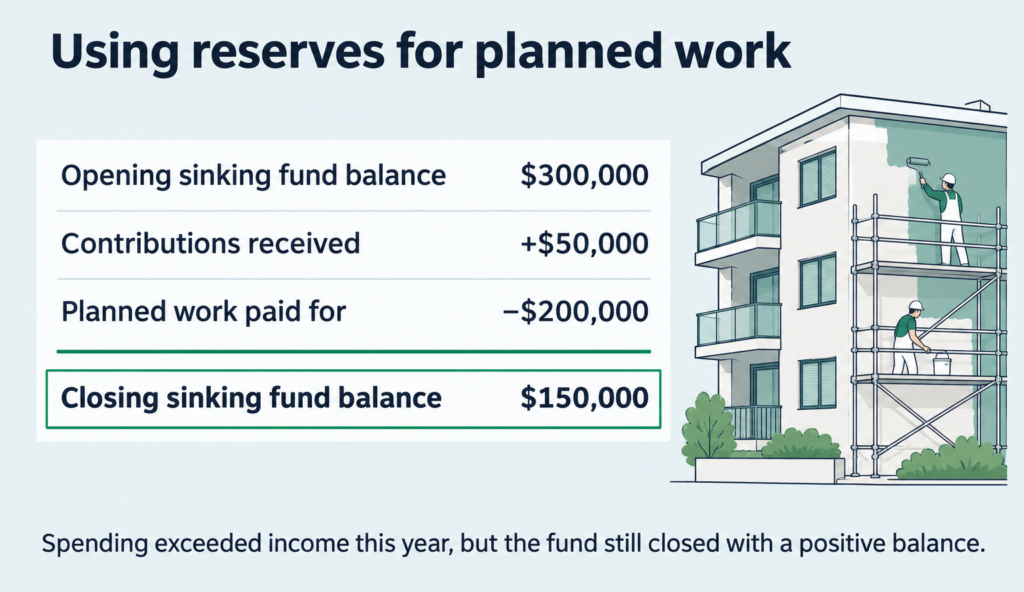
This should not be confused with a deficit in the period. A fund can spend more than it receives during a year without being in financial difficulty.
For example, a sinking fund starting with $300,000, receiving $50,000 and spending $200,000 would finish with $150,000. Its expenditure exceeded its income for the year, but its accumulated balance remains positive.
Any time a negative in fund balances shows up this is a red flag that should be investigated.
Administrative fund deficits: timing or continuing pressure?
An administrative fund deficit should be read alongside the levy cycle, budget, expenditure and outstanding contributions.
For instance, a large annual insurance payment shortly before a levy instalment falls due can put pressure on cash. The scheme may slip into deficit with levy payments pending. This is a timing error which will most likely clear when those contributions are paid.
That explanation should be checked against later statements.
On other occasions a deficit may occur for other reasons. More persistent concerns include:
- Recurring costs exceeding the amounts budgeted. For instance, insurance budgeted at $50,000 but actual cost $75,000.
- Unexpected legal, investigation or maintenance expenses.
- An earlier accumulated deficit that has not been recovered.
- Levy arrears restricting the money available to pay bills.
An annual budget is an “educated guess”. Things can happen which drive up costs and a deficit in the administrative fund is an indicator that this is happening.
Can one fund cover the other?
The administrative and sinking funds must be separately accounted for. Queensland Government guidance states that money cannot be transferred between them.
A healthy balance in one fund should therefore not be treated as an automatic answer to a deficit in the other.
The records need to explain how the affected fund’s position will be addressed.
Resolving deficits in administrative funds
Contributions are set once per annum. A special levy or amendment to future contributions already approved can be amended at any time by holding an EGM.
For an administrative fund deficit this is unlikely to happen. It would simply create more administrative cost than benefit unless the deficit is very large.
That means that schemes often finish the financial year with a deficit. Essentially the administrative fund has “borrowed” from the sinking fund to cover its costs which is not allowed.
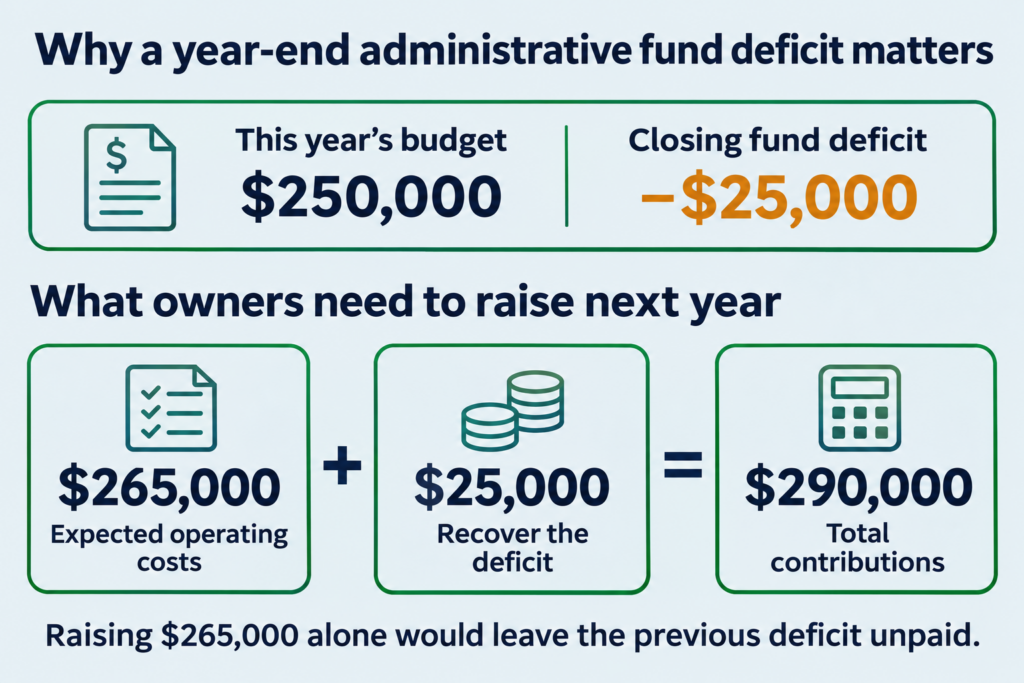
Consequently, the deficit should be repaid in the next financial year.
That means that next financial year the administrative fund levies will need to be higher. The deficit amount needs to be repaid, and depending on the reason the deficit arose in the first place, the contributions may need to be increased to ensure another deficit does not occur in the next year.
Why a sinking fund deficit warrants closer investigation
A negative accumulated sinking fund balance is more problematic than one in administrative funds which are designed to reset each year. Clearing an administrative fund deficit is usually straightforward.
Deficits in sinking funds don’t happen as frequently, mostly because the administrative fund is unlikely to have enough to “borrow” against.
A sinking fund negative balance therefore warrants investigation into how capital expenditure has been funded and what liabilities remain. One important possibility is money was borrowed for major works and the debt remains outstanding.
In the schemes we review, that may involve a strata loan, which is an unsecured loan, for a substantial project or even several loans associated with different stages of work.
However, the negative figure alone does not identify the lender, outstanding debt or repayment obligations. Nor does it guarantee that the work is complete and funding requirements are resolved. It is an indication that something is ongoing that requires explanation.
How borrowing can leave a negative fund balance
Borrowing provides money to pay for work, but it also creates a liability.
In accounts that recognise the borrowing as a liability and charge the capital works to the sinking fund, spending the borrowed money can leave the fund with a negative accumulated balance.
Consider this simplified example:
| Transaction | Amount |
|---|---|
| Existing sinking fund cash and accumulated balance | $100,000 |
| Strata loan drawn for major works | $500,000 |
| Major works paid for and charged to the fund | $600,000 |
After the work is paid for, there may be no cash remaining from those amounts, while the $500,000 loan is still outstanding. On that simplified accounting basis, the accumulated fund balance would be negative $500,000.
Actual financial statements for a scheme may include other assets, liabilities and adjustments, so the negative fund balance should not automatically be considered as the outstanding loan amount.
To verify exactly what is owed look for a loan statement.
The practical point is that the contractor may have been paid while the body corporate still owes the lender.
Completed work can mean ongoing financial commitments
Borrowing may enable necessary work to proceed. Its existence does not, by itself, establish poor management.
For an owner / buyer, the important questions are what the borrowing achieved and what remains to be funded.
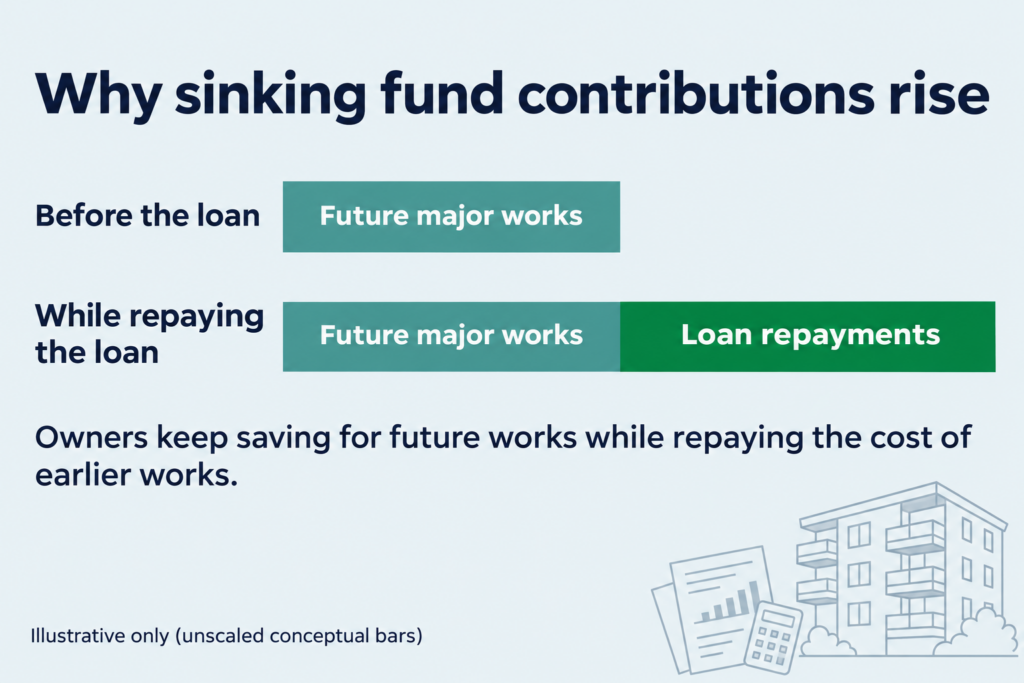
The building may have a new roof, repaired balconies or completed painting. Owners may nevertheless face years of contributions towards principal repayments, interest and fees.
At the same time, other parts of the building continue to age.
The financial plan therefore needs to accommodate both debt repayments and future capital expenditure. Otherwise, the scheme may reach its next major project with limited reserves and existing debt still outstanding. Expensive capital works then become more expensive again.
Queensland bodies corporate can borrow, but approval requirements differ between regulation modules. The records should establish the relevant decision and loan arrangements.
What if there is more than one loan?
- The purpose of each loan and whether the related work is complete.
- The amount drawn and the current outstanding balance.
- Interest rates, fees and repayment terms.
- Whether repayments have commenced or will increase later.
- The contributions approved to meet those repayments.
- Whether further borrowing or additional works are being considered.
What to look for when there is a deficit in body corporate funds
- Previous year-end statements, to establish when the deficit arose.
- Approved budgets and levy schedules.
- Levy arrears and unpaid creditor balances.
- Loan agreements, current loan statements and repayment schedules.
- General meeting decisions approving borrowing, works and contributions.
- Major works contracts, invoices and progress reports.
- Sinking fund forecasts and proposals for future expenditure.
What makes the position more concerning?
- Deficits persist without a documented funding response.
- Loans remain outstanding but repayments are unclear in the budgets.
- Further major works are needed while existing debt is still being repaid.
- Several loans or additional drawdowns increase the commitments.
- Arrears or unpaid accounts add pressure to an already stretched position.
- Completed works have not resolved the original problem.
- The records do not explain how future expenditure will be funded.
What does this mean for a buyer?
A negative balance is the starting point for understanding the scheme’s finances.
An administrative deficit may reveal a temporary reporting position or a continuing gap between contributions and operating costs. A sinking fund deficit may reveal that past capital expenditure is still being paid for through borrowing.
Current levies alone may not explain either situation.
A pre-purchase strata report can help connect the financial statements, borrowing decisions, works records and budgets. That helps you understand what has already been spent, what remains owing and what commitments you may be contributing towards after purchase.
[…] Further reading: Deficit in Body Corporate Funds. […]