

Average body corporate fees in south east Queensland run around $5,000 – $6,000 per annum. That’s $96 – $115 per week. Many are a lot higher. The highest levy I’ve ever seen was around $25,000 p.a. or $480 per week.
And of course many levies are much lower than that average. The lowest levy I’ve seen was $165 per annum which was for a body corporate that was a narrow slip of land between some houses and the ocean.
So why do body corporate fees vary so widely?
The levies in a building reflect the cost of running that building and will be a direct result of:
- Size of the building
- Location of the body corporate
- Design and construction of body corporate common property
- What facilities are included
Size Really Does Matter (when it comes to body corporate fees)
Smaller buildings have less expensive body corporate fees, but then, larger buildings can also be reasonable. The most expensive levies are found in mid-sized buildings.
A smaller building is cheaper to run because it simply doesn’t require as much work. There’s less to clean and power and less repairs and maintenance (on average, buildings are highly individual) because there’s just less of the building.
However, there’s also less owners to contribute to covering the costs.
Which is something larger buildings take advantage of. Past a certain point, around 150 – 200 lots, economies of scale kick in. Bigger buildings are substantially more complicated and expensive to run, but, the cost per lot owner is reduced because of the number of lots sharing the costs.
Mid-sized buildings are usually the most expensive in terms of levies. They have the higher running costs associated with large buildings but not the economies of scale that reduce costs per lot owner in larger buildings.
Location
Environmental issues do play a part in how much a building costs to run.
For instance, buildings in the centre of the city may have noise and pollution issues that might require some creative solutions from the body corporate. Buildings near the ocean will be more vulnerable to storms and damage from salt water. A search of any building in the “Schoolies” zone in Surfers Paradise will turn up ongoing discussions about security.
Different locations have different problems all of which need to be addressed by body corporates and paid for by lot owners.
What Are You Made Of?
Standard format plans, or gated communities, are, for the most part, cheaper to run than building format plans or apartment buildings. Standard format plans have less common property and that means less levies are required to maintain said common property.
An apartment building constructed from block will be cheaper to maintain than one that is rendered or wood, both of which require regular painting and treatment.
A building with elevators is more expensive to run that one with just stairs.
Technological add-ons, something developers have been embracing of late, are more expensive to maintain than standard alternatives. Sure the technology marvels are great, but they can become obsolete quickly and then be difficult to replace or maintain.
Buildings design and construction is, along with size, a key factor in levy cost.
You Get What You Pay For
The main driver of body corporate expenses though is facilities.
If the body corporate boasts a swimming pool, extensive gardens or a gym then correspondingly the cost of the levies will increase. After all someone must maintain the swimming pool, and the gardens and the gym, all body corporate costs, all funded from levies.
Body corporates come with an enormous range of facilities including spas, saunas, games rooms, barbeques, theatres, libraries, media rooms and even individual pools per unit. Any facility offered is a double edged sword as it drives up the cost of levies.
The biggest, and costliest facility in Queensland buildings is a building manager or Resident Unit Manager (RUM). The RUM is, basically, a contractor hired by the body corporate to undertake certain tasks, usually cleaning, gardening and small repairs.
Size, Location, Design and Facilities Are All Decided By The Developer
For most body corporates the choice of whether or not to have a RUM is made by the developer, along with decisions about facilities, construction and design, location and size.
Developers design projects balancing exciting designs that they think will sell against expected running costs. They must provide projected levy costs when selling off the plan.
The problem is that levies don’t stay at the projected position. All levies increase, usually in keeping with CPI, but levies in new buildings increase quicker as the real cost of running the body corporate becomes apparent.
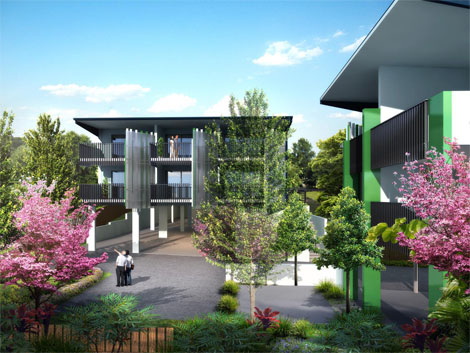
Some developers are taking this into account and are building with a view to keeping costs low. The Evoque development in Kelvin Grove for example is a low rise building with no gym and no pool and 20 units. Best of all levies are just $1,500 per year or around $28 per week.
A low levy body corporate will likely attract a lot of investors.
It’s a different story when you’re choosing somewhere to live though, where the things that likely affect decisions to buy are location, size, design and facilities, all the things that drive levy costs.