


Water ingress in a body corporate tells you that water is entering somewhere it should not. It does not, by itself, identify the source, the cause, who is responsible, the extent of the damage or whether the underlying problem has been resolved.
What does water ingress mean?
Water ingress is a broad term for moisture entering a lot, common property or both. It describes what is happening, but not why it is happening.
That distinction matters. A damp patch on a ceiling might be caused by a roof defect, a cracked tile, failed waterproofing, a leaking pipe or water travelling from somewhere else entirely. The visible symptom is the beginning of the investigation, not the conclusion.
Why water ingress in a body corporate matters
No owner wants water entering their property. Even a relatively small leak can damage paint, plaster, flooring, cupboards, furnishings and personal contents. If moisture remains, the damage can spread and become more difficult and expensive to repair.
Water ingress can also create a broader problem for the body corporate. Repeated incidents may lead to multiple insurance claims, higher premiums or excesses, or conditions being imposed at insurance renewal. More importantly, the leak may be a symptom of a larger defect that will continue to deteriorate until its cause is identified and rectified.
The real question is therefore not simply, ‘Has the visible damage been repaired?’ It is, ‘Has the source of the water been found and has the underlying cause been properly rectified?’
How can you recognise water ingress in a body corporate?
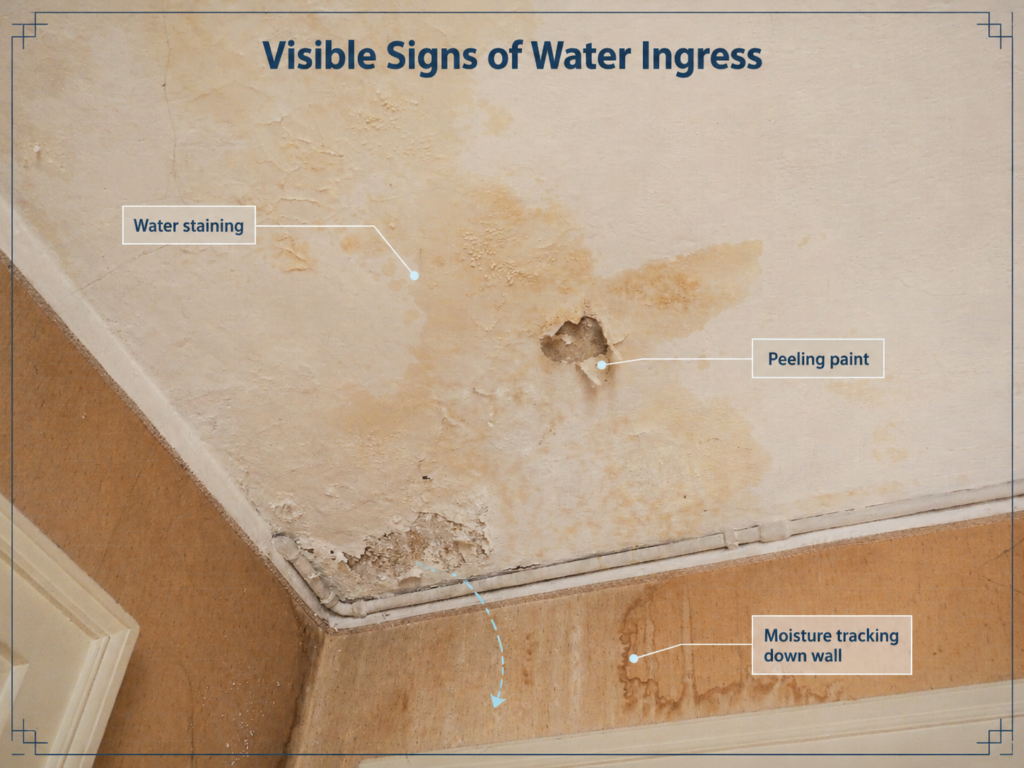
The signs can be obvious, such as active dripping or a wet carpet, but they can also be subtle. Common indicators include water staining; damp carpet or flooring; mould; bubbling or peeling paint; musty odours; warped, buckling or swollen ceilings, walls, floors or cupboards; and unexplained dripping sounds inside a wall or ceiling.
Sometimes leaks can be entirely hidden and other indicators will come up like rust staining; efflorescence or leaching; or crumbling concrete.
In body corporate records, the first sign is usually correspondence from an owner, caretaker or committee member reporting evidence of a leak. That initial report may later be followed with photographs, inspection reports, quotes and / or an insurance claim.
Why the visible leak may not reveal the source
Water follows gravity, but it also follows the path of least resistance. It can travel along framing, pipes, concrete, membranes or other building elements before it becomes visible. The place where water appears may be some distance from the place where it entered.
For example, a leak may first appear in a top-floor unit and be treated as a roof leak. Sealing the most obvious entry point might stop that symptom, but if it was not the true or only source, the water may later appear in a different location or on the floor below. Some leaks take several investigations or repair attempts to resolve. Others have more than one source.
This is one of the easiest points to miss when reading body corporate records: a reference to a ‘repair’ does not necessarily prove that the problem was solved.
What can cause water ingress?
Potential causes for water ingress in a body corporate range from a single cracked roof tile or failed seal to defective waterproofing, damaged roofs or gutters, leaking windows, faults in external walls, plumbing failures, balcony defects or larger building problems such as cracking or movement.
The type of development changes the likely causes and complexity.
In a multi-storey apartment building, water may travel between floors or enter through balconies, the façade, windows, the roof or shared services. Investigation, access and rectification can become complex and costly.
In a townhouse development, a leak may be more localised around a roof, gutter, wall or window and may be easier to access, although that does not automatically make responsibility straightforward.
The appearance of the building does not, by itself, decide who is responsible. The survey plan, lot boundaries, common property, exclusive-use arrangements and any owner alterations may all be relevant. Responsibility is a separate question that should be considered once the source is understood.
What should happen after water ingress in a body corporate is reported?
A sound response follows a sequence. The details vary with the seriousness and complexity of the problem, but each stage should leave evidence in the records.
Report and contain the problem
The leak should be reported promptly and reasonable steps taken to limit further damage while the cause is investigated. An insurance claim may be made.
Investigate the source
A straightforward matter may be inspected and repaired by a contractor. A recurring, widespread or technically complex leak may require leak detection, building consultants or engineers. The investigation should distinguish if the place where water appears differs from the point where it enters.
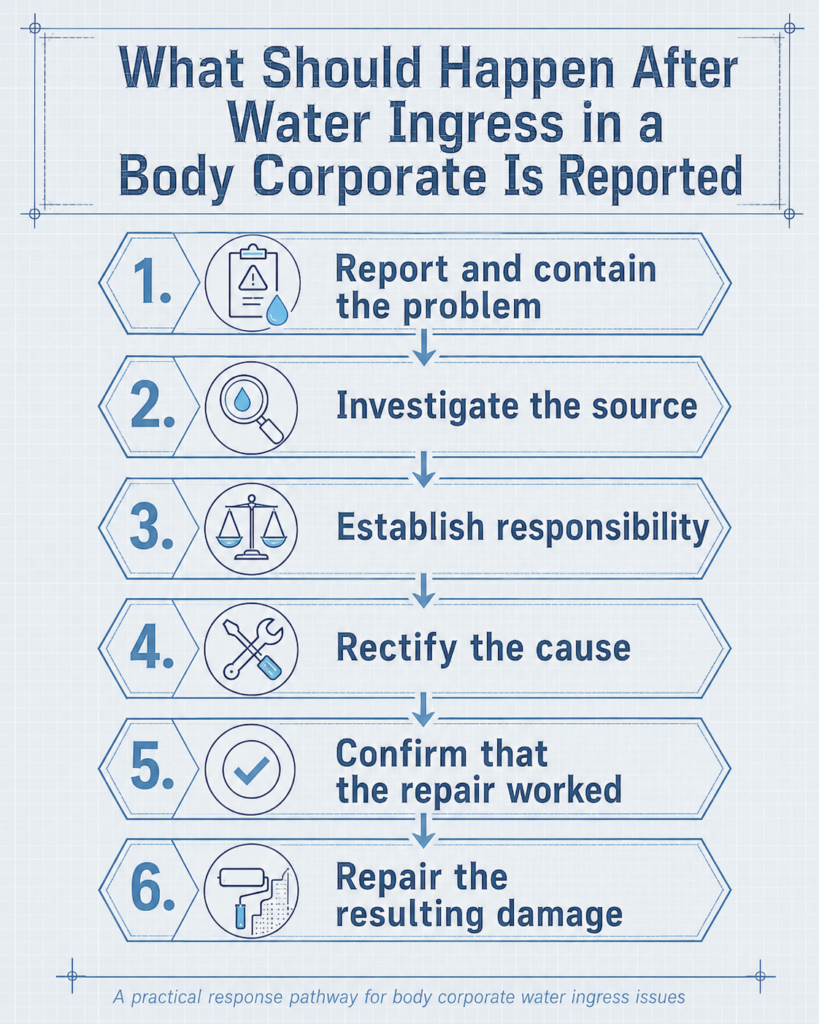
Establish responsibility
Once the likely source is known, the body corporate and affected owners need to determine who is responsible for the relevant building element and the required work.
Rectify the cause
The source of the water should be repaired. If the required work is substantial, the body corporate may also need to address scope of works, quotes, approvals and funding.
Confirm that the repair worked
The area may need to be monitored, particularly through further rain or other relevant conditions. A closed work order or paid invoice is evidence that work occurred, but not necessarily that the leak was permanently resolved.
Repair the resulting damage
Once the source has been rectified and the affected area is sufficiently dry, consequential internal damage can be repaired. Depending on the circumstances, this may involve an insurance claim or work paid for by the responsible party.
What can the body corporate records tell you?
Water ingress rarely tells its full story in one document. The useful evidence is usually spread across correspondence, committee and general meeting minutes, photographs, contractor or engineering reports, leak-detection findings, quotes, scopes of work, invoices, insurance claims and financial records.
Read the documents as a chronology: the initial report, investigation, responsibility, approved work, funding and later confirmation that the leak stopped. Quotes, invoices, and financials show what was proposed or paid for; neither proves that the source was correctly identified or the repair succeeded.
The absence of recent discussion is not conclusive either. It may mean the matter was resolved, but it may also mean that correspondence is missing from the records reviewed, the issue has not returned under the right conditions, or the matter has simply stopped appearing in formal minutes.
When should you be more concerned?
Delay is one of the clearest warning signs because water continues to do damage while responsibility, scope or funding remains unresolved.
Concern should also increase:
- where the leak keeps returning
- several lots or areas are affected
- the source remains uncertain
- repeated temporary repairs have been attempted
- reports or quotes are present but there is no evidence of completed work
- insurance claims are accumulating
- the records refer to cracking, deterioration, a dispute or difficulty funding the rectification
Water ingress does not necessarily mean a body corporate is unhealthy. The stronger indicator is how the body corporate responds: whether it investigates promptly, obtains suitable advice, makes decisions, funds the work, completes the repair and checks that the problem has actually stopped.
If you are buying and there are reports of water ingress in your body corporate make sure you carry out a building and pest inspection to the internal of the lot with an emphasis on determining if there are any leaks or moisture.
The question to keep asking
When you see water ingress mentioned in body corporate records, do not stop at the visible stain or the first repair. Follow the evidence until you can answer four questions: Where did the water originate? What damage has it caused? Has the underlying cause been rectified? How effectively has the body corporate responded?
Water ingress is a sign, not a diagnosis. Understanding the difference is what allows an owner or buyer to recognise whether the records describe an isolated, well-managed leak or an unresolved problem with wider implications for the building, its insurance and its finances.
This article provides general information only. It is not legal, financial, engineering or building advice. The circumstances of every body corporate are different. Obtain advice from an appropriately qualified professional where necessary.