

Lisa Rutland

Body corporate specialist

2 minutes read

Body Corporate Levies & Expired Current Levy Year Issued

Body corporate levies are set on a year to year basis, three months after the start of the new financial year. For reporting this creates issues.

Sometimes a disclosure statement or records search will quote levies for a period that has expired. For instance, say the levies are quoted to 31/7/2012 and yet the date of the report is 31/8/2012.  Why aren’t the levies to the year end 31/7/2013 quoted? Is it a mistake?

It could be a mistake, but most likely, its an issue with when the next levies are issued.

Body Corporate End of Year Process

Levies are issued at the Annual General Meeting (AGM) and they are issued for one (1) year only.

But, following the end of financial year the body corporate has three (3) months to hold the AGM.

That period is to allow time to audit the previous financial year (if resolved to do so), prepare a budget for the next financial year and then convene the AGM in accordance with legislation.

So, if the financial year end is 31st July then the body corporate has until 30th November to convene their AGM and issue new levies.

Using Body Corporate Levies To Provide Cash Flow

From a body corporate’s perspective the flow of money is all important. To avoid situations where a deficit arises, body corporate levies for the next financial year are often pre-issued at the AGM.

The example levy issue below shows the levies issue per lot entitlement for the four periods of the financial year ended 31/7/2012 – the first two periods having been pre-issued – and underneath that the first two periods of the next financial year.
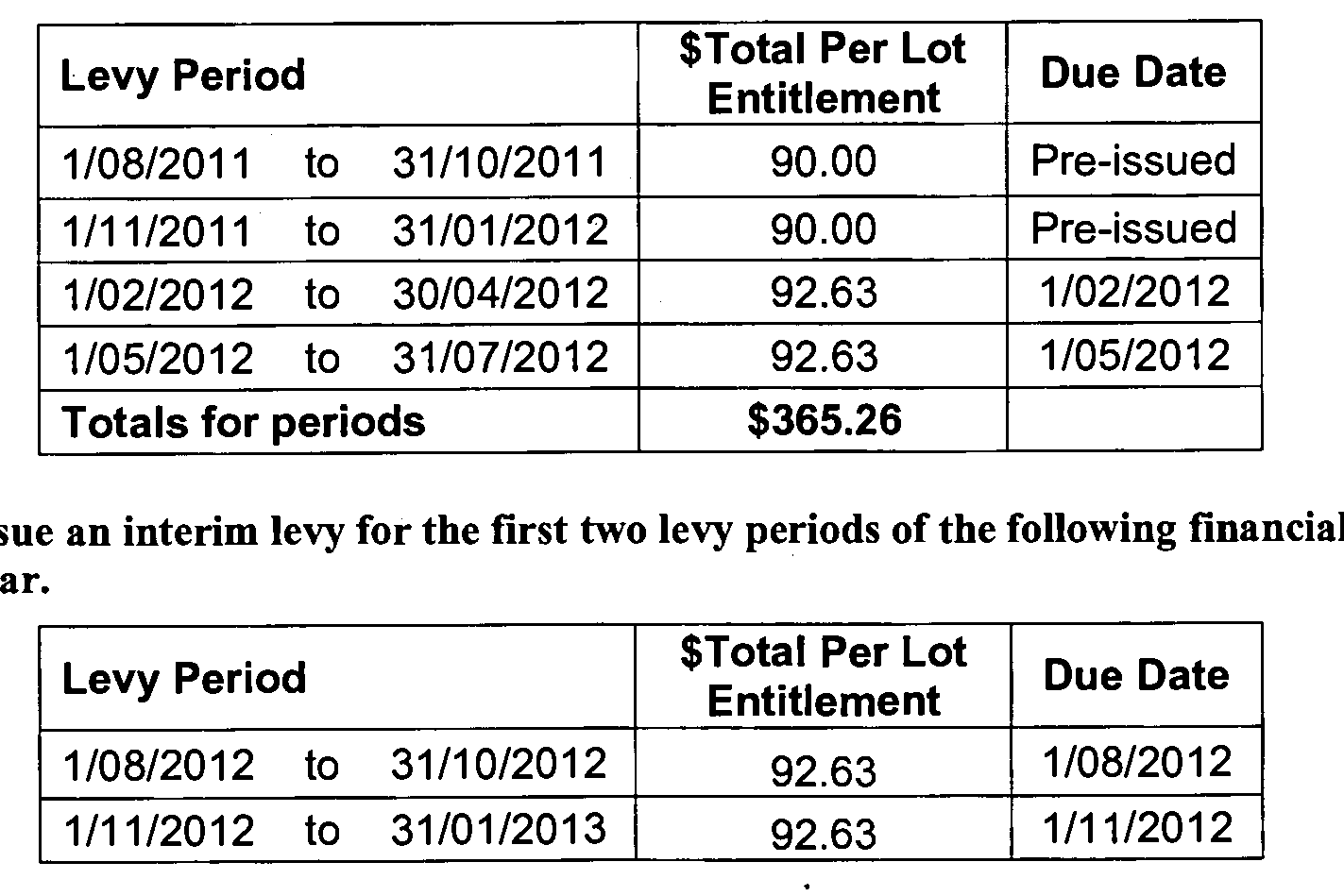
An example administrative fund levy issue for a body corporate

At the next AGM the whole financial year will be issued along with the pre-issue for the next year.

Its important to note that there is no requirement in body corporate legislation to pre-issue levies for the next financial year and consequently not all body corporate manager’s have pre-issues approved at the AGM.

If the current financial year has expired on search documents this is most likely the reason. Refer to levy statements if included for how much the pre-issues are. Some documents will include the proposed levies for the next year if they have been calculated.

What If The AGM Is Late?

Sometimes the AGM doesn’t get held on time and there are lots of reasons that can happen from weather issues to scheduling delays to just plain incompetence on someone’s part be it a supplier, committee or body corporate manager. Sometimes it’s very difficult to co-ordinate so many variables.

There are specific guidelines for body corporates when that situation arises, some that get followed and some that don’t.

From a reporting perspective however, there isn’t anything that can be done about it. Each individual body corporates matters will play out as they play out and until matters are resolved there may not be anything to report.

guest

0 Comments
Oldest
Newest Most Voted

Ask a Body Corporate Question Terms

  1. Purpose of the form

The Ask a Body Corporate Question form allows readers to submit general questions that may be answered through existing or future Body Corporate Blueprint content.

The form is intended to help identify subjects that buyers, owners and other readers would like to understand. It is not intended to provide advice about a particular body corporate, property, dispute or transaction.

  1. General information only

Information provided in response to a question, or published in the Body Corporate Blueprint, is general educational information.

It does not constitute legal, financial, engineering, building, insurance or other professional advice. You should obtain appropriate professional advice about your particular circumstances before acting or relying on general information.

  1. No professional engagement

Submitting a question does not engage MyBodyCorpReport to inspect records, investigate a matter, prepare a report or provide professional advice.

No client or professional relationship is created by submitting a question or receiving a response.

  1. No guaranteed response

Submission of a question does not guarantee that it will be answered individually or used in published content.

Questions may be declined, edited, combined with similar questions or held for possible future use. It may not be possible to respond to questions that require examination of body corporate records, contracts, plans, reports or other supporting information.

This form should not be used for urgent, time-sensitive or transaction-specific enquiries.

  1. Protecting privacy and confidentiality

Please do not include:

• the name or address of a body corporate or property
• a community titles scheme number or lot number
• the names or contact details of other people
• confidential correspondence or records
• allegations identifying a particular person or organisation
• sensitive personal, financial, medical or legal information.

MyBodyCorpReport may remove identifying information from a question. However, you are responsible for ensuring that information you submit is appropriate to share.

  1. Use of submitted questions

By submitting a question, you give MyBodyCorpReport permission to:

• consider it for an individual response
• use it to identify possible article or resource topics
• edit it for clarity and relevance
• combine it with similar questions
• reproduce or discuss it anonymously in general educational content.

Your name, email address and other identifying information will not be published with the question without your permission.

  1. Personal information

Any name and email address supplied through the form will be used to administer the submission, contact you about your question where appropriate and notify you if relevant content is published.

Personal information will be handled in accordance with the MyBodyCorpReport Privacy Policy.

Submitting a question will not automatically add you to a marketing mailing list. Any consent to receive newsletters or promotional communications will be requested separately.

  1. Questions requiring individual assessment

A general question may help explain what a document, event or warning sign could mean. Determining what it means for a particular body corporate usually requires consideration of its records and individual circumstances.

If you require an assessment of a particular scheme, a body corporate records search or another appropriate professional service may be required.