


A Building Management Statement (BMS) is a document that governs how shared facilities are accessed, maintained and funded.
That’s a fairly simplistic definition of something that is very complex. A BMS must be registered over at least two lots, at least one of which must be a volumetric lot.
What is a volumetric lot?
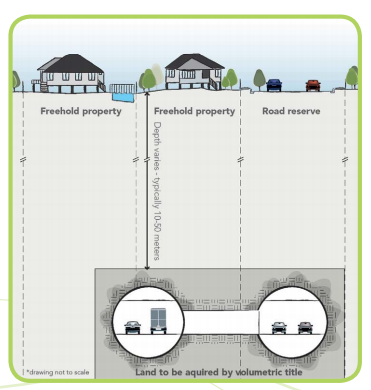
Our land titles system gives us ownership of our land, being all the space on the surface of the earth, all the space underneath to the earth’s core and space above into … um, well, space.
You can actually sell the air space above or subspace below your lot. The new lot that’s created from your sub or air space is called a volumetric lot.
That may sound a little far-fetched but it happens all the time. A recent example is Brisbane City’s resumption of land to build the Northern Link Tunnel. They did of course resume whole lots, but also volumetric lots below existing lots. Click here to read their great explanation of volumetric lots.
How does this affect body corporates?
The most common volumetric lots that you see in everyday life are residential or hotel towers built above retail or office precincts.
In effect it’s a bit like building with blocks. On the bottom is the retail, then office, then residential, all neatly stacked. Underneath there may be a basement car park shared by all entities.
And that’s the key point: they are all separate entities.
A good example here on the Gold Coast is Southport Central.
Southport Central is three large towers and two subsidiary buildings built on the site of the old Southport school.

The three towers of Southport Central
The precinct consists of three body corporates; Southport Central Residential, Southport Central Commercial and Southport Central Retail. There’s also Southport Central Building Management Group, but I’ll come back to that later.
Each of the three towers contains a portion of each of the three body corporates; retail has shops with offices above them and apartments on top, all stacked neatly above the shared basement.
Shared Facilities
Building Management Statements are used when there are shared facilities. Shared facilities would be things like shared access ways, stairs, elevators, water supplies, fire safety equipment and so on.
In the case of Southport Central there is a large open plan access way around and between the buildings. There are numerous stairwells, each building has shared elevators, all sorts of things.
Gary Bugden in his report All About Strata and Building Management Statements and Building Management Committees notes
Inevitably, these shared facilities are located within one of the component use areas. However, because they are used by two or more areas, there is a need to ensure that they are properly maintained and that the cost of that maintenance is shared fairly by those who use them.
Who pays for what?
The crux of a BMS, other than ensuring access, is to set out who is responsible for paying what toward the upkeep of the shared facilities.
Certain elements of any complex building will benefit one portion more readily than another. For instance grease traps would almost exclusively be a retail cost, since that is where restaurants and cafes would be situated. Conversely elevators would almost never be used by retail who have no need to access the building proper.
As you can imagine calculating who pays for what is complex and ripe for disagreements.
Developers circumvent the whole process by calculating all these items ahead of time and then registering the Building Management Statement before lots are settled.
Building management group
When a BMS is registered it immediately creates a building management group made up of all the lot owners, or an appointee in the case of a body corporate, who are tasked with maintaining and co-ordinating the shared facilities.
The building management group usually issue and pay levies, of a type, and have accounts where they accumulate funds similar to how a body corporate is managed.
It’s important to note however that a BMS operates under the Land Act. The building management group it creates is not associated with body corporates at all, notwithstanding a scheme may be a member of the group.
What impact does a BMS have on lot owners?
If a body corporate is subject to a BMS the projected costs are included in the yearly budgets and are recovered from lot owners via their regular levy payments the same as every other expense.
Otherwise most owners will never even know about the BMS.
I have seen some BMS costs, usually for grease traps or air conditioning, recovered directly from retail lot owners. Those costs are issued as a statement from the body corporate to the lot owner, the same as any monetary liability is recovered.
For the most part a BMS is something that operates in the background of a complex building and has little effect on lot owners.
Of course it’s a different story if you’re on the committee.