

Who Pays For What? Building Format Plan v Standard Format Plan

Something that comes up time and again in body corporates is who pays for what?

The body corporate is responsible for common property. The lot owner is responsible for the lot.

Issues arise in determining what is common property and what is the lot, since boundaries will differ between plans.

There are two types of plans in Queensland: Standard Format Plans which are horizontal developments like gated communities, and Building Format Plans which are vertical developments such as high rise buildings.

What is common property, hence body corporate responsibility, and what is the lot, hence owner responsibility is determined by the plan of the subject body corporate. Below is an Infographic which compares differences.
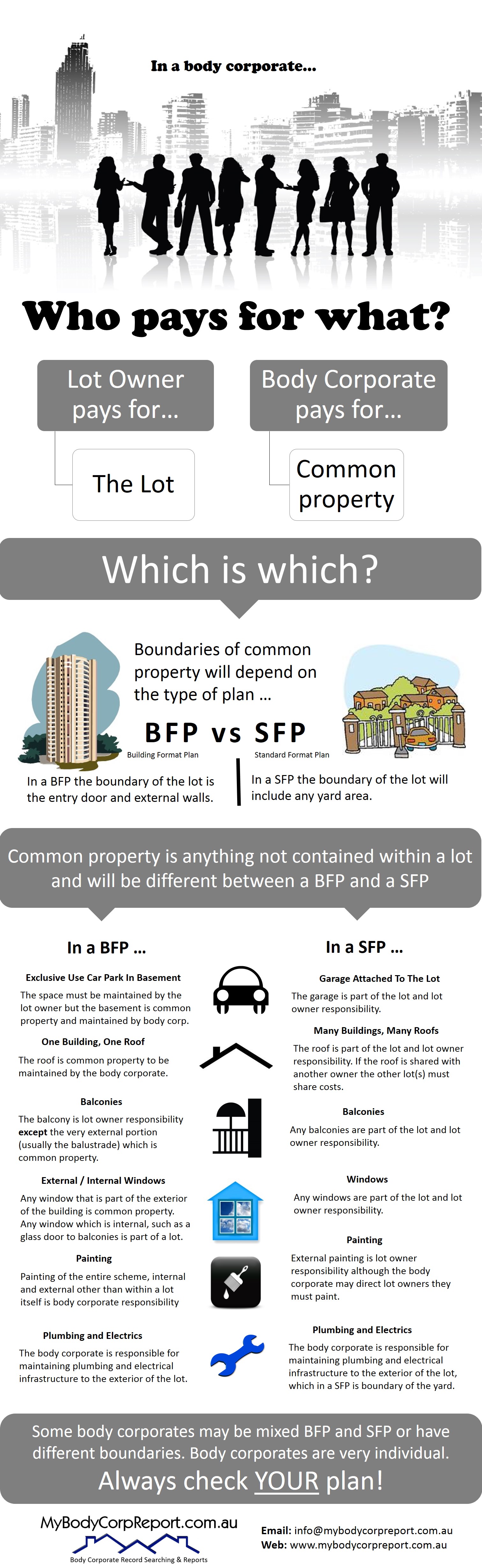
building format plan v standard format plan

I cannot stress the importance of finding out the boundaries of your lot.

The body corporate cannot pay for works that are lot owner responsibility. It’s not fair use of group funds.

Equally there is no sense paying for something that is body corporate responsibility.

As important, undertaking repairs works that are not yours to arrange can actually lead to conflict with the Committee. Body corporates are often complex and made more so by the legislation they must act within, and random acts, even kind acts, can have consequences you’ve not considered.

You might also like: Common Property which discusses how to find out if your body corporate is a building format plan or a standard format plan.

Comments

  1. Hi ,
    Thanks for all your helpful articles. I am from Victoria how do I find out my building OC format is Building Format plan or Standard Format plan? Are the roof cover whole 3 story ( ground floor , first and top floor ) and foundation of the building common property ?

  2. Alan Chapman says:

    Hi, I am having an issue with who is responsible for the stopcock (water mains shut off valve) to my townhouse, in an SPF. Any thoughts?
    Thanks, Alan

    • Hi Alan

      If the water mains shut off valve serves just your townhouse then it is your responsibility, notwithstanding it may be located on common property.

      If it serves more than one townhouse then it is common property and body corporate responsibility.

      In SFP’s there are usually shut off valves for each lot.

  3. Hi Lisa,
    In Standard Format, are the walls between common area the responsibility of the lot owner or body corporate? Thanks.

    • Hi Victor

      In a SFP there should not be any walls between the lot and common property.

      There may be walls between one lot and an adjoining lot or lots. That wall will be the responsibility of the two lot owners concerned.

  4. Tony Earnshaw says:

    I live in and own, a 4th floor unit in a body corporate appt building. All balconies in my block (above and below) have been previously built-in to a uniform design, with bricks and windowframes. I assume that this was agreed to at the time by the BC committee.
    We are now getting water ingress through the now exterior wall, and waterproofing is required. Could you please advise whether it is a BC or unit owners responsibilty, and why that is?

    • Hi Tony

      It depends on who did the extension. Usually it would be something that is approved by the body corporate as an improvement on common lot for which the owner is liable. Essentially once changes are made to the common property the person who made the changes is responsible for upkeep.

      A simpler example would be an air conditioner fitted to the exterior wall of the building. Its on common property but it remains the property of the owner and is there’s to fix if it breaks down.

      Find out who did the extension. If the body corporate undertook all works on behalf of the owners then it may be their responsibility. You need to check the original approvals.

  5. susanne harriss says:

    I live in a complex of 10 units and the bottom unit has a tiled balcony which is above the garages on the ground floor. These tiles have lifted with wear and tear and has now caused water to leak into the garages. We are now being told that Body Corporate has to pay for this unit to have their tiles re-done as they deem the balcony to be a roof line underneath. Is this correct? And if this is correct, how does the Body Corporate monitor the owner maintaining their own property?

    • Hi Susanne

      There’s a lot to unpack with this question.

      Its my understanding the tiles don’t lift due to wear and tear. They become drummy for all sorts of reasons including a water leak in the membrane underneath and incorrectly installed expansion joints. I’m not an expert on tiling or waterproof membranes though. Speaking from experience of seeing this situation played out.

      The body corporate is deemed responsible for the waterproof membranes.

      There are a whole lot of variables here though. Usually waterproof membranes are changed because they’re 1) faulty in the first place or 2) deteriorated. If the scheme has been watertight before and now that the tiles have lifted is not, that seems to indicate that the problem occurred because the tiles lifted. The crux of the matter will be what caused the tiles to lift.

      The lot owner is responsible for taking care of the tiles. If in maintaining or changing tiles the waterproof membrane is damaged, and that can be proven, then the owner may be responsible for rectification tiles and membrane.

      If deterioration of the membrane caused the tiles to lift then yes, the body corporate would be responsible for making right the membrane and replacing the tiles. In that situation the only reason the tiles needed replacing was so the body corporate can fulfil their responsibilities.

      My advice is get clear on the cause of the problem to determine who is responsible for rectification.

  6. We wish to purchase a unit in a duplex. 2 houses one joining wall. There is a body corporate for that as well as the other townhouses in the complex. Who pays for termite inspections, barriers, treatment and maintenance?

    • Hi Donna

      The body corporate pays for termite inspections, barriers, treatment and maintenance on common property. The lot owner pays within the lot.

      In a BFP the boundaries will be in walls, ceilings, doors and floors whereas in a SFP the lot will include the entire building and the land around it. Refer to you plan to find out if BFP or SFP and for the boundaries of the lot.

  7. I have planter boxes on the balcony which either go to the outside and hence join common property, or are between me and my neighbour. They also hold up the balustrade fence. Who is responsible for painting cost associated with my side of the planter boxes.

    • Hi Bill

      This is a tricky one and I can’t say for sure. With fences you are responsible for maintenance and painting on your side of the fence so there’s reason to expect that it would be similar with planter boxes.

  8. Hi Lisa, your article is really informative. Have you ever seen a building format plan changed to a standard format plan? I am in a townhouse complex that has been setup as a building format, but I think we would be much better off changing to a standard one. Do you know if this is possible and what is involved? Thanks!

    • Hi Albany

      Its a costly exercise I’m afraid. You’d need to pass a resolution without dissent at general meeting. A new survey plan would need to be prepared and a new CMS.

      I’ve never actually seen this done as usually the cost/compliance puts people off. You might also need advice from a Surveyor / Town planner / Solicitor to make sure all the boxes are ticked.

  9. Hi Lisa, we are under BFP with low set villas.
    Every entry of a unit has the security screen door and after that the door, both locked and unlocked with one key. A half of window has added security fly screens on external sides. Who is responsible for maintenance of the external door behind the security screen door and external windows that are behind security fly screens? Thank you Lisa for reply.

    • HI Helen

      The door is usually common property but will depend on whether the boundary is the door or flyscreen. Check your plans first then discuss with committee / strata management.

Trackbacks

  1. […] are two types of body corporates; Building Format Plans (BFP) and Standard Format Plans (SFP). The simplest way to think about […]

  2. […] And that’s where it gets a bit more complicated. Quite a lot of owners have difficulty with identifying boundaries between common property and the lot. […]

  3. […] installation cost is covered by the body corporate if the scheme is a building format plan, or the lot owner if a standard format […]

  4. […] exactly the same as the distinction between what is lot owner responsibility and what is body corporate, except in this case its between the RBC and the […]

  5. […] body corporates who don’t collect much in the way of sinking levies at all. For some schemes, standard format plans mainly, this is because they don’t have a lot of common […]

  6. […] defining common property is assisted by what type of plan the body corporate is registered under; Building Format Plan or Standard Format Plan. Different rules of defining common property will apply depending on your […]

  7. […] installation cost is covered by the body corporate if the scheme is a building format plan, or the lot owner if a standard format […]

  8. […] 10. Who pays for what? Building Format Plan vs Standard Format Plan […]

  9. […] of body corporates who don’t collect much in the way of sinking levies at all. For some schemes, standard format plans mainly, this is because they don’t have a lot of common […]

  10. […] installation cost is covered by the body corporate if the scheme is a building format plan, or the lot owner if a standard format […]

Speak Your Mind

*

This site uses Akismet to reduce spam. Learn how your comment data is processed.

Facebook
RSS
Follow by Email