


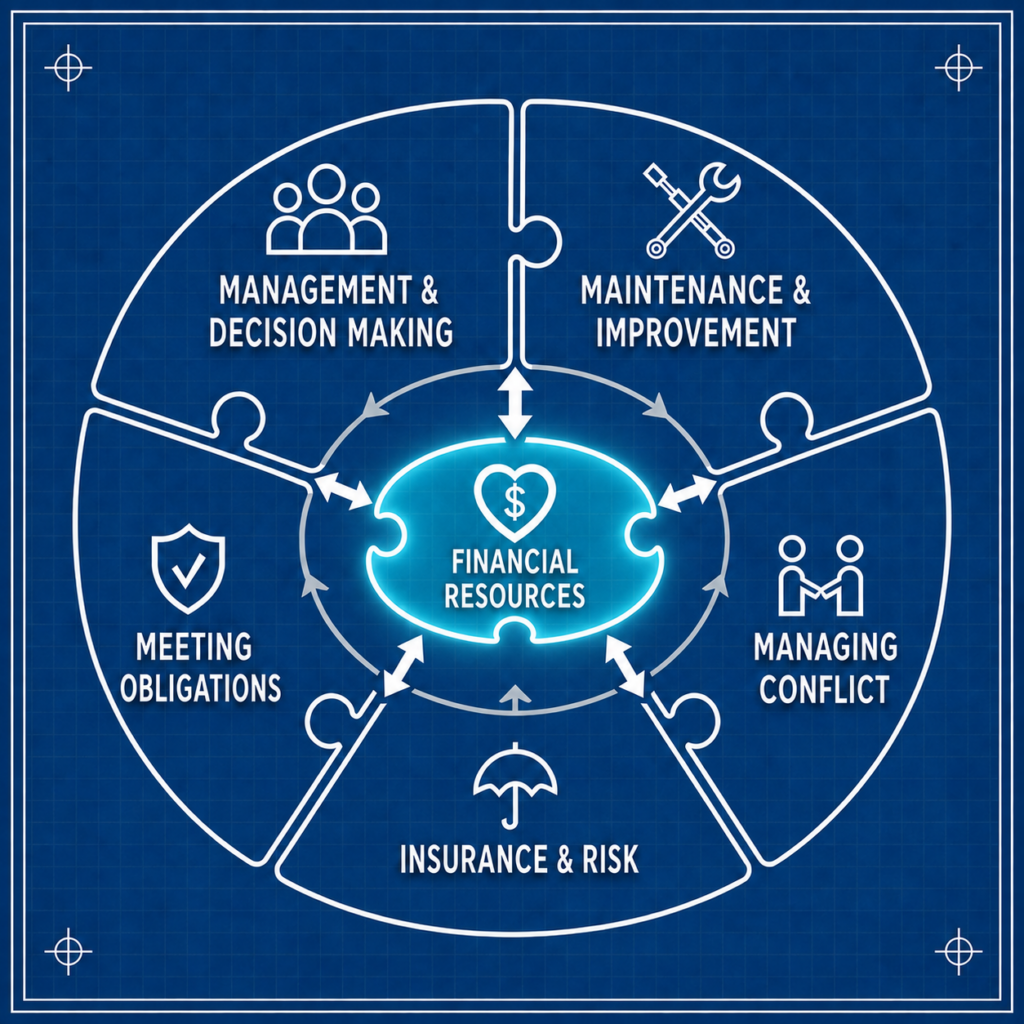
Body corporate special levies are a funding decisions – but it can also be an important clue about maintenance planning and financial pressure.
The words special levy tend to attract immediate attention. For an owner, they mean an additional payment beyond the contributions ordinarily expected. For a buyer reviewing body corporate records, they can signal an emerging cost that may affect affordability soon after settlement.
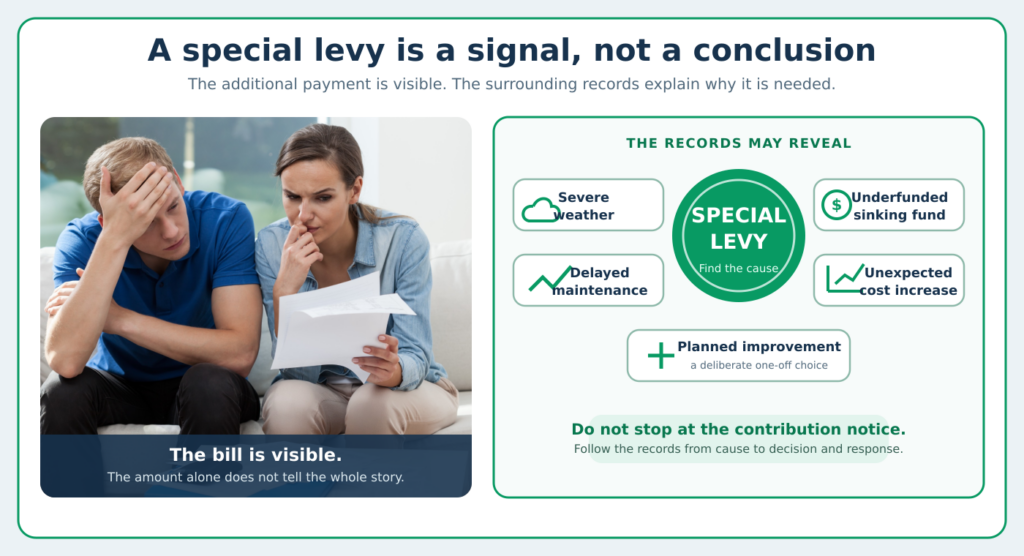
But the levy itself is only part of the story. It may fund sensible preventative work, an unavoidable response or a welcome improvement. It may also reveal delayed maintenance, an underfunded sinking fund, an administrative deficit or a project whose final cost remains uncertain.
The amount matters. The timing matters. Most importantly, the reason for the levy and the body corporate’s response matter.
What are special levies?
In Queensland legislation, the formal term is a special contribution but most people will call it a special levy.
A body corporate should adopt administrative and sinking fund budgets each financial year and fix the contributions owners pay. If a liability comes up and the budget contains no provision, or inadequate provision, the body corporate should raise a special contribution for additional funds.
Contributions are required to be fixed by ordinary resolution at general meeting and special levies are no different. the motion should include:
- how much is going to be raised;
- how much per lot entitlement each owner is required to pay;
- how many instalments are required and when they are due (owners must have a minimum of 30 days written notice)
Funding and spending are separate decisions
A budget – or a special contribution – provides funding, but it is not necessarily authority to enter into a contract or carry out the work.
The required approval for the expenditure depends on matters such as the nature and cost of the proposal, the committee spending limit, the major spending limit, the applicable regulation module and whether the work is maintenance, an improvement or another type of decision. The meeting papers should therefore explain both:
- why additional money is required and how the contribution has been calculated; and
- what work, contract or liability the body corporate is being asked to approve.
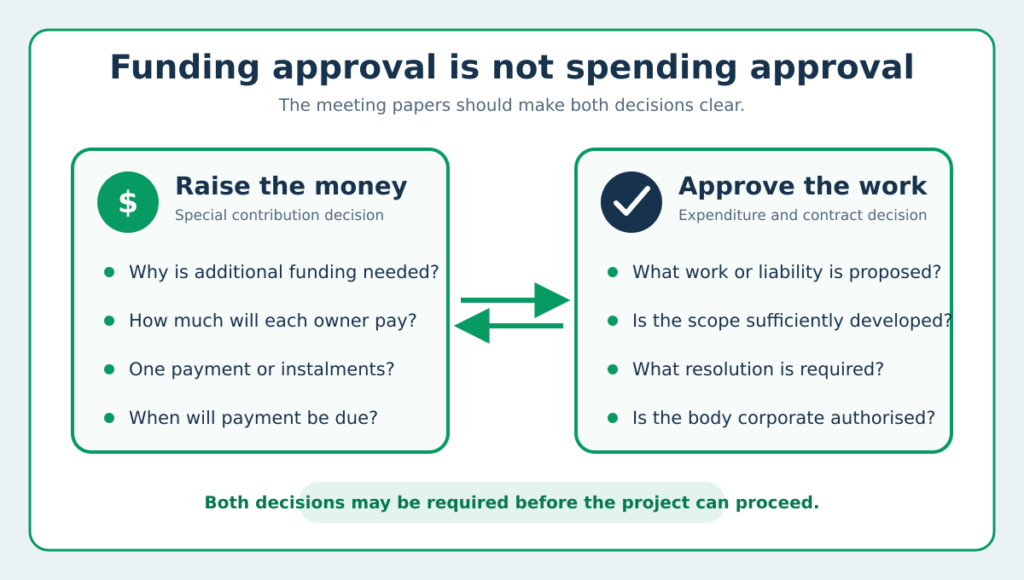
A motion that raises money without a sufficiently developed scope, reliable cost information or the necessary spending approval may leave the scheme funded but still unable to proceed confidently.
Special levies are a signal, not a conclusion
By its very nature a special levy is an indicator that something unplanned has happened. They can arise in many different circumstances. The existence of one does not, by itself, establish whether the scheme is well or poorly managed rather indicates that more context is required: why is the contribution required?
A planned or explainable expense
Sometimes a special levy is needed becasue somehting has happened. A severe storm, an unexpected insurance shortfall or a deliberate improvement may create a legitimate one-off funding need.
If the purpose, scope, price and approval pathway are clear, the levy may show that the body corporate is responding appropriately to events.
A funding shortfall
Special levies to recover funding shortfalls happen in different ways depending on the fund it relates to.
Administrative fund shortfalls, or deficits, are more immediate as the fund is designed to be emptied each year. If a deficit forms in the fund, particularly at year end, this indicates the budget was incorrect. Ideally the cause can be identified.
A sinking fund shortfall might be more pervasive as it can take years before it is identified. Enough funds may not be saved for planned expenditure which can trigger a special levy.
In both of these cases the deficit is only half of the issues being identfied. The shortfall in fund, particularly if its recurring or long-standing indicates that increases in annual contributions collected may also be required. Essentially owners now are paying more
A worsening defect or delayed repair
A defect may begin as a manageable maintenance issue and become more expensive while responsibility, investigation or repair options are debated. In that situation, the special levy is part of a longer maintenance and management story.
The useful questions are not simply ‘How much is the levy?’ but:
- Has the underlying cause been properly identified?
- Is the proposed work temporary, staged or intended to be a complete repair?
- Does the scope address the cause as well as the visible damage?
- Are further investigations, variations or related works likely?
- Has the body corporate allowed for professional fees, access, contingencies and reinstatement?
A body corporate loan
Borrowing does not remove the cost; it changes when owners fund it. A loan may reduce immediate payment required from each owner, but it creates a longer financial commitment for the scheme.
Refer to the body corporate records should show the amount borrowed, approval obtained, interest and fees, repayment periods and funding of repayments.
What usually happens next?
Once a valid contribution is due, it is a body corporate debt. Late payment can result in loss of any discount, penalty interest and reasonable recovery costs. An owner who disputes the decision to raise a special levy should obtain advice about the appropriate challenge process rather than simply withholding payment.
The financial consequences can extend beyond the owners’ individual accounts. If a number of owners cannot pay on time, the body corporate may still have a contract to fund. Arrears can create cash-flow pressure, delay the work, increase management and recovery costs and contribute to conflict about the project.
Large remedial projects also carry a risk of variations. Once work begins, concealed damage or additional compliance requirements may become apparent. A contribution described as ‘once only’ may therefore be followed by further funding if the original scope or contingency was inadequate.
How to recognise a special levy before the notice arrives
- committee minutes discussing reports, quotations, cash-flow problems or the need for an extraordinary general meeting;
- general meeting agendas containing motions for special contributions, borrowing or major expenditure;
- engineering, building, fire safety or insurance reports identifying significant work;
- financial statements showing low cash, growing creditors, arrears or an administrative fund deficit; and
- sinking fund forecasts that recommend higher contributions before major work falls due.
The 'special levy' that is not called one
Sometimes a scheme sharply increases ordinary annual contributions for one year instead of passing a separately labelled special contribution. The legal and accounting treatment may differ, but the practical effect for owners can be similar: a sudden additional funding burden.
A significant increase should therefore be investigated even if the words special levy do not appear. Compare several years of budgets and contribution notices. A sustainable annual increase is different from a temporary correction caused by a deficit, major project or earlier under-collection.
What questions owners and buyers ask now?
- What liability or project is the contribution funding?
- Is it being paid from the correct administrative or sinking fund?
- What reports, quotations and scopes support the amount?
- Has the expenditure itself been properly approved?
- Does the amount include professional fees, contingencies and likely variations?
- Is this the first levy connected with the issue, or one of several?
- What remains unpaid and how much has already been spent?
- Are owners in arrears, and could that affect the project’s cash flow?
- Will further contributions or loan repayments be required?
- Will the proposed work resolve the underlying problem?
What the records can reveal
The contribution notice tells you what is payable. It rarely tells you the whole story.
Understanding a special levy usually requires the documents to be read together: meeting agendas and minutes, financial statements, contracts, scopes
of work, quotations, reports, correspondence and later project updates.
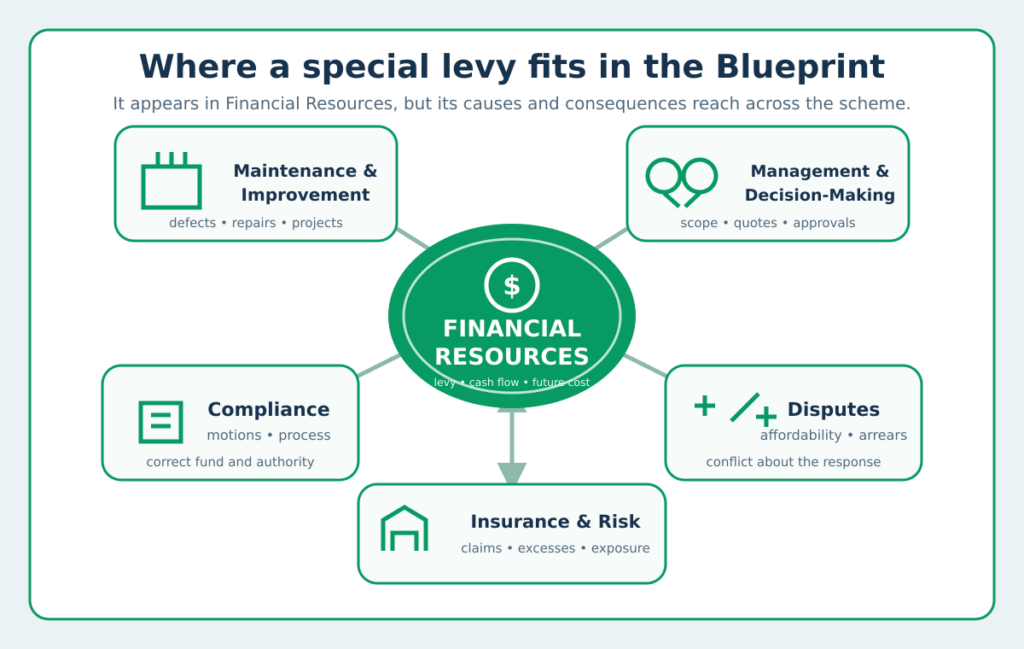
Viewed through the Body Corporate Blueprint, a special levy begins in Financial Resources but often connects directly to Maintenance, Management and Decision-Making, Insurance and Risk, Compliance and Disputes. The levy is the visible financial outcome of decisions and events occurring elsewhere in the scheme.
That is why the most useful conclusion is not simply that a special levy exists. It is whether the records show a documented, properly approved and adequately funded pathway from the original problem to a durable resolution.
This article provides general information only. It is not legal, financial, engineering or building advice. The circumstances of every body corporate are different. Obtain advice from an appropriately qualified professional where necessary.