

When body corporate repairs are delayed it does not always mean there is a problem. The more useful question is whether the records show a reasonable, continuing response.
A water leak has been investigated. A contractor says the source is common property. The report has been sent to the body corporate—and months later, the repai has not been completed. What does that delay mean?
Sometimes it means very little. Repairs in a body corporate can take time because responsibility must be confirmed, quotations obtained, insurance or warranty claims considered, funding arranged and the correct approval obtained. At other times, delay is the first visible sign of a deeper problem with the way the scheme is being managed.
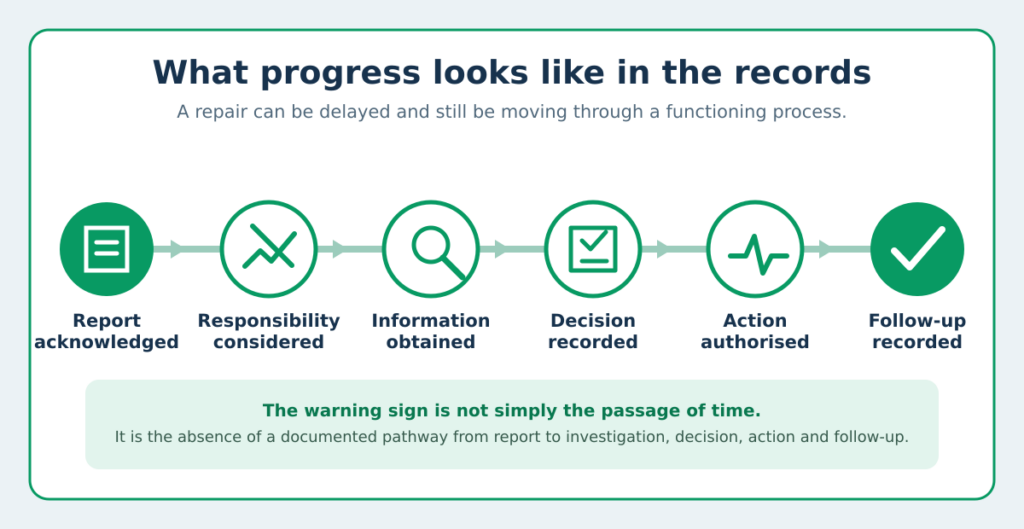
The real warning sign is not simply the passage of time. It is the lack of a documented pathway from report to repair
Why repairs may take time
- obtaining a second technical opinion or clarifying whether the source is common property or part of a lot
- making an insurance claim or waiting for an insurer’s response
- pursuing a builder or contractor under a defect or warranty process
- seeking quotations or developing a proper scope of works
- prioritising an urgent safety issue ahead of less urgent work
- working out whether the expenditure can be approved by the committee or requires a general meeting
- considering how the work will be funded, including whether additional contributions are needed.
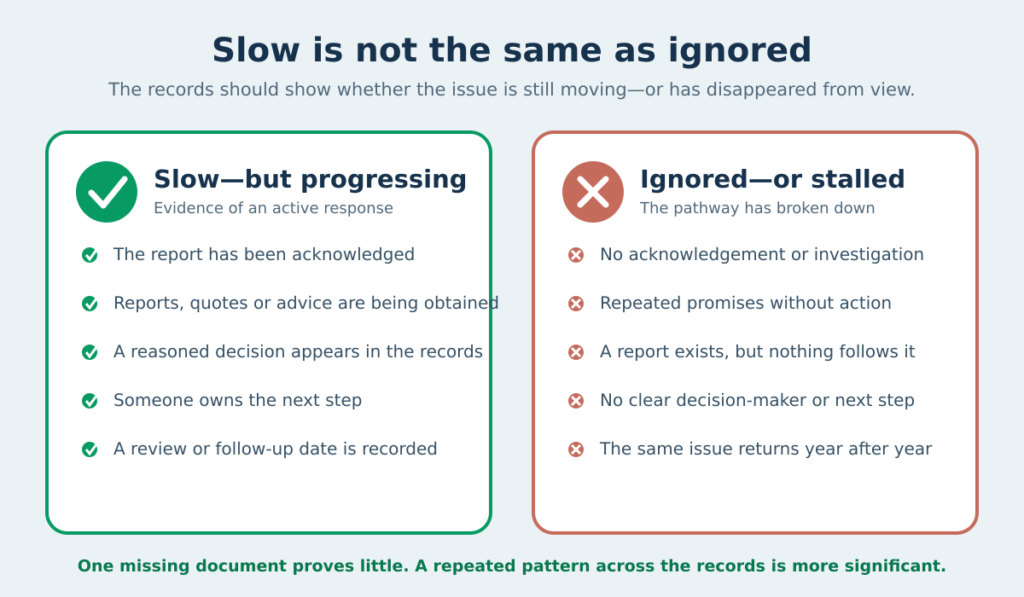
Slow is not the same as ignored
Body corporate decision-making is rarely instantaneous. Even a well-managed scheme may need several months to move from the first complaint to completed work, particularly where the cause is disputed or the project is costly or complex.
A deferred repair is also not automatically an ignored repair. A committee might decide to obtain another report, combine related works into a larger project, wait for an insurance decision or schedule non-urgent work in the next financial year. The important questions are whether the decision is reasonable in the circumstances, whether ongoing damage and risk are being controlled, and whether someone remains responsible for moving the matter forward.
Concern increases when there is no acknowledgement, no investigation, no recorded decision, repeated promises without action, or the same unresolved item appearing in records year after year. Those are indicators of a different problem.
Why delays matter
Unresolved building problems rarely improve by themselves. Water ingress can continue damaging finishes and contents and may contribute to mould. Corrosion and concrete spalling can progress. A minor roof, plumbing or waterproofing defect can become a larger and more expensive project.
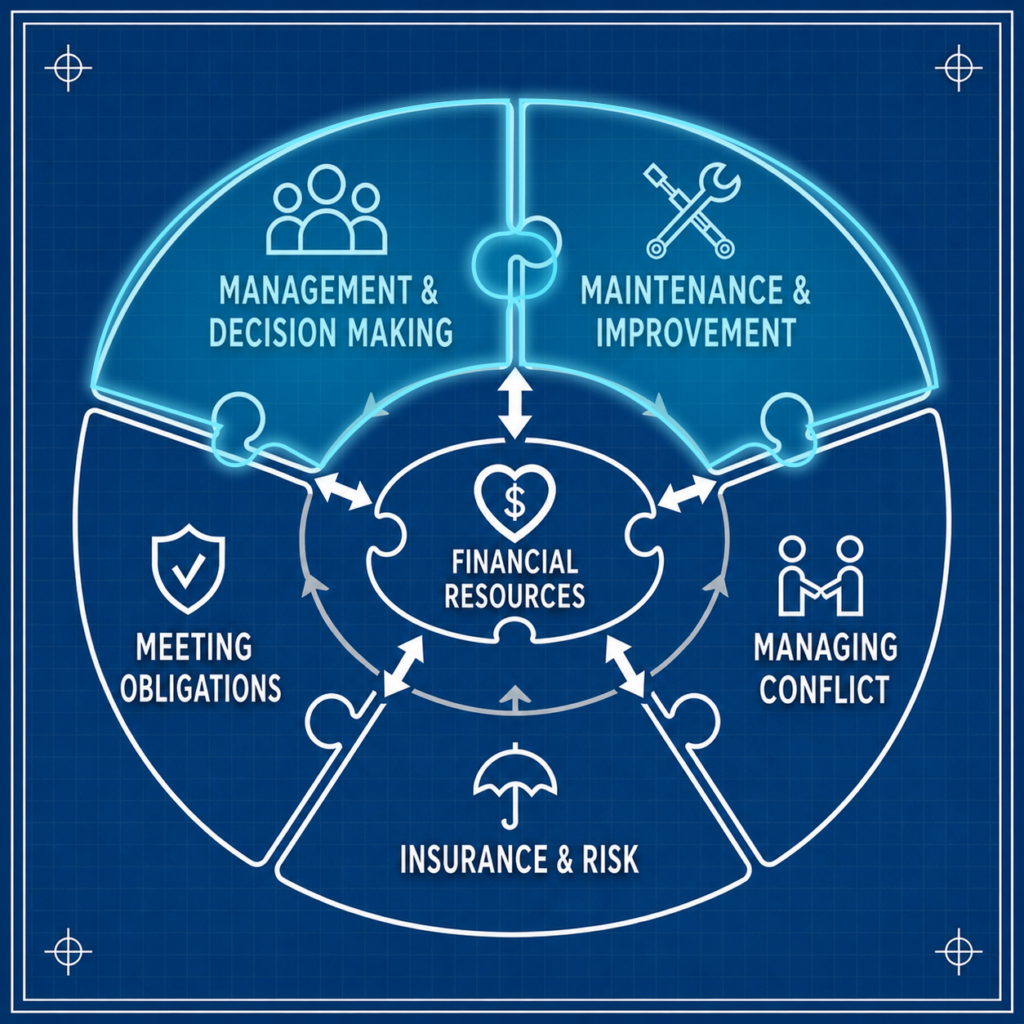
Delay can also create secondary problems across the Body Corporate Blueprint:
- Financial Resources: the eventual repair may cost more, require a special levy or place pressure on cash reserves.
- Insurance & Risk: continuing damage may complicate a claim, increase the body corporate’s exposure or reveal that temporary risk controls were inadequate.
- Meeting Obligations: some defects involve safety or statutory obligations that cannot reasonably be left unresolved.
- Managing Conflict: owners who feel ignored may seek formal dispute resolution.
- Management & Decision Making: poor record handling, unclear delegation and a lack of follow-up may allow the issue to disappear between the committee, body corporate manager and caretaker.
This is why a delayed repair is more than a maintenance issue. The defect concerns the physical property; the response reveals the management system around it.
What a reasonable response looks like
A reasonable response does not always mean agreeing with the owner’s contractor or commencing work immediately. It usually means that the report is acknowledged, responsibility is considered, further information is obtained where needed, a decision is made by the appropriate decision-maker, and that decision is communicated.
For a scheme regulated by the Body Corporate and Community Management Act 1997, the applicable regulation module generally requires the body corporate to maintain common property in good condition. Exactly who is responsible can still depend on the survey plan, the location and function of the item, exclusive-use by-laws, improvements and other circumstances.
The body corporate is entitled to test an owner’s conclusion. An owner’s report is evidence, not necessarily the final word. But disagreement should lead to a reasoned response or further investigation—not indefinite silence.
What an owner can do
If you have reported the problem and nothing appears to be happening, a calm, documented escalation is usually more effective than sending increasingly frustrated messages.
- Follow up in writing. Refer to the date of the original report, attach it again and ask what action has been taken, what happens next and when an update can be expected.
- Keep a chronology. Record reports, photographs, calls, emails, inspections, further damage and every response received.
- Ask for a decision. If informal correspondence is going nowhere, consider submitting a properly framed motion for the committee or a general meeting, depending on the decision and expenditure required.
- Make the proposal workable. A useful motion identifies the action sought and may include a quotation, scope, funding proposal or authority to obtain further advice.
- Continue limiting damage where reasonably possible. Urgent health, safety or property risks may require prompt professional advice; do not assume that a pending body corporate process removes the need to protect people or property.
- Consider dispute resolution. If direct attempts fail, conciliation through the Office of the Commissioner for Body Corporate and Community Management may be available. Adjudication may follow if the matter is not resolved, subject to the applicable requirements.
Before lodging a dispute application, evidence of self-resolution is important. A clear request, supporting material, a motion where appropriate, follow-up correspondence and the response—or absence of one—help show what has already been attempted.
A not about motions and approvals
A motion can require the issue to be formally considered, but it does not guarantee that the proposed work will be approved. The wording, decision-maker, spending limits, available funds and the regulation module applying to the scheme all matter. Costly works may require general meeting approval or a separate funding decision. Owners should obtain advice about their particular scheme before relying on a specific procedural pathway.
What would make the delay more concerning?
- water ingress is continuing or mould is developing
- there is a potential structural, electrical, fire-safety or other personal-safety risk
- concrete spalling, corrosion or another progressive defect has been identified
- the affected owner is suffering continuing property damage or loss of use
- the body corporate has no clear reason for rejecting professional findings and has obtained no alternative advice
- the delay appears connected to lack of funds, chronic indecision or dysfunctional relationships
- several similar defects suggest a building-wide problem rather than an isolated repair.
What to look for in body corporate records
- repeated discussion of the same repair across committee or general meeting minutes
- multiple unanswered requests from an owner
- reports that identify a problem but no later scope, quotation, approval or completion record
- quotes obtained repeatedly without a decision
- insurance or warranty claims mentioned without later updates
- temporary repairs recurring without the underlying cause being rectified
- the same issue appearing over several financial years
- evidence of escalating damage, mould, safety concerns or disputes
- a pattern of many unresolved maintenance matters rather than one isolated delay.
The takeaway
Three months without a completed repair is not, by itself, proof of poor management. Complex body corporate repairs often take time. What matters is whether the records and communications show that the problem has entered a functioning process and continues to move through it.
A well-managed body corporate may not have an immediate solution, but it should usually be able to show what it has considered, what it has decided, who is responsible for the next step and when the matter will be reviewed. When those links are missing, a maintenance problem may also be telling you something important about management.
This article provides general information only. It is not legal, financial, engineering or building advice. The circumstances of every body corporate are different. Obtain advice from an appropriately qualified professional where necessary.