
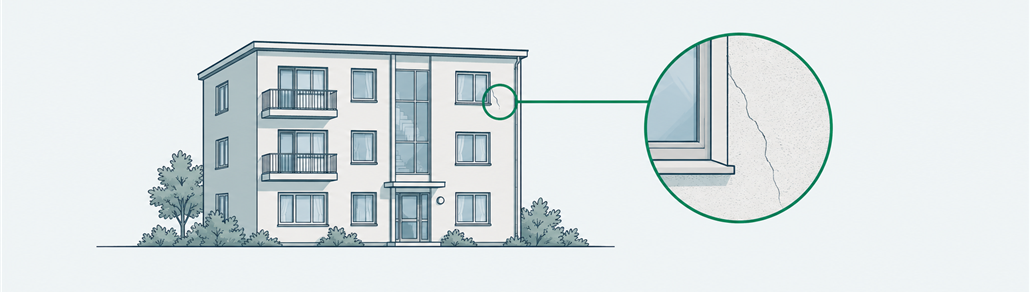

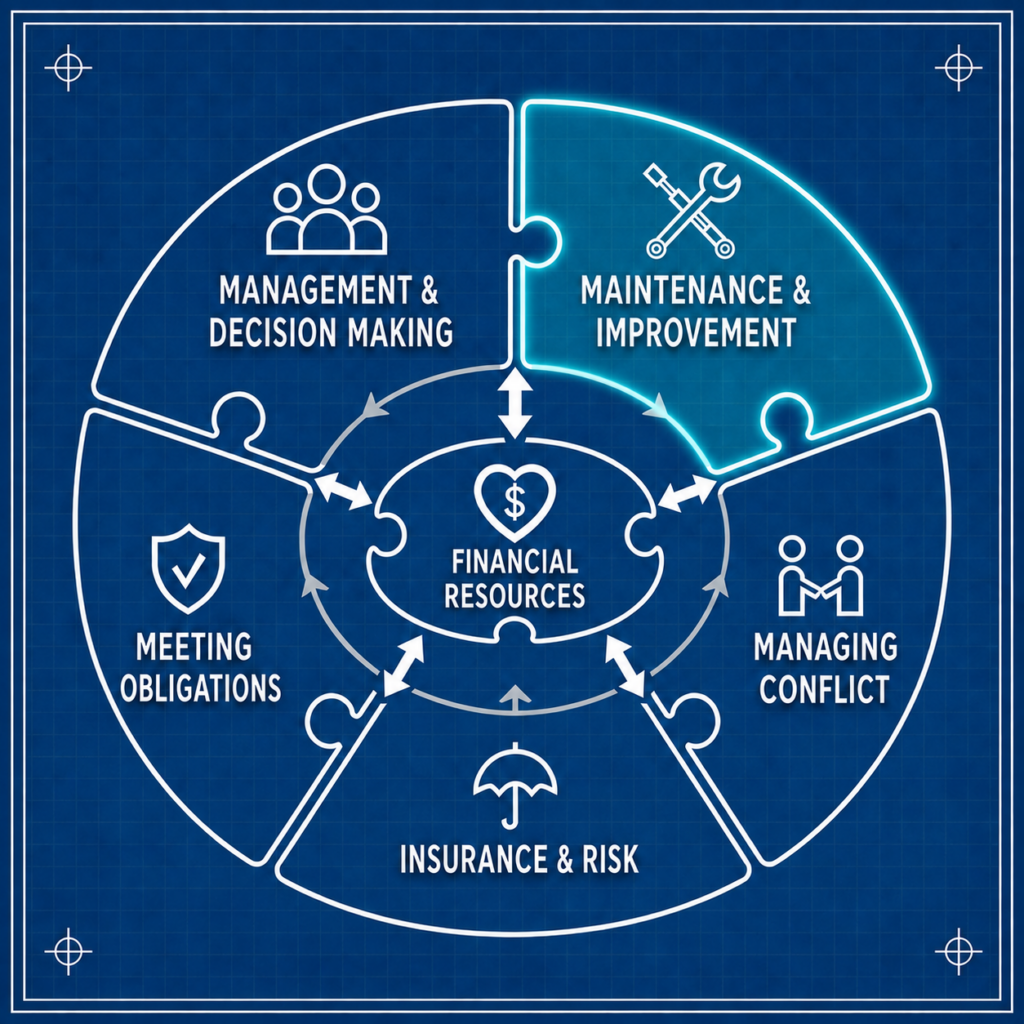
Report of cracking in a body corporate can be unsettling.
Does it mean the building is moving? Is there a structural problem? Are expensive repairs coming?
Not necessarily. But possibly, which is why cracking is a red flag.
Some cracks affect finishes and can be dealt with through relatively straightforward repairs. Others indicate movement, deterioration or a problem requiring specialist investigation.
For a buyer or owner, the useful questions are: what has cracked, what is causing it, and how has the body corporate responded?
What do we mean by cracking?
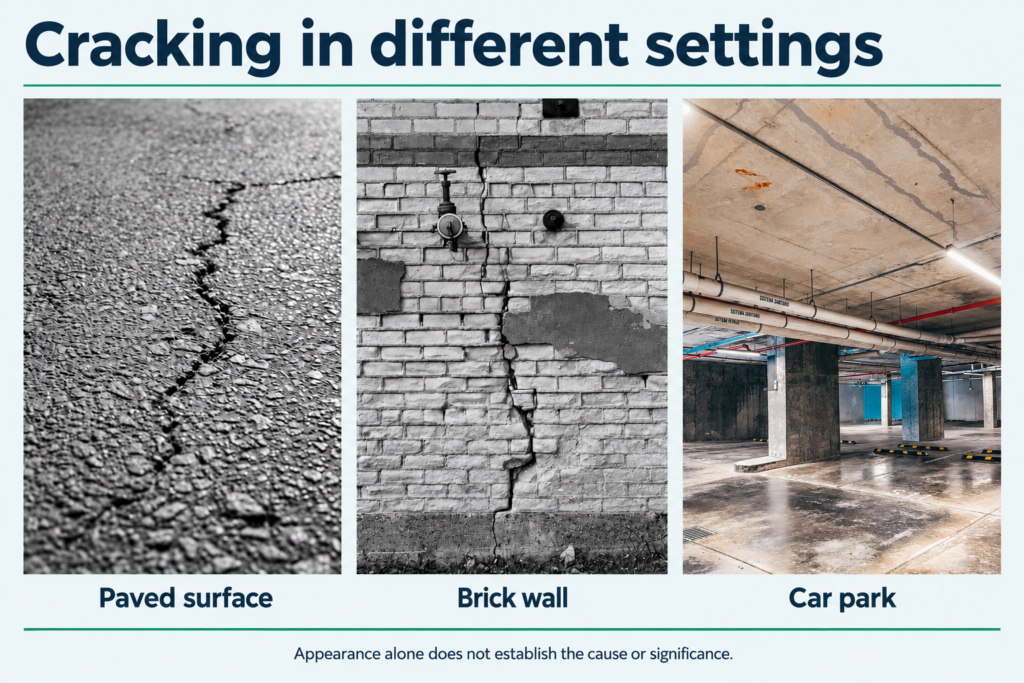
Cracking can appear in many parts of a property:
- Internal walls, ceilings and around door or window openings.
- Brickwork, render and external walls.
- Concrete driveways, paths and slabs.
- Retaining walls.
- Balconies, beams and columns.
Those examples do not all carry the same significance.
A crack in a plaster finish is a different observation from cracking through a structural concrete element. Even cracks that look similar can have different causes.
The word “cracking” in meeting minutes tells you that something was noticed. It does not, by itself, tell you how serious it is.
Why do buildings crack?
Building materials can shrink, expand and move. The ground supporting a building can also change.
Concrete cracking can result from shrinkage, temperature changes, movement during construction, corrosion of reinforcement and structural loading. Identifying the cause is an important part of deciding how to respond. ACRA’s guidance on concrete cracking emphasises that possible remedial measures should be considered only after the causes have been properly identified.
Two situations are particularly useful to understand when reading body corporate records.
Ground and foundation movement
If different parts of the ground beneath a building move by different amounts, the building may crack.
Soil conditions, changes in moisture, drainage, trees and the performance of fill can all be relevant. A leaking pipe or water collecting near a building may therefore be part of an investigation into cracking.
QBCC guidance explains the relationship between ground movement, moisture conditions and building damage.
In a townhouse complex, records about drainage, retaining walls or site movement may help explain cracking reported inside a lot. However, cracking should not automatically be labelled “subsidence”, and foundation movement is not confined to townhouses.
Movement within the building
Concrete and other building materials also move independently of the ground beneath them.
Depending on their design and purpose, joints help accommodate movement or control where cracking occurs. Their presence is not itself a defect.
If a report discusses joint movement, cracking or failed seals, look for the professional’s explanation of what has happened and what needs attention.
Avoid assuming that every joint requires the same treatment, or that repairing a visible crack will necessarily address the underlying cause.
Does the size of the crack tell you whether it is serious?
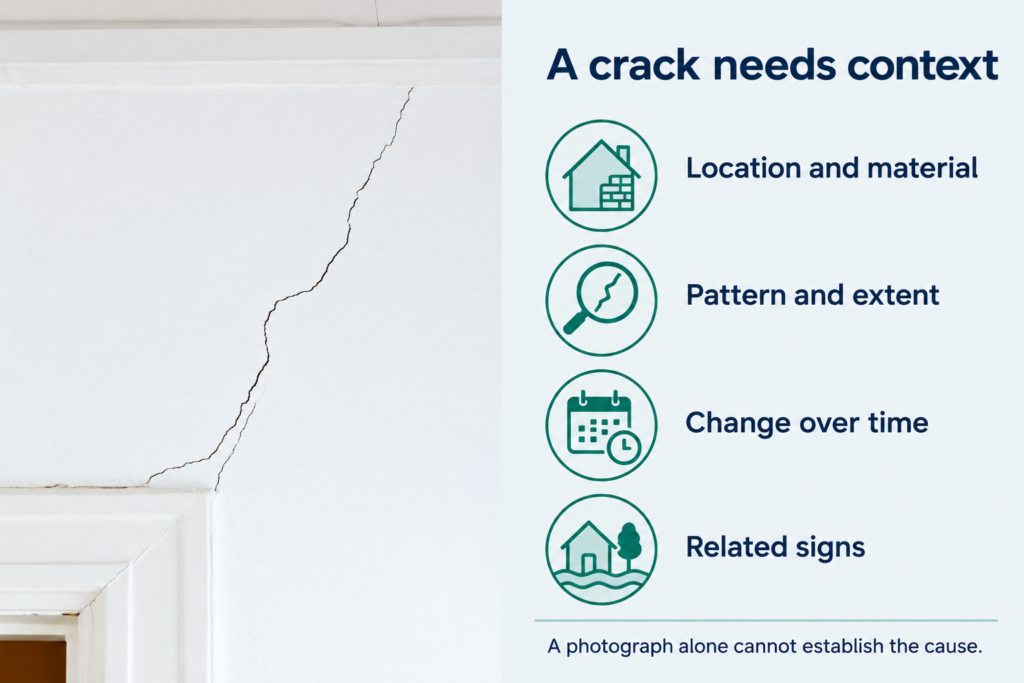
Crack width can be useful information, but it is not the whole assessment.
The material, location, pattern, associated movement and whether the crack is changing also matter. A measurement needs to be interpreted in context.
The QBCC Standards and Tolerances Guide contains criteria for particular building elements and circumstances. It is primarily a guide to assessing building work, with defined applications and timeframes. It should not be treated as a universal test of whether an existing building is safe.
For records review, the useful question is whether an appropriately qualified professional has assessed the cracking and explained its significance.
What should happen after cracking is reported?
The response should be appropriate to the circumstances.
An isolated crack in a finish may need a different response from recurring cracking, movement affecting several areas, or cracking in a structural element.
Where the cause or significance is uncertain, I would expect to see an investigation by an appropriate building professional. Structural concerns may require an engineer.
The resulting advice might recommend repairs, further testing, monitoring or investigation of related issues such as drainage.
An engineering report does not automatically mean a major problem has been found. It may explain why the cracking is relatively minor. It may also identify questions that cannot yet be answered.
What matters is whether the records show a clear next step.
Where a professional identifies an immediate safety concern, the response should follow that advice promptly rather than wait for the ordinary maintenance process.
Monitoring should have a purpose
- What is being monitored and where.
- Who is responsible.
- How changes will be recorded.
- When the information will be reviewed.
- What changes should prompt earlier advice.
Does filling a crack mean the problem is fixed?
Not necessarily.
Filling and repainting may be an appropriate repair where the cause has been understood and the treatment suits the problem.
But a neat finish does not demonstrate that movement has stopped. If the cause remains active, cracking may recur or appear nearby. The Concrete Society advises understanding and, where necessary, addressing the cause before repair.
Consider an owner who reports a crack beside a window. It is patched and painted. Months later, the same owner reports that it has returned.
That does not prove a serious structural defect. It does mean the earlier repair may not have resolved the cause, and the later report deserves attention.
Repeated cosmetic repairs are different from a documented investigation followed by an appropriate repair and reassessment.
What might fixing cracking in a body corporate involve?
The response depends on the findings.
- For cosmetic issues repair of the cracking might be sufficient.
- If the problems are more serious drainage improvements, joint repairs, or waterproofing works to stop the problems may be required.
- In serious situations concrete repairs or work to address foundation movement may be required.
- In rare cases major rebuilding works to elements may be required.
Some projects are limited.
Others require further design, investigation and substantial expenditure.
If underpinning is mentioned, do not assume it is either inevitable or a minor repair. Look for the professional recommendation, the proposed scope and the reasons for that approach.
Once substantial work is recommended, follow the project through scope, quotes, decisions, funding and completion. A recommendation is not evidence that the work occurred.
What would make me more concerned?
I would be more concerned about unresolved findings and repeated reports than the word “cracking” on its own.
Examples include:
- Owners repeatedly reporting the same cracking without a clear response.
- Reports that cracks are widening, recurring or appearing in additional areas.
- Professional recommendations remaining outstanding.
- Drainage or other contributing problems being identified but not addressed.
- A monitoring period passing without a recorded reassessment.
- Repairs being described as complete, followed by further reports of the same symptoms.
These are reasons to investigate further. They are not, by themselves, proof that the committee has done nothing.
There may be correspondence, monitoring results or a later report missing from the records supplied.
Equally, an older report describing a crack as minor should be read alongside any later evidence of change.
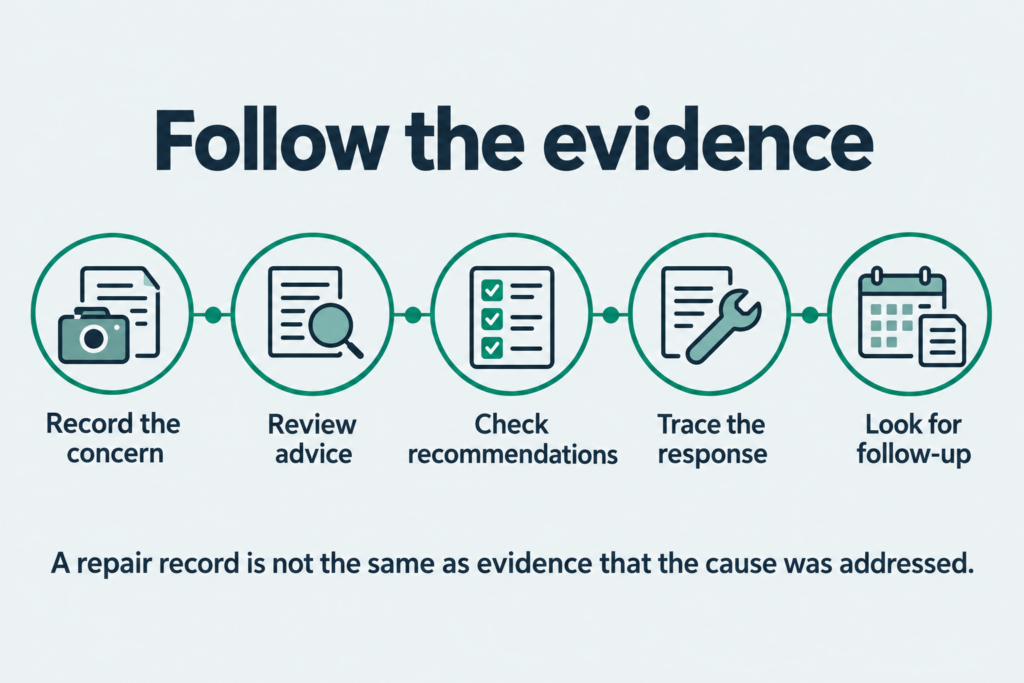
Which records tell the story?
Start with the original report of cracking, then follow the response.
Correspondence and photographs may show what was noticed and when. Committee minutes or decisions made outside a meeting may record an inspection being authorised.
Professional reports explain the findings and limitations. Quotes and scopes describe proposed work. Financial records show expenditure, while completion documents and later inspections help establish what was done and whether further action was required.
A paid invoice may confirm that a crack was repaired. It does not necessarily establish that its underlying cause was resolved.
For a buyer, records review and inspection of the property provide different information. One helps explain the history and decisions; the other can identify current physical conditions requiring attention.
Follow the cause and the response
Cracking can be a relatively minor maintenance issue. It can also be a visible sign of a problem elsewhere in the building or site.
You do not need to diagnose it from the minutes.
You do need to understand what was reported, what professional advice was obtained, what action followed and whether the issue remains unresolved.
The important distinction is between a crack that has been covered over and a problem that has been understood and appropriately addressed.
This article provides general information only. It is not legal, financial, engineering or building advice. The circumstances of every body corporate are different. Obtain advice from an appropriately qualified professional where necessary.