
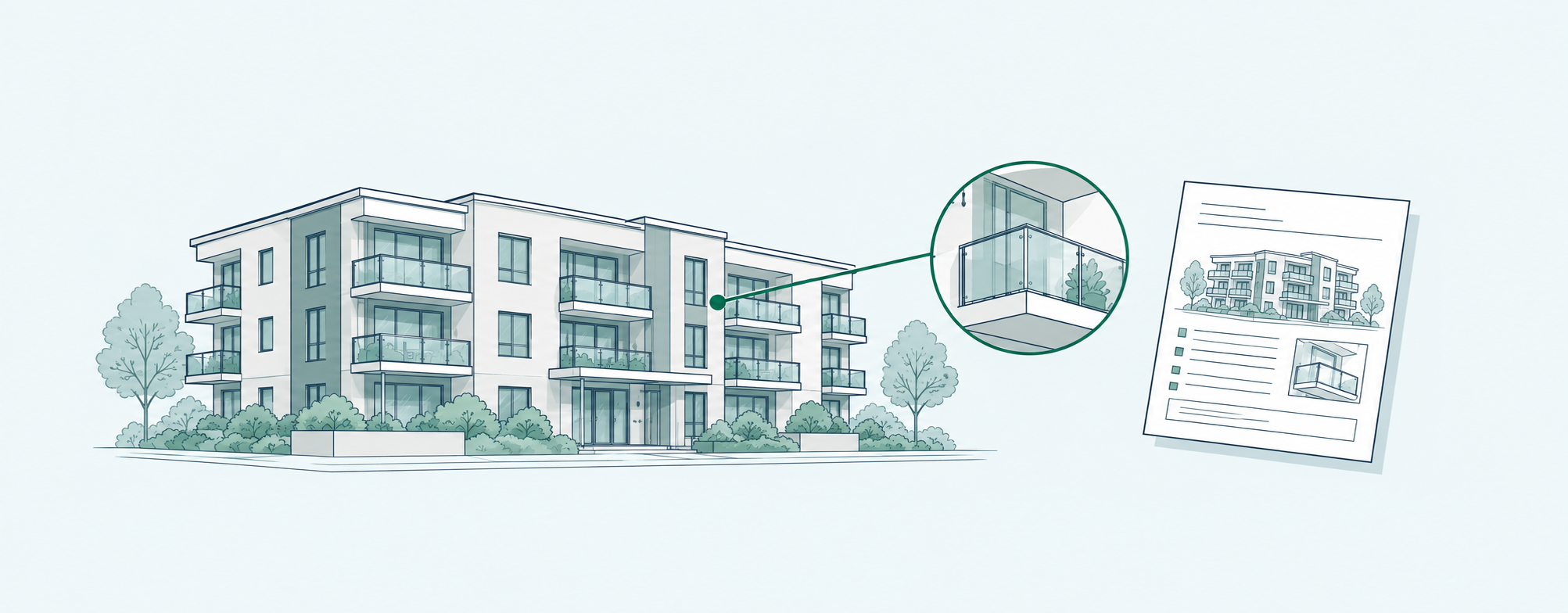

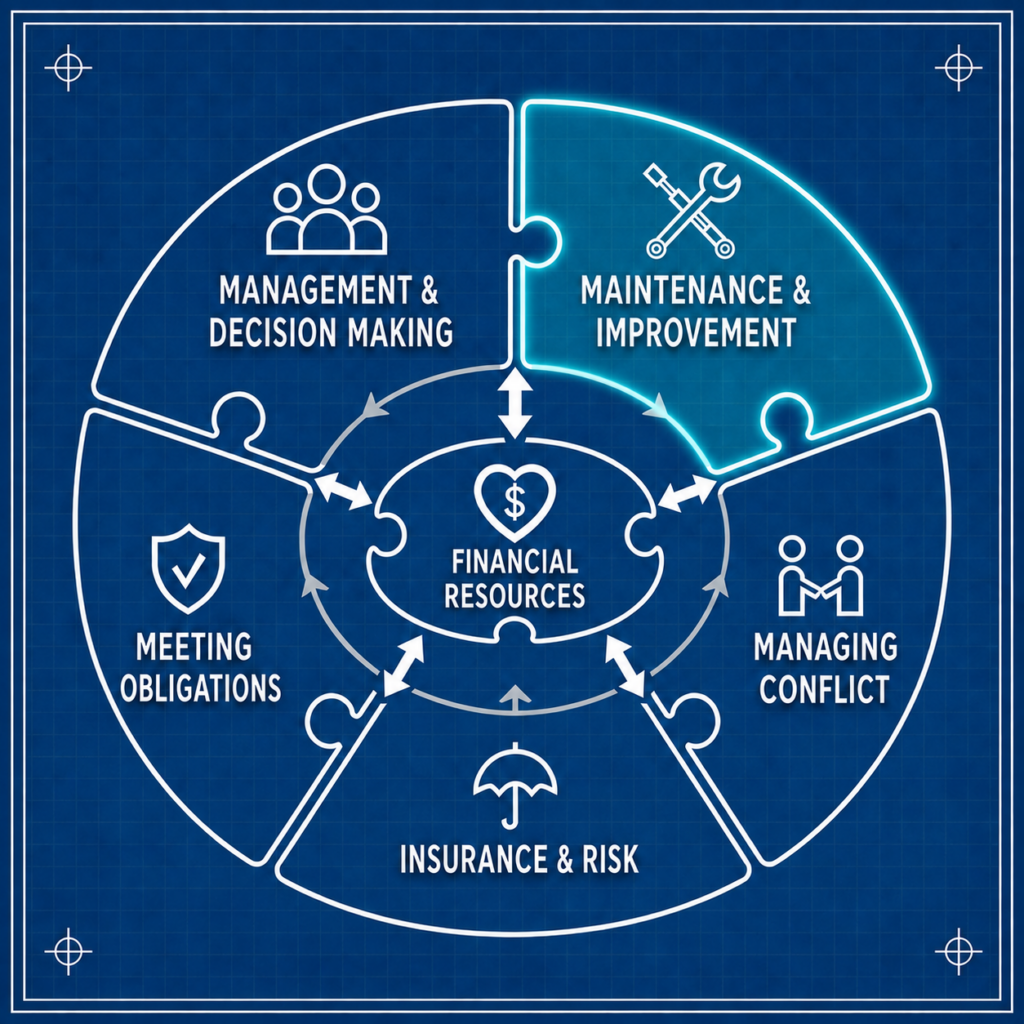
Body corporate engineering reports can be unsettling to find in the records. Does a report mean something is wrong with the building? Are expensive repairs coming? Should you be worried?
Not necessarily.
A report may identify a significant problem. It may also confirm that something which looked alarming is relatively minor. Sometimes it recommends further investigation because there isn’t enough information to reach a conclusion.
The useful questions are: why was the report obtained, what did it find, and what happened next?
What are engineering and builidng reports?
For this article, we’re talking about a professional engaged to investigate a particular issue and provide advice.
There might be cracking in a wall, water entering a basement, concrete deteriorating on a balcony or movement in a retaining wall. The body corporate needs help understanding what is happening, why it is happening and what can be done about it.
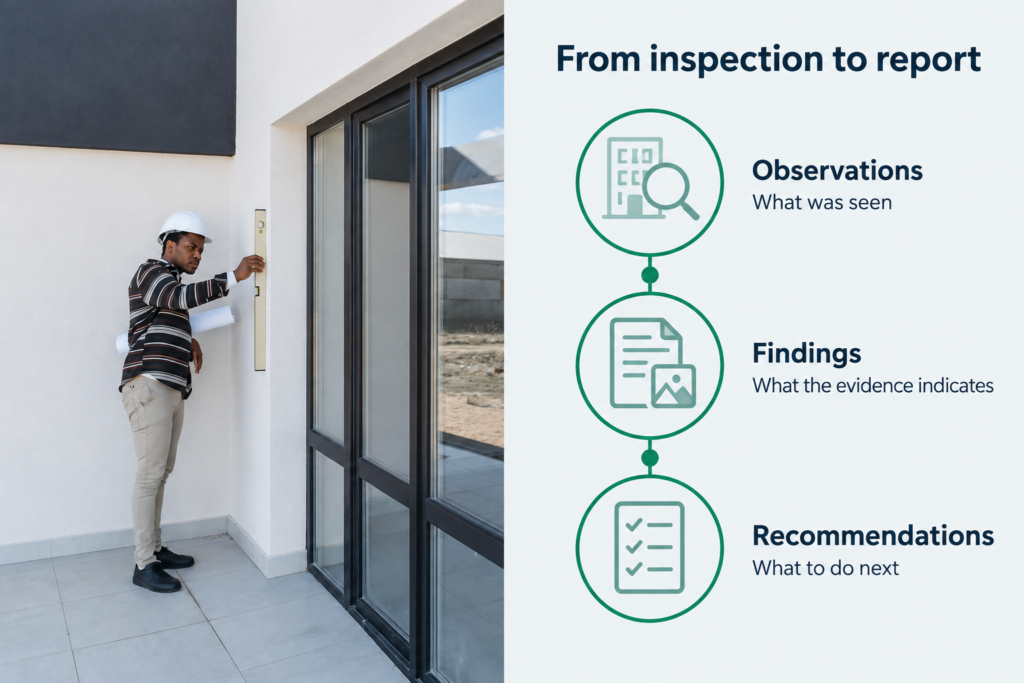
An engineering or building report records the professional’s observations, findings and recommendations. Depending on the engagement, it might also include photographs, testing results, repair options or advice about urgency.
Not every report has the same purpose or depth.
A building inspection might identify a concern which needs specialist investigation. An engineer might inspect
one particular structural element. A contractor might provide written observations after attending to a leak.
Each can contribute useful information, but they don’t necessarily answer the same questions.
Why would a body corporate need one?
Most committees are made up of ordinary owners. They may bring considerable experience to the role, but that doesn’t make them building specialists.
A caretaker may know the property well. A strata manager may help with meeting procedures and arranging quotes. Neither should be expected to diagnose a complex building problem outside their expertise.
Consider a recurring leak.
The first step might be to engage an appropriate contractor to investigate and repair it. But if the water keeps returning, the source is unclear or several parts of the building are involved, the committee may need more specialised advice.
The same applies to cracking. A visible crack is an observation. Understanding its cause, significance and appropriate treatment may require professional assessment.
Obtaining a report can be evidence that the committee is taking a concern seriously and seeking advice before spending owners’ money.
Who prepares the report?
The professional should be appropriate for the problem being investigated.
That could mean a structural engineer, a building consultant, a geotechnical engineer investigating ground conditions, or another specialist with relevant experience.
The committee, an owner or a manager acting on the committee’s instructions might commission the report. The engaged professional prepares it.
That distinction matters when reading the records. Ask who requested the advice and what they asked the professional to investigate.
In Queensland, professional engineering services generally require an appropriately registered engineer, subject to statutory exceptions. The Board of Professional Engineers Queensland provides information about registration and checking an engineer’s credentials.
How do you recognise a report in the records?
Sometimes the report itself is easy to find. It may be included in the documents supplied for a body corporate records search or available through an owners’ portal.
Other times, you’ll find references to it elsewhere:
- Committee minutes approving an inspection.
- A caretaker’s report describing a recurring problem.
- A quote to investigate cracking, leaks or deterioration.
- An invoice from an engineer or building consultant.
- Correspondence discussing findings or requesting further advice.
- Meeting minutes considering recommended works.
An expense labelled “reports” in the financial statements is a clue, but it doesn’t establish that a building problem exists. The payment could relate to a different type of report.
If the minutes refer to an engineering report and you haven’t seen it, request a copy. A brief summary in the minutes may leave out qualifications, limitations or recommendations that matter.
What should you look for in the report?
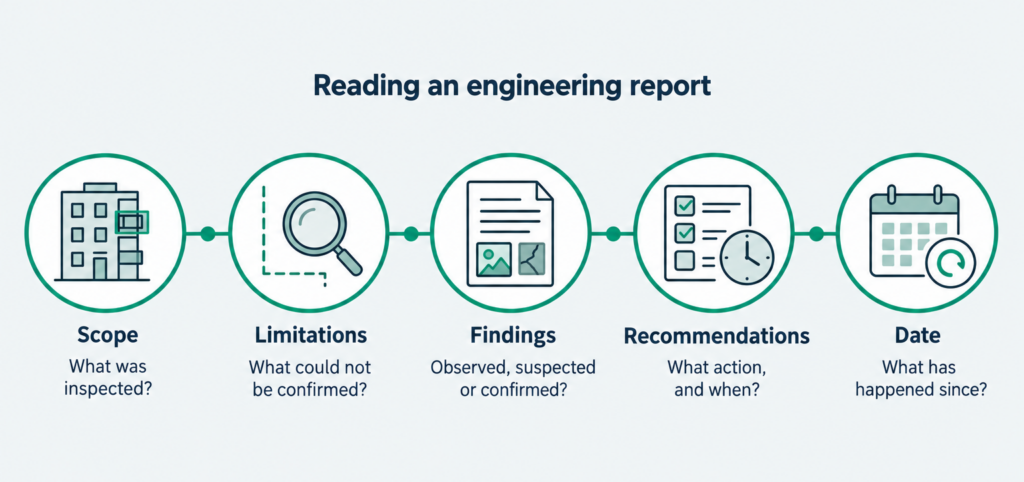
Start with the reason it was commissioned, then follow the investigation through to its recommendations.
What was inspected?
Was the inspection limited to one balcony, one apartment or one section of a retaining wall? Advice about a particular area should not automatically be treated as an assessment of the entire building.
What access and testing were available?
A visual inspection has different limitations from an investigation involving testing or opening up parts of the building. Look for inaccessible areas and anything the author says could not be confirmed.
What did the professional conclude?
Distinguish between an observed symptom, a suspected cause and a confirmed finding. Those are different stages of understanding a problem.
What action was recommended, and when?
The recommendation might be to repair, monitor, undertake further testing or obtain advice from another specialist. Check whether the report identifies a timeframe or any immediate safety measures.
How old is the report?
An older report may have been followed by repairs, further deterioration or a later assessment. It is one point in the history of the issue.
You don’t need to become an engineer to read the records. You do need to recognise where the answer remains uncertain.
What usually happens next?
A report often gives the body corporate a basis for deciding what to do.
That might mean obtaining repair quotes, arranging further investigation, commissioning a repair design or monitoring the issue over a specified period.
More complex problems can involve several stages. Identifying the cause does not necessarily produce a complete specification, a reliable price and a contractor ready to start.
The body corporate also needs to establish responsibility for the work. Queensland maintenance responsibilities depend on factors including the survey plan and the property or infrastructure involved.
Once the scope is clearer, the records may show discussion about approvals, funding and timing.
Where a report identifies an immediate hazard or recommends urgent make-safe measures, look for evidence of a prompt response consistent with the professional advice. Planning the permanent repair may take longer than addressing an immediate risk.
Does a report mean major works or a special levy are coming?
It can indicate that possibility, but it doesn’t establish it.
A report may recommend a relatively minor repair. It may confirm that monitoring is appropriate. It may identify substantial works whose scope and cost are still being investigated.
Even where major works are recommended, the funding position is a separate question.
Does the body corporate have funds available? Has the work been allowed for in its planning? Are quotes being obtained? Has a special levy or borrowing proposal actually been considered?
Follow the evidence through the report, minutes and financial records. Avoid jumping straight from “engineer engaged” to “large special levy coming”.
What would make me more concerned?
I would be more concerned about significant recommendations with no visible follow-up than the mere existence of a report.
For example:
- The report recommends urgent action, but later records do not explain what was done.
- The same problem keeps appearing in minutes after repeated repair attempts.
- A recommendation for further investigation remains unresolved.
- A monitoring period has passed without a recorded reassessment.
- Substantial works are discussed, but the scope, likely cost or funding remains unclear.
- The committee says the issue is resolved, but supporting completion records are missing.
These are reasons to ask questions. They are not, by themselves, proof that the committee has done nothing.
There may be correspondence you haven’t received, a later report or a reasonable explanation for the timing. The next step is to find that information.
Equally, uncertainty about a repair does not automatically mean the advice is poor. Some building problems require staged investigation. What matters is understanding what remains uncertain and how the body corporate intends to resolve it.
What documents tell the whole story?
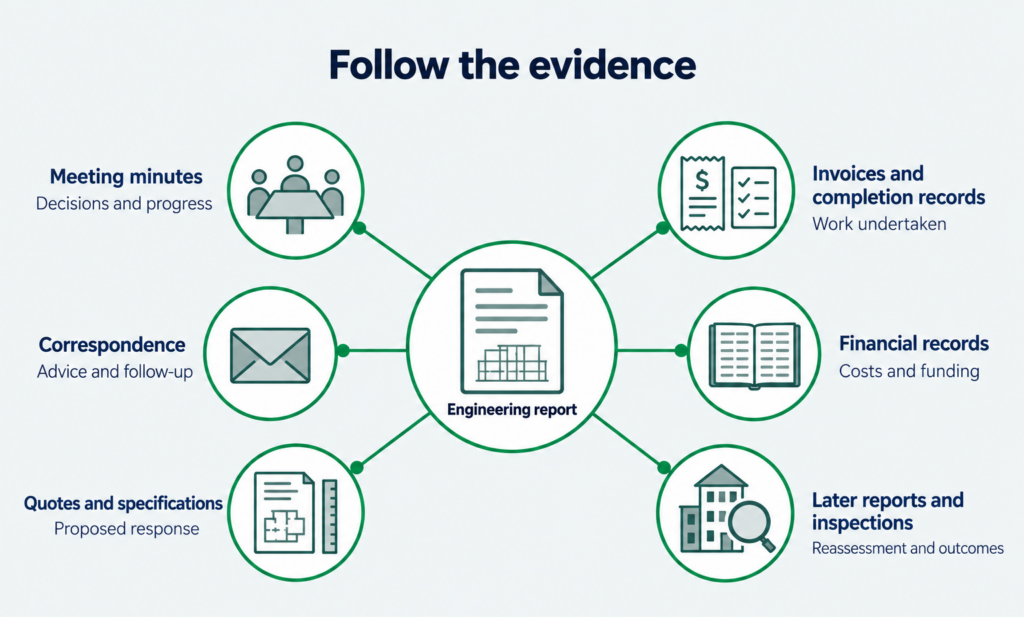
The report is the starting point. Read it alongside:
- Committee and general meeting minutes for decisions and progress.
- Correspondence for explanations, specialist advice and follow-up.
- Quotes and work specifications for the proposed response.
- Invoices and completion records for evidence of work undertaken.
- Financial statements and budgets for expenditure and funding.
- Later reports or inspections for reassessment and confirmation of outcomes.
A paid invoice shows that money was spent. Depending on the work, you may also need evidence that the recommended repair was completed and any required follow-up occurred.
When an engineering or building report appears in the records, follow the story from the original concern through to the latest action. A committee that investigates, obtains appropriate advice and responds to it may be managing the building responsibly—even when the problem itself is substantial.
This article provides general information only. It is not legal, financial, engineering or building advice. The circumstances of every body corporate are different. Obtain advice from an appropriately qualified professional where necessary.