



Why cleaning the visible growth is only one part of resolving mould in a body corporate
Mould appearing inside a unit can look like a straightforward cleaning problem. Sometimes it is. Mould in a body corporate can be anything but straightforward. The location of the visible mould does not necessarily identify the source of the moisture—or the person responsible for fixing it.
Mould may be associated with condensation or ventilation within the lot. It may also be the visible end point of water entering through a roof, wall, window, balcony, waterproofing system, pipe or another part of the building. Water can travel before it appears, so the affected ceiling or wall may be some distance from the defect.
That makes mould a useful warning sign. The aim is not simply to remove what can be seen. It is to understand the pathway from moisture source to damage, rectify the cause and confirm that the repair has worked.
The central question
What is creating the moisture, and who is responsible for maintaining the building element or service causing it?
What is mould?
Mould is a type of fungus that grows when spores encounter sufficient moisture and suitable conditions. It can occur within an individual lot, on common property or across both.
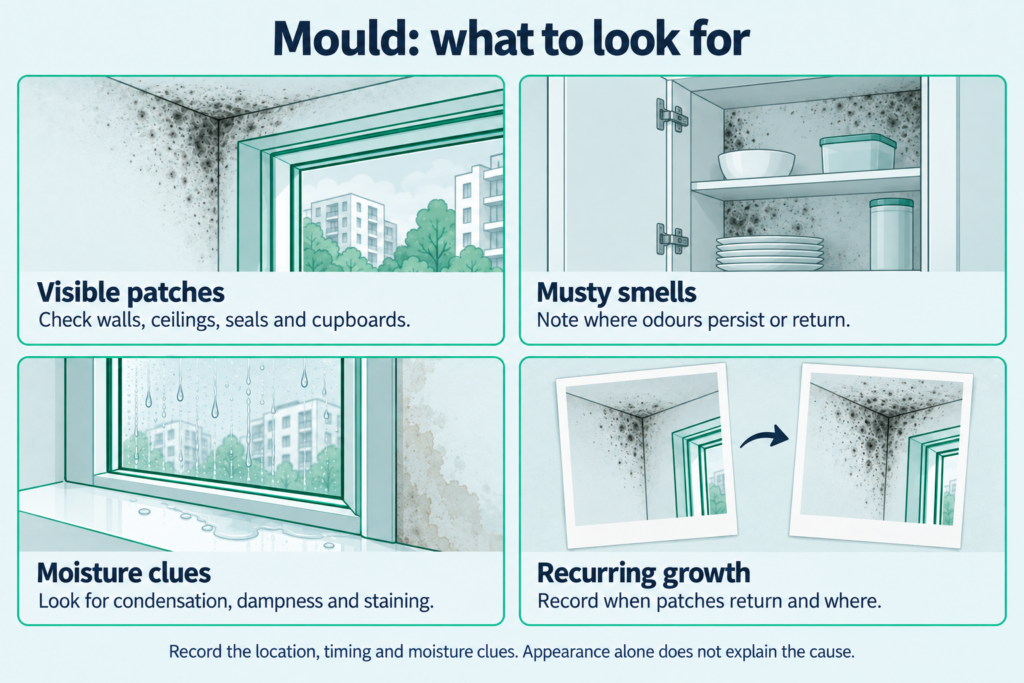
It may appear as black, green, grey, white or brown patches; speckled or fuzzy growth; discolouration; or staining. A persistent musty or earthy smell can also be a clue, even where growth is concealed behind finishes, in cabinetry, under flooring or within a ceiling space.
Mould is not always easy to identify from appearance alone. Dirt, water staining and efflorescence can be mistaken for mould. Where the substance or cause is unclear—or the problem keeps returning—further investigation may be needed.
Why mould in a body corporate matters
Mould can damage plasterboard, paint, timber, carpet, insulation and other materials. It can also produce unpleasant odours and affect how occupants use and enjoy their home.
Health effects vary. Queensland Health notes that mould can affect health, particularly for susceptible people, and advises against dry abrasive cleaning because it can release spores into the air. Anyone experiencing symptoms or facing extensive contamination should obtain appropriate health and remediation advice rather than relying on a general article.
For the body corporate, recurring or widespread mould may indicate a building defect, failed maintenance, water ingress or another moisture pathway requiring investigation. It may also create a trail through the records: complaints, inspection reports, quotations, insurance correspondence, meeting motions and repeated attempts at repair.
What usually causes mould in a body corporate?
Common possibilities include:
- water ingress through roofs, external walls, windows, doors or balconies
- plumbing leaks or failed utility infrastructure
- failed waterproofing in bathrooms, laundries, balconies or other wet areas
- defective drainage, blocked outlets or overflowing gutters
- rising damp or moisture moving through masonry and concrete
- leaking air-conditioning equipment, condensate lines or mechanical systems
- condensation, high indoor humidity or inadequate ventilation
- building defects or deterioration of common property
- a combination of building and occupancy factors rather than one isolated cause.
The source may be inside the affected lot, another lot or common property. More than one factor may contribute. For example, limited ventilation may make a room vulnerable, while intermittent water ingress keeps adding moisture to the building fabric.
Visible inside the lot does not automatically mean the owner is responsible
Responsibility in a community titles scheme generally follows the relevant maintenance obligation, not simply the location where the damage becomes visible. Queensland body corporate guidance states that the body corporate must maintain common property in good and structurally sound condition, while an owner must maintain their lot in good condition. The detailed division depends on the survey plan, the applicable regulation module, the building element involved, utility infrastructure rules, exclusive-use arrangements and any owner-installed improvements.
A mould-affected wall inside a lot could therefore involve:
- an owner maintenance issue, such as indoor condensation or a leaking fixture serving only that lot
- a body corporate maintenance issue, such as a common property roof, external wall or shared pipe
- another owner’s maintenance issue, such as water escaping from an adjoining lot
- several overlapping causes requiring evidence before responsibility can be determined.
The presence of mould does not, by itself, prove liability. Nor does a mould location on a boundary wall automatically settle the question. The physical source and the legal responsibility for the relevant building element both need to be established.
A useful distinction
The mould is the resulting condition. The moisture source is the cause. Responsibility will usually turn on the cause and the relevant maintenance obligation.
What do people commonly miss?
- assuming mould inside a lot must be the owner’s responsibility
- assuming mould beside common property must be the body corporate’s responsibility
- investigating only the visible surface and not the adjoining structure
- cleaning or painting before the material has dried and the cause has been rectified
- accepting a diagnosis based only on photographs
- failing to consider water moving from above, beside or behind the affected area
- treating each recurrence as a new event rather than recognising a pattern
- failing to document earlier reports, inspections, repairs and unsuccessful rectification.
What can the body corporate records tell you?
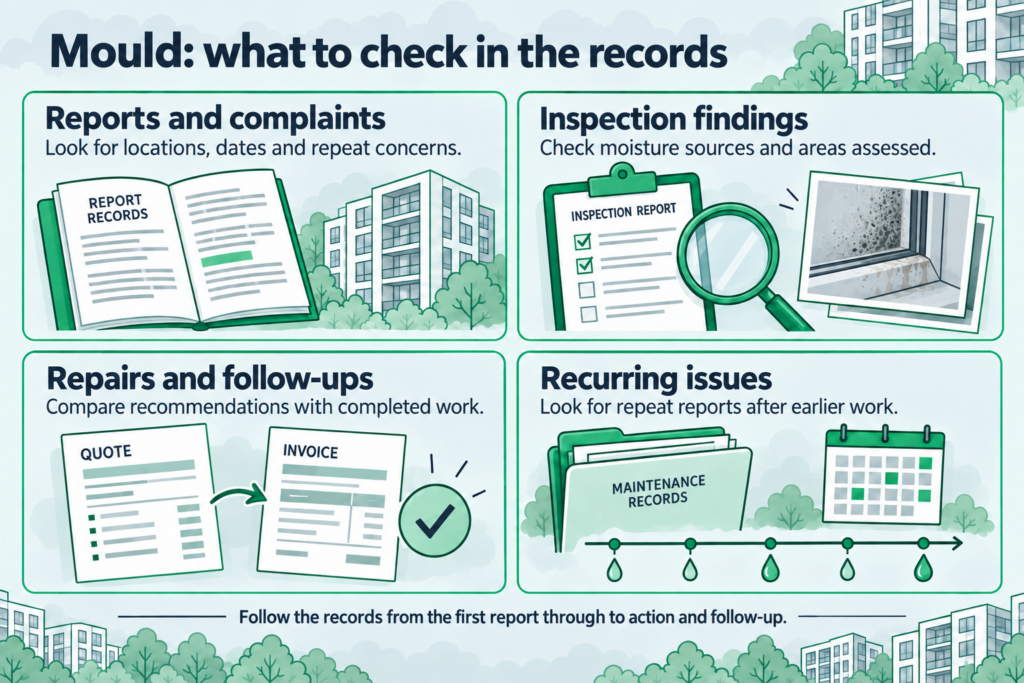
A current mould complaint may be only the latest point in a much longer story. Records can help establish whether the scheme has recognised the pattern, investigated the cause and followed the issue through to a verified outcome.
Useful records may include:
- emails and written complaints from owners, occupiers or letting agents
- committee and general meeting minutes
- maintenance requests, work orders and contractor invoices
- plumber, roofer, waterproofer, engineer, building consultant or hygienist reports
- moisture readings, thermal imaging or leak-detection results
- photographs showing progression or recurrence
- quotations, scopes of work and tender comparisons
- insurance notifications, reports, decisions and correspondence
- records of access requests involving adjoining lots
- evidence that completed works were tested or monitored.
The important question is not whether a single invoice says the mould was cleaned. It is whether the records show a documented pathway from report to investigation, decision, repair, remediation and follow-up.
Warning signs in the records
- the same unit or building elevation appears repeatedly over several years
- different contractors propose different causes but no coordinated diagnosis is obtained
- cleaning, sealing or repainting is repeated without source rectification
- reports recommend further investigation but the recommendation disappears from later minutes
- responsibility is debated for months while moisture damage continues
- quotes are obtained but motions are deferred or allowed to lapse
- insurance is expected to solve a maintenance problem without clarity about the underlying defect
- works are marked complete but recurrence is not checked after rain or seasonal humidity.
Mould as part of a wider pattern
Within the Body Corporate Blueprint, mould rarely sits neatly in one box. It may begin as a maintenance symptom, lead to questions about management and decision-making, create health or insurance concerns, develop into a dispute and eventually affect financial resources through investigation costs, remedial works or special levies.
That wider context is particularly important for a buyer. A small patch of mould may be readily explained and resolved. Recurrent mould across multiple lots, years of inconclusive reports or repeated cosmetic treatment can point to a more significant unresolved building issue.
The takeaway
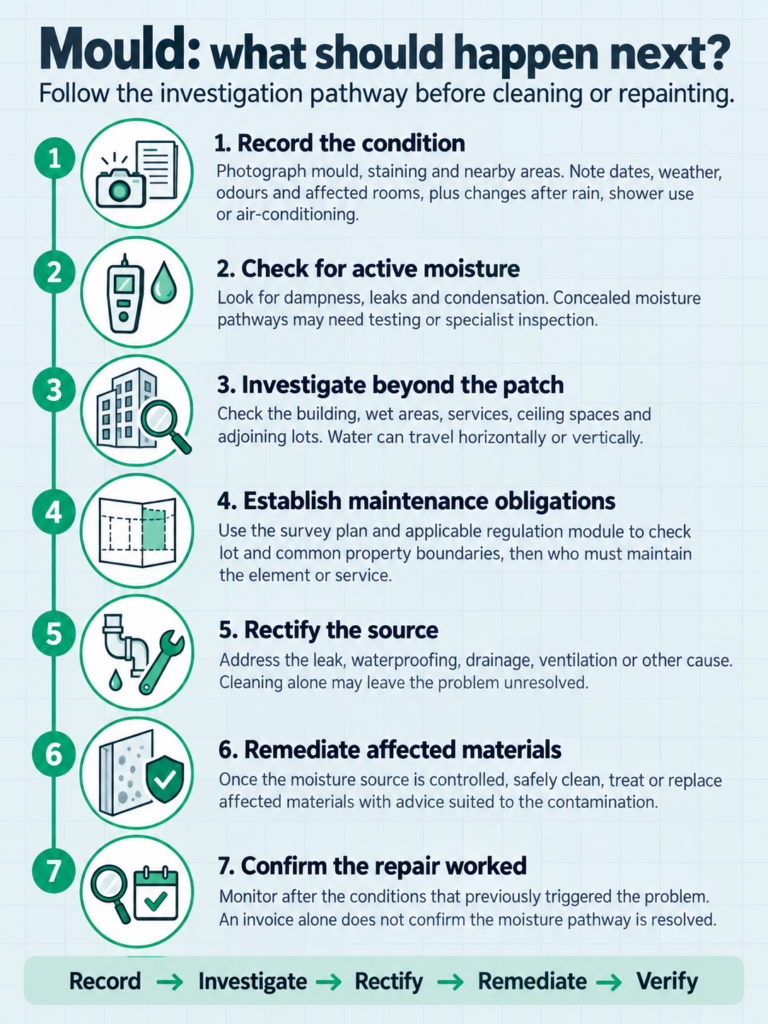
Mould should not be ignored, but nor should its location be used as a shortcut to conclusions about cause or responsibility. Start with the moisture. Trace its pathway. Identify the relevant building element. Check the maintenance obligation. Repair the cause, remediate the affected materials and confirm the problem has not returned.
In a body corporate, the most revealing evidence is often not the visible mould itself. It is the quality of the pathway recorded around it.
This article provides general information only. It is not legal, financial, engineering or building advice. The circumstances of every body corporate are different. Obtain advice from an appropriately qualified professional where necessary.