

Lisa Rutland

Body corporate specialist

2 minutes read

What is a Body Corporate

When we talk about body corporate most people picture either a high rise building or a group of townhouses. Strata titling, the process that creates a body corporate can be used for all sorts of developments. In this article I look at the most common types of body corporate.

The complicated answer to the question “What is a Body Corporate?” is, it’s a mechanism for holding and managing common property.

To make things a little clearer lets look at a simple illustration.

A Simple Land Subdivision
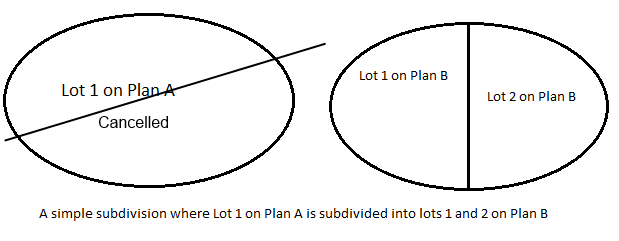
simple subdivision

The process of developing land is relatively simple to understand.

A developer wants to subdivide lot 1 on “Plan A”.

A new plan is drawn up and registered. The new plan cancels lot 1 on “Plan A” and creates the new plan “Plan B” with two lots in it’s place. The geographical boundaries of the land in total remain unchanged, however now there are two lots in place of one.

Effectively “Plan A” no longer exists.

Now that the lots have been subdivided they may be sold to separate owners.

Subdividing Smaller Blocks

Say the new owner of lot 2 on “Plan B” decides to make a little money from the block of land by subdividing it again.

The government has regulations regarding minimum lot size and lot 2 on “Plan B” cannot be subdivided into two equal lots that meet that minimum requirement. Further, if the land cannot be subdivided then the lots cannot be sold separately.

To overcome this problem the lot is strata titled.

Effectively what that means is the land is not separated. The two lots are created through the same process, in this case cancelling lot 2 on “Plan B” and creating lots 1 and 2 on “Plan C” with some leftover land.
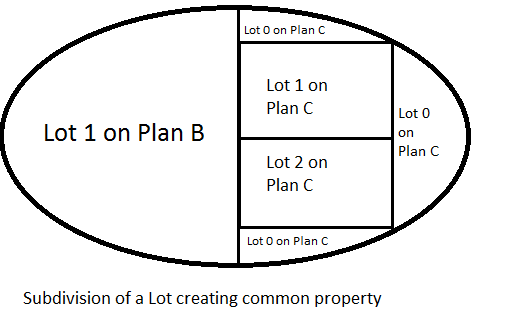
Subdivision creating common property

Who owns the leftover land?

Lot 1 and lot 2 on “Plan C” jointly own the land. It is common property.

To tie everything up nice and neat and legal that common property is assigned the real property address lot 0 on “Plan C”. At the same time the “Body Corporate for Example Community Title Scheme xxxxx” is created as the owner of lot 0 on “Plan C”.

Who owns the “Body Corporate for Example CTS xxxxx”?

The owners of lot 1 and lot 2 on “Plan C” jointly own the common property so they jointly own the body corporate created to hold and manage that land. It is held for their joint benefit. It is also their joint responsibility to care for that land, or rather the mechanism that owns that land, the body corporate.

Lot 1 and Lot 2 on “Plan C” can both be sold as individual lots, however, what’s transferred at time of sale is not just the lot, but also a proportion of ownership in the body corporate.

This is a very simplistic example of a subdivision. That said, its the same process for all body corporates in Queensland, from duplex’s to those with hundreds of lots.

guest

0 Comments
Oldest
Newest Most Voted

Ask a Body Corporate Question Terms

  1. Purpose of the form

The Ask a Body Corporate Question form allows readers to submit general questions that may be answered through existing or future Body Corporate Blueprint content.

The form is intended to help identify subjects that buyers, owners and other readers would like to understand. It is not intended to provide advice about a particular body corporate, property, dispute or transaction.

  1. General information only

Information provided in response to a question, or published in the Body Corporate Blueprint, is general educational information.

It does not constitute legal, financial, engineering, building, insurance or other professional advice. You should obtain appropriate professional advice about your particular circumstances before acting or relying on general information.

  1. No professional engagement

Submitting a question does not engage MyBodyCorpReport to inspect records, investigate a matter, prepare a report or provide professional advice.

No client or professional relationship is created by submitting a question or receiving a response.

  1. No guaranteed response

Submission of a question does not guarantee that it will be answered individually or used in published content.

Questions may be declined, edited, combined with similar questions or held for possible future use. It may not be possible to respond to questions that require examination of body corporate records, contracts, plans, reports or other supporting information.

This form should not be used for urgent, time-sensitive or transaction-specific enquiries.

  1. Protecting privacy and confidentiality

Please do not include:

• the name or address of a body corporate or property
• a community titles scheme number or lot number
• the names or contact details of other people
• confidential correspondence or records
• allegations identifying a particular person or organisation
• sensitive personal, financial, medical or legal information.

MyBodyCorpReport may remove identifying information from a question. However, you are responsible for ensuring that information you submit is appropriate to share.

  1. Use of submitted questions

By submitting a question, you give MyBodyCorpReport permission to:

• consider it for an individual response
• use it to identify possible article or resource topics
• edit it for clarity and relevance
• combine it with similar questions
• reproduce or discuss it anonymously in general educational content.

Your name, email address and other identifying information will not be published with the question without your permission.

  1. Personal information

Any name and email address supplied through the form will be used to administer the submission, contact you about your question where appropriate and notify you if relevant content is published.

Personal information will be handled in accordance with the MyBodyCorpReport Privacy Policy.

Submitting a question will not automatically add you to a marketing mailing list. Any consent to receive newsletters or promotional communications will be requested separately.

  1. Questions requiring individual assessment

A general question may help explain what a document, event or warning sign could mean. Determining what it means for a particular body corporate usually requires consideration of its records and individual circumstances.

If you require an assessment of a particular scheme, a body corporate records search or another appropriate professional service may be required.