



Who pays when a roof leaks, a window needs replacing or the building needs painting—the body corporate or the lot owner? Body corporate maintenance responsibilities need careful consideration.
In Queensland, an important part of the answer is whether the property is registered under a building format plan or a standard format plan.
The usual starting point is that the body corporate maintains common property and owners maintain their lots. But there are exceptions. Knowing where the boundary lies is essential, and so is understanding the maintenance obligations that apply.
This guide focuses on Queensland community titles schemes governed by the BCCM Act 1997.
Start with the registered plan
Before deciding who should arrange or pay for repairs, establish:
- The scheme’s plan of subdivision.
- The boundaries of the affected lot and common property.
- The applicable regulation module, recorded in the community management statement.
- Any relevant exclusive use by-law or approval for an owner’s improvement.
The registered survey plan and community management statement serve different purposes. You may need both.
A townhouse is not automatically on a standard format plan. Townhouses, villas and duplexes can also use building format plans.
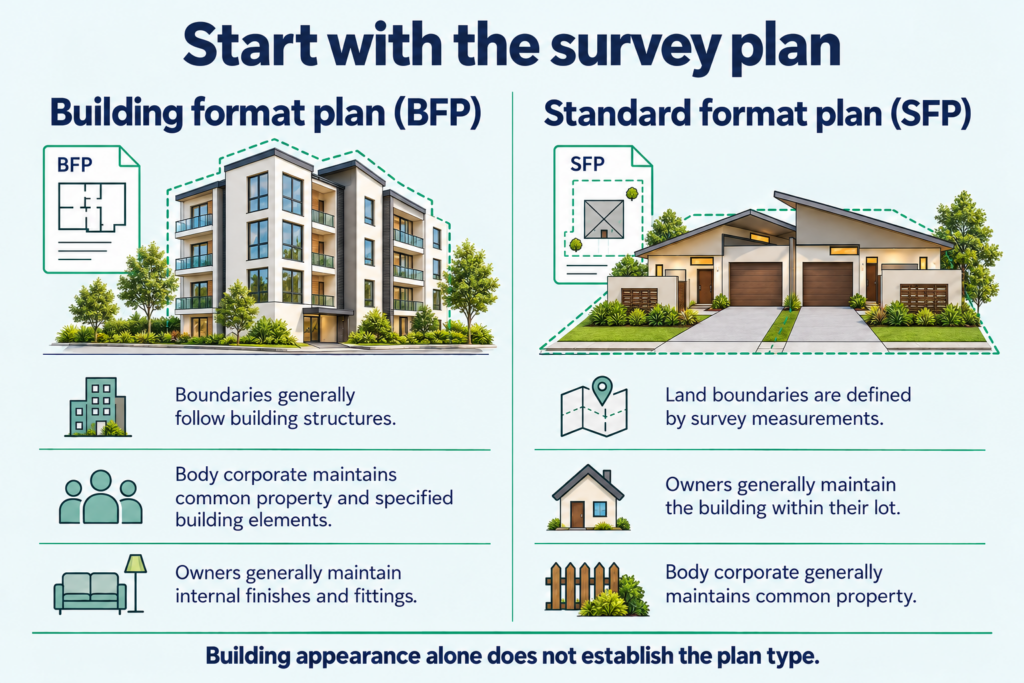
What is the difference between the plans?
The difference between the plans relates to where the boundaries are measured for each type.
A building format plan commonly defines boundaries by reference to building structures. Where a floor, wall or ceiling separates a lot from another lot or common property, the boundary is generally its centre.
A standard format plan defines boundaries using survey measurements and reference marks. In a standard format plan owners are buying a piece of land. That land commonly includes a building and its surrounding yard all contained within the boundaries of the lot.
The practical difference is that an owner under a standard format plan will usually have more responsibility for maintaining the building within their lot.
Who usually maintains what?
This is a starting guide only and will differ based on things like exclusive use and boundaries. The registered plan, applicable legislation and relevant exceptions must be checked for the particular property.
| Item | Building format plan | Standard format plan |
|---|---|---|
| Building roof and foundations | Usually body corporate responsibility, including specified structural obligations within lots. | Usually the owner’s responsibility where within the lot. Shared structures need closer assessment. |
| Exterior repainting | Usually the body corporate where the surface is common property. | Usually the owner where the building is within their lot. |
| Doors and windows | Usually the body corporate where in a boundary wall between a lot and common property; otherwise generally the owner. | Generally the owner where within their lot. If within a common property structure body corporate. |
| Internal finishes and fittings | Generally the owner. | Generally the owner. |
| Common-property roads, gardens and facilities | Generally the body corporate. | Generally the body corporate. |
| Gardens and driveways within a lot | Generally the owner. | Generally the owner. |
| Boundary fencing | Generally the body corporate. | Generally the body corporate. |
| Interior fencing | Dividing fences act applies - owner(s) responsible their lot, the body corporate common property. | Dividing fences act applies - owner(s) responsible their lot, the body corporate common property. |
See the Queensland Government’s detailed guidance for building format plans and standard format plans.
Balconies need a closer look
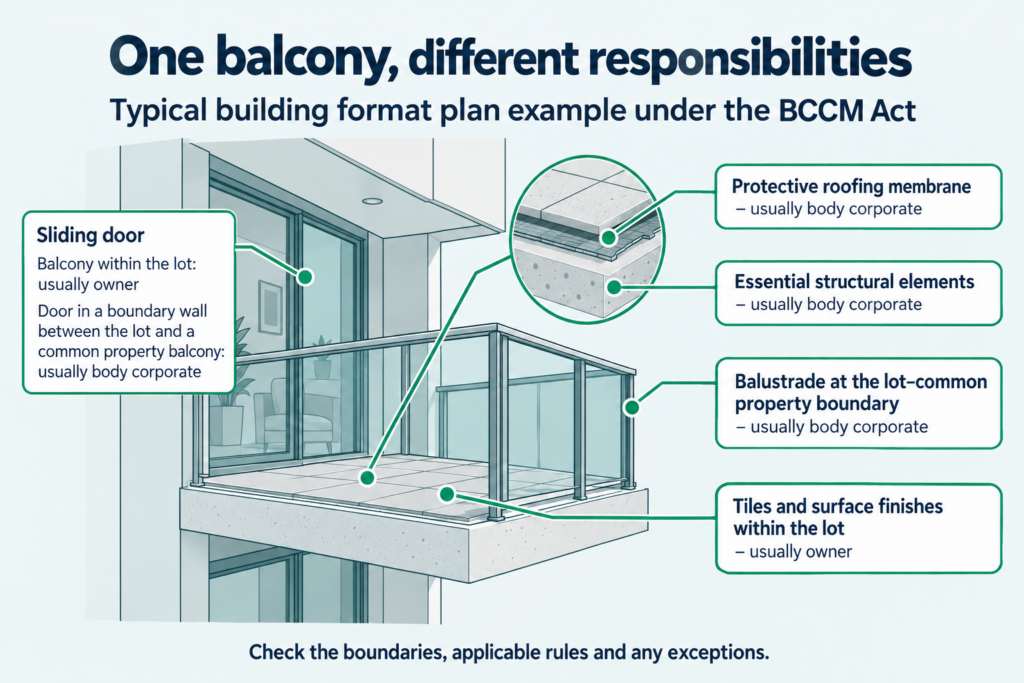
A balcony can involve several different responsibilities.
In a building format plan, even a balcony within a lot may have structural elements, boundary balustrades or a protective roofing membrane that the body corporate must maintain. Tiles and other finishes may fall to the owner.
Avoid treating the entire balcony as one item. Identify the component needing work.
Plumbing and electrical services do not simply stop at the boundary
A pipe inside your lot is not necessarily your responsibility.
Under the general utility infrastructure rules, the infrastructure is excluded from common property only where it:
- Supplies a service to that lot alone.
- Is within the lot’s boundaries.
- Is not within a boundary structure.
All three conditions matter.
A shared pipe may therefore remain a body corporate responsibility even where it passes through a lot. Conversely, particular equipment serving one lot, such as an individual air-conditioning or hot-water system, can remain the owner’s responsibility despite being on common property.
For a plumbing or electrical problem, establish both the location and what the infrastructure services.
What about exclusive use car spaces and courtyards?
Exclusive use gives a lot owner particular rights over common property. It does not turn that area into part of the lot.
However, the lot owner will be responsible for maintaining and paying any operating costs relating to the exclusive use area unless the by-laws says differently. Read the by-laws actual wording for clarity. If the by-law is unclear the provisions of the applicable act with apply.
Similarly, responsibility for an owner-installed improvement should be checked against the applicable rules and its approval conditions.
“Maintenance” does not extend to structural elements of an exclusive use area.
If the body corporate insures it, does the body corporate maintain it?
Not necessarily.
Building insurance and maintenance are separate issues. A body corporate may insure a building even though the owner is responsible for maintaining parts of it.
For example, in a standard format plan, the body corporate generally must insure buildings sharing a common wall. That does not automatically make routine roof repairs or exterior painting a body corporate expense.
For damage that might be insured, check the policy as well as the maintenance position. Who maintains the item, whether the damage is covered and who pays an excess are separate questions.
Can the body corporate arrange work that owners must pay for?
There are circumstances where the body corporate can carry out maintenance and bill it to the owner later.
For example, an agreed arrangement may allow the body corporate to organise maintenance for an owner and charge that owner for the service. This is common in standard format plan schemes where the body corporate may arrange exterior repainting to take advantage of economies of scale then enter an agreement with each individual owner for repayment.
There are also circumstances where a body corporate can undertake required maintenance an owner has failed to perform and recover the reasonable cost. For instance repair of a shower leaking from one lot into another. This is a lot owner cost, but the body corporate became involved due lack of action or timing concerns.
That does not mean a majority vote can simply transfer owners’ private maintenance expenses to the body corporate’s general funds. Establish the proper basis for both the work and the charges.
What should you do when responsibility is unclear?
Describe the problem precisely. “The balcony needs repairs” is less useful than identifying damaged tiles, a leaking membrane or deteriorating structural concrete.
Then bring together the relevant evidence:
- The survey plan, to establish boundaries.
- The community management statement, including applicable by-laws.
- Any approval records, particularly for alterations or improvements.
- Professional findings, where the cause or affected component is uncertain.
- Committee correspondence and decisions, explaining the proposed response.
If the plan is difficult to interpret, a surveyor may be needed. If the cause of the damage is unclear, an appropriate building professional may need to investigate.
Seek agreement about responsibility before commissioning non-urgent work on the assumption that someone else will reimburse you. Immediate safety concerns should be raised promptly.
The question is not simply, “Is this inside my unit?” It is: what needs repairing, where is it, and which maintenance obligation applies?
Those answers give owners and committees a much firmer basis for deciding who should arrange the work and who should pay.
This article provides general information only. It is not legal, financial, engineering or building advice. The circumstances of every body corporate are different. Obtain advice from an appropriately qualified professional where necessary.