


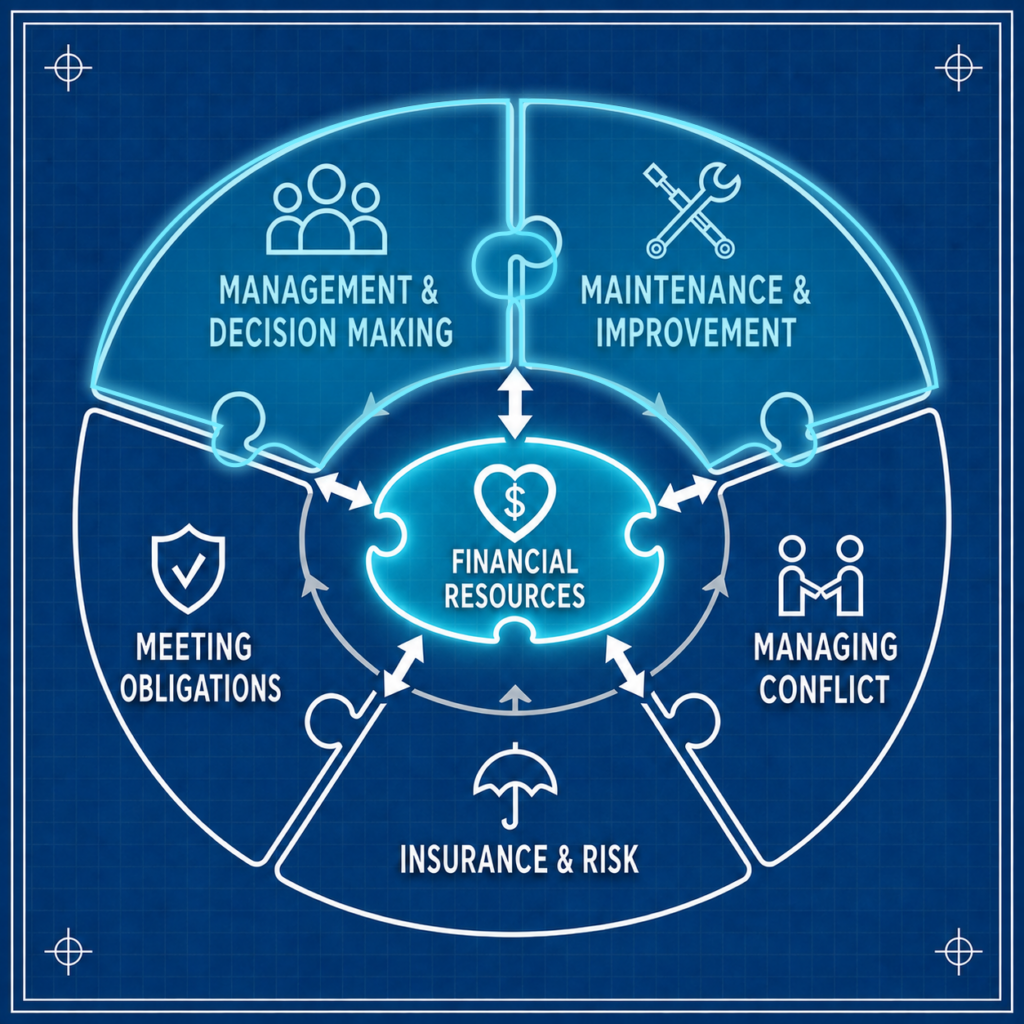
Capital works in a body corporate usually follow a process.
- A problem is identified.
- The cause is investigated.
- Recommendations are made for repair.
- A scope of works is developed to fulfil the recommended repairs.
- Tenders or quotes are obtained.
- Funding of the works is arranged.
- Works and funding are approved by owners.
- The work proceeds.
Then the body corporate has to determine whether the original problem has actually been resolved.
Sometimes that process moves smoothly. Sometimes it takes years.
For a buyer, the important question is often not simply: Are there major works? It is: Where is the body corporate in the process?
What counts as major works?
Major works may involve planned maintenance, building defects, improvements, or a combination of these.
Examples include:
- exterior painting
- concrete spalling repairs
- waterproofing membrane works
- roof repairs or replacement
- window replacement
- lift refurbishment or replacement
- road resurfacing
- plumbing infrastructure
- balustrade replacement
- fire safety system rectifications such as replacement of sprinklers or fire alarm panel
- common property refurbishment
Some projects are expected and planned well in advance. Others arise suddenly because a defect or failure has been identified.
Either way, most major projects move through a similar sequence.
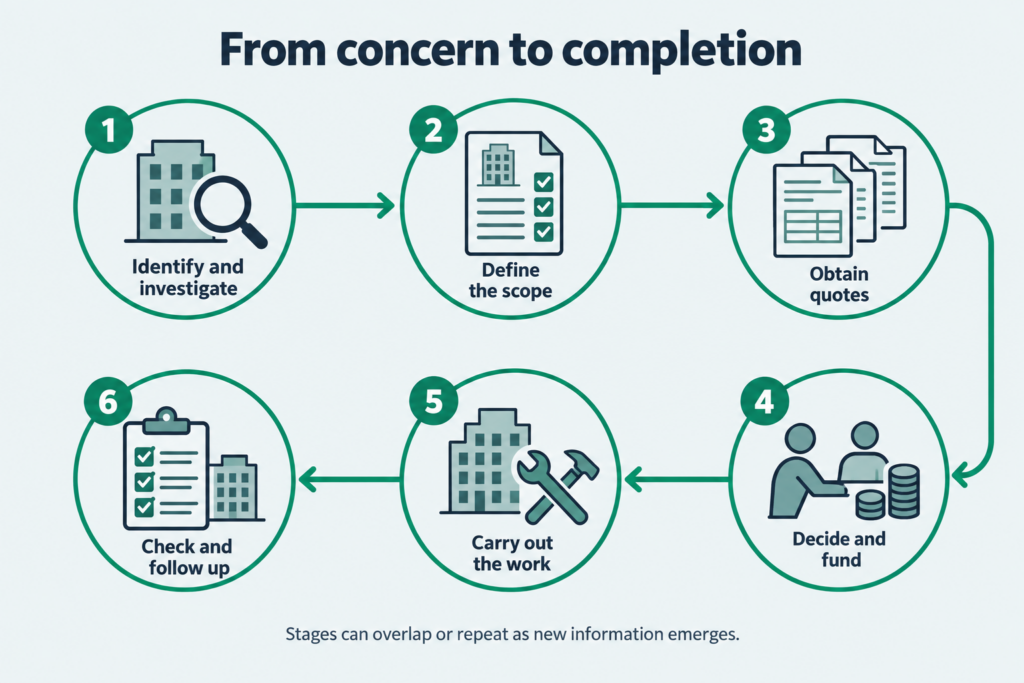
1. A problem is identified and the issue is investigated
The process usually starts with a sign that something needs attention.
That may be an owner reporting water ingress, cracking appearing in a wall, a contractor identifying deterioration, or a sinking fund forecast flagging future replacement.
At this stage, the body corporate may only know the symptom.
Water appearing inside a lot does not necessarily identify where it is entering. Cracking does not by itself identify the cause.
The next step is usually investigation. Some problems can be dealt with quickly. Others require specialist advice from an engineer, building consultant, waterproofing consultant or other expert.
The investigation may consider:
- what is causing the problem
- how extensive it is
- whether it is urgent
- what work is required
- whether there are different repair options
This is also where projects can begin to stall. Repeated minor repairs without a clear diagnosis may indicate that the underlying cause has not yet been resolved.
2. Recommendations for repair and a scope of works to be completed are developed
Once the problem is better understood, the body corporate needs to decide what work should actually be done.
That may involve:
- specialist recommendations
- further investigation
- repair options
- preparation of a scope of works
- staging the project
- considering related works
The scope turns a broad problem into a defined project.
Instead of: The building has water ingress the records may progress to: Replace the failed waterproofing membrane and repair associated damage.
That is an important step forward.
3. Quotes or tenders are obtained
Once the proposed work is sufficiently defined, the body corporate can seek prices.
Major works usually fall outside the schemes major spending limits so multiple quotes will be required. For less compliacated projects the body corporate may approach contractors directly for quotes. Larger projects may go through a formal tender process. A specialist project manager may be appointed at this stage to review the quotes and provide advice to committee on whether the quotes will adequately address the scope of works.
For records review, one distinction is particularly important: A quote shows that work was considered. It does not show that the work was approved or completed.
If quotes appear repeatedly over several years, the next question is:
- What happened after the quote was obtained?
- Was a contractor selected?
- Was expenditure approved?
- Was funding available?
- Did the work proceed?
4. Works are approved and funding arranged
Once the proposed solution is solidified the body corporate must approve the works. How that happens will depend on the regulation module and spending limits of the scheme. Approval by owners at general meeting are likely to be required. The type of motion will depend on the amount of type of works.
Minutes of meeting should show that multiple quotes were considered and:
- a contractor is selected
- approval of expenditure
- authority to enter into a contract
- approval of additional funding
This stage can take time. Owners may disagree about cost, timing, scope or whether the work is necessary. Further reports or quotations may be obtained before a decision is made.
Where the same issue appears repeatedly without a clear decision, the project may effectively be stalled.
Funding may come from:
- existing sinking fund savings
- current contributions
- additional contributions
- a special levy
- borrowing
- insurance
- a settlement or recovery
- a combination of sources
For buyers, this stage is particularly important. Funding may have been decided but it may not yet have been collected. Alternatively if a loan has been entered then the buyer will be taking on the debt as part of their purchase.
5. The works proceed
Once approvals and funding are in place, the project can begin.
Large projects do not always run exactly to plan. There may be:
- delays
- access issues
- contractor availability problems
- scope changes
- additional defects
- variations
- extra costs
These issues do not necessarily mean the project has failed. They simply form part of the project history.
For records review, evidence that work has actually commenced is more meaningful than evidence that it was merely approved.
6. Completion is not always the end
Once the work is finished, there may still be follow-up.
The body corporate may need to deal with:
- defects in the completed work
- further testing
- monitoring
- recurring symptoms
- contractor callbacks
- additional recommendations
A statement that works were “completed” does not always mean the original issue has been permanently resolved.
Later records can be just as important as the records leading up to the work
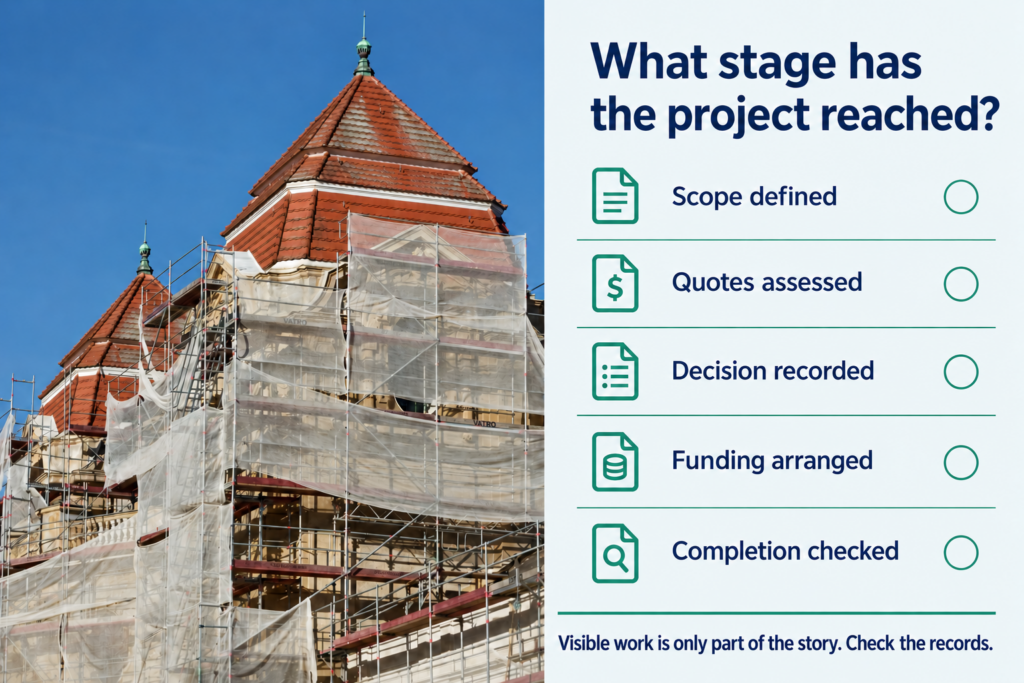
Where is the project now?
When reviewing body corporate records, it is useful to identify the current stage of the project. A project may be:
- Identified – the problem or need has been recognised.
- Under investigation – the cause, extent or response is still being determined.
- Recommended or scoped – work has been recommended or a scope prepared.
- Quoted or tendered – costs are still being established.
- Approved – the body corporate has decided how to proceed.
- Funded – the source of funding has been determined and collected.
- Underway – the work has commenced.
- Completed – the work is completed.
- Under review – further rectification , monitoring or follow-up is occuring.
- Unresolved – the issue continues to appear in the records without a clear parth to completion.
Why the stage matters in a Pre Purchase Strata Report
A project that has been scoped, priced, approved and funded presents a different level of uncertainty from one that has only just been identified.
If the cost is still unknown, future levy exposure may also be uncertain.
Consider two schemes.
In the first:
- a defect has been identified
- an engineer has been engaged
- no scope has been finalised
- no quotes have been obtained
- the cost is unknown
In the second:
- the scope is complete
- the cost is known
- a contractor has been selected
- funding has been approved
- the work is scheduled
Both schemes have major works.
But the level of uncertainty for a buyer is very different.
That is why a Pre-Purchase Strata Report should not simply identify that major works exist. It should help establish where the project sits in the process, what has already happened, and what remains unresolved.
When the process stalls
Major works do not always progress neatly from one stage to the next.
The process may stall because:
- the cause remains uncertain
- experts recommend different approaches
- the scope changes
- costs increase
- funding is insufficient
- owners reject a proposal
- other projects become more urgent
- disputes arise
- completed work fails to resolve the problem
Sometimes the records show years of movement between investigation, quotation and discussion. That does not necessarily explain why the delay occurred. But it is a reason to look more closely.
Follow the process for capital works in a body corporate, not just the headline
This article provides general information only. It is not legal, financial, engineering or building advice. The circumstances of every body corporate are different. Obtain advice from an appropriately qualified professional where necessary.