



Painting may be predictable, but the preparation, access, repairs and funding can turn it into one of a body corporate's largest maintenance projects.
Exterior repainting happens more often than many owners expect. It is usually routine maintenance, but it rarely involves paint alone. Access can be expensive, hidden façade defects may emerge during preparation, and the total cost can place real pressure on a scheme that has not been saving adequately.
For buyers and owners, the important question is not simply when the building was last painted. It is whether the body corporate has inspected, planned and funded the next project—and whether the proposed scope deals with the condition of the building beneath the paint.
Why exterior repainting matters
Exterior coatings maintain appearance, but they also help protect exposed building surfaces from weathering. On concrete and rendered buildings, the coating system forms part of the façade’s protection. On timber and other substrates, deterioration of the coating can leave the material more exposed to moisture and ultraviolet light.
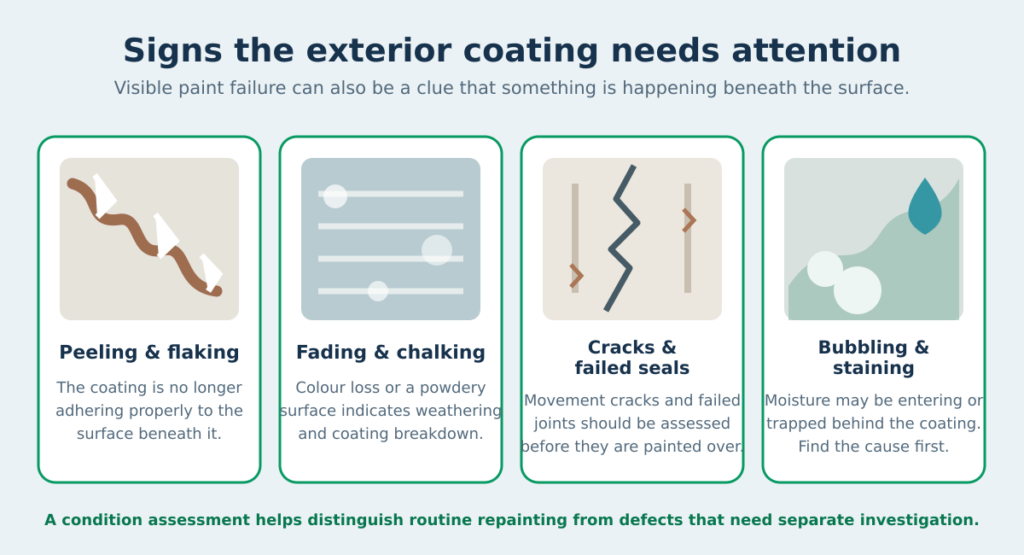
That does not make paint a substitute for waterproofing or building repairs. Moisture trapped behind a coating can produce bubbling, blistering or peeling. Rust staining, cracking, efflorescence and concrete spalling may point to issues that need to be investigated and repaired before the final coating is applied.
Even schemes dominated by face brick usually have painted elements: slab edges, balustrades, soffits, fascia, gutters, doors, trim and other external components.
How often should a building be painted?
There is no single repainting interval that suits every body corporate. A sinking fund forecast will usually nominate a cycle based on the previous repaint, expected service life and estimated cost. A general rule of thumb used by those who prepare sinking fund forecasts is every 8 – 12 years, depending on several factors.
The actual timing should then be tested against the condition of the building.
Factors that can shorten or extend the cycle include:
- the coating system and quality of the previous preparation;
- the building material and condition of the substrate;
- coastal exposure, traffic pollution, ultraviolet light and prevailing weather;
- dark colours or elevations receiving intense sun;
- regular washing and other façade maintenance; and
- moisture, cracking, efflorescence, corrosion or other underlying defects.
Forecast versus condition The sinking fund forecast tells the scheme when expenditure is expected. An inspection tells when work is actually required. A sound project uses both.
What should happen before quotations are obtained?
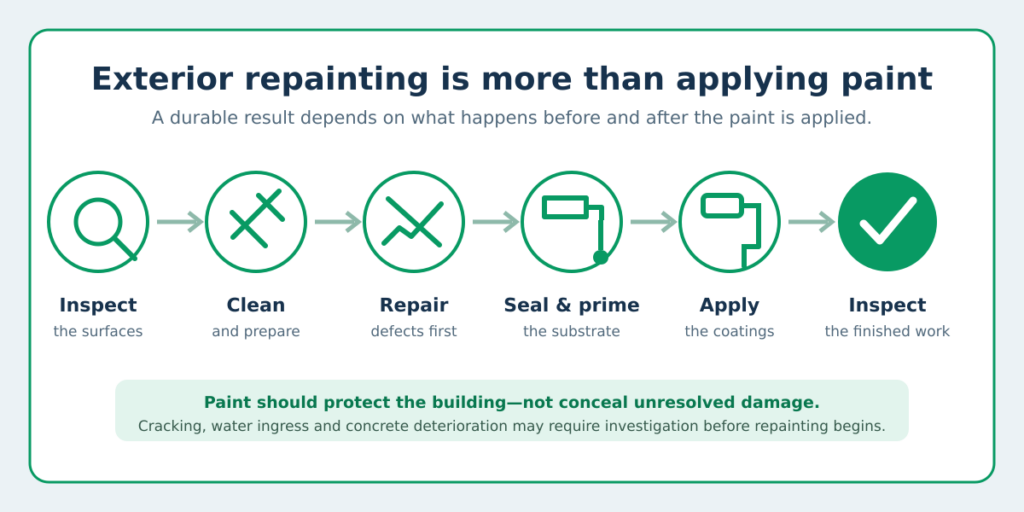
For a smaller, straightforward scheme, obtaining quotations may be a sensible starting point. For a large building—or where there are signs of deterioration—the better first step may be a façade inspection and a clear scope of work.
Preparation can uncover repairs that are not obvious from ground level. Depending on the building, the scope may need to address:
- cracked, drummy or deteriorated render;
- concrete spalling and reinforcement corrosion;
- failed sealants around joints, windows and doors;
- waterproofing or drainage defects;
- rusting metalwork; and
- safe access, protection of property and management of occupants during the works.
On larger projects, a suitably qualified project manager, building consultant or engineer may help define the scope, run a tender, compare submissions, administer the contract and inspect the completed work. That costs money, but it can reduce the risk of comparing quotations that allow for different work—or discovering major variations after access has already been installed.
Bundling exterior repainting with other works
Access is frequently one of the largest project costs. Scaffolding, swing stages, elevated work platforms and rope access may be needed before anyone can inspect or work on the façade properly.
If access is already in place, it may be economical to combine repainting with concrete repairs, sealant replacement, roofing or gutter work, waterproofing repairs or other façade maintenance. This can alter the planned repainting date, but it may avoid paying for the same access twice.
Townhouse schemes may stage repainting across several sections or financial years. Staging can smooth cash flow, although the body corporate should consider price escalation, consistency of colour and finish, contract risk and whether delaying part of the work may allow deterioration to continue.
Who is responsibe for exterior repainting?
Responsibility depends on the location and ownership of the surface, the applicable regulation module and the scheme’s particular documents.
In a building format plan, the body corporate is responsible for maintaining common property including most exterior building elements.
In a standard format plan, the exterior of a building located within a lot is generally the lot owner’s responsibility, while the body corporate remains responsible for common property. A body corporate may sometimes arrange a painting service—such as coordinated exterior repainting—for areas owners are responsible for, with owners paying the cost.
Before assuming who must paint or pay, check the registered format plan, community management statement, any relevant by-laws and the boundaries of the precise surface involved.
Funding and approving the work
Painting common property is capital expenditure ordinarily met from the sinking fund. Ideally, the body corporate has been raising sufficient funds consistently that exterior repainting can happen routinely without further injection of funds.
If sufficent funds are not available the commitee will need to explore other funding options. Some painting contractors will offer payment terms over several years. Maintenance painting contracts are another option. Otherwise additional funds will need to be found which may mean increased sinking fund contributions, special levies or strata loans.
Approval of the works must be obtained prior to entering the contract. The approval pathway depends on the applicable regulation module, cost of the work, and the scheme’s spending limits:
- The committee can generally approve expenditure within its committee spending limit.
- If the proposed expenditure is above committee spending limit, an ordinary resolution at a general meeting will be required. If the cost is more than $2,000 per number of lots or is considered an improvement then a special resolution will be required.
- The major spending limit principally determines whether two quotations are required; it is not, by itself, the line between committee and general-meeting approval.
- If repainting includes an improvement rather than maintenance—for example, a material change to the appearance—the improvement provisions and their approval thresholds may also apply.
A change of colour does not automatically mean that a special resolution is required. The correct resolution depends on whether the proposal is an improvement, its cost, the applicable regulation module and any scheme-specific architectural controls. The motion and approval requirements should be checked before owners vote.
What should the body corporate records show?
The body corporate records should reveal a progression from forecast to inspection, scope, approval and completion. Look for:
- the sinking fund forecast and annual budgets;
- committee or general meeting minutes discussing condition, timing and funding;
- façade, engineering, building or condition reports;
- the scope of work and any tender documents;
- quotations, tender comparisons and the approved motion;
- the contract, variations and project-management reports; and
- completion inspections, warranties and maintenance instructions.
Where formal committee meetings are infrequent, useful evidence may instead sit in correspondence, meeting attachments, budgets, explanatory notes and notices of general meeting.
What would concern me if I saw it in the records?
I would look more closely where:
- the forecast shows repainting is due but savings are materially behind;
- the work has been repeatedly postponed without a condition assessment;
- obvious bubbling, cracking, rust staining, spalling or moisture issues are being treated as paint defects;
- quotations have been obtained without a consistent scope of work;
- the contract price leaves no realistic allowance for repairs or variations;
- the scheme intends to paint over known defects; or
- the records show repeated cosmetic work without addressing the underlying cause.
The takeaway
Exterior repainting is predictable enough to plan for, but important enough not to reduce to a line in the sinking fund forecast. Good schemes monitor the façade, investigate defects, define the work properly and save for the full project—including access, repairs and professional oversight where needed.
The paint is the visible finish. The real story is the condition of the surface underneath, the quality of the planning and whether the body corporate has the funds to act when the work is required.
This article provides general information only. It is not legal, financial, engineering or building advice. The circumstances of every body corporate are different. Obtain advice from an appropriately qualified professional where necessary.