


Insurance is one of the largest recurring expenses for many bodies corporate, but the premium itself tells only part of the story.
For a buyer reviewing body corporate records, the more useful questions are often:
- What is insured?
- Is the building insured for an appropriate replacement value?
- Have there been significant claims?
- Are premiums or excesses changing?
- Is an insurance issue actually pointing to a larger maintenance or building problem?
Body corporate insurance can therefore provide useful information about both the financial position of a scheme and the risks affecting the property.
Body corporate insurance: what must be insured
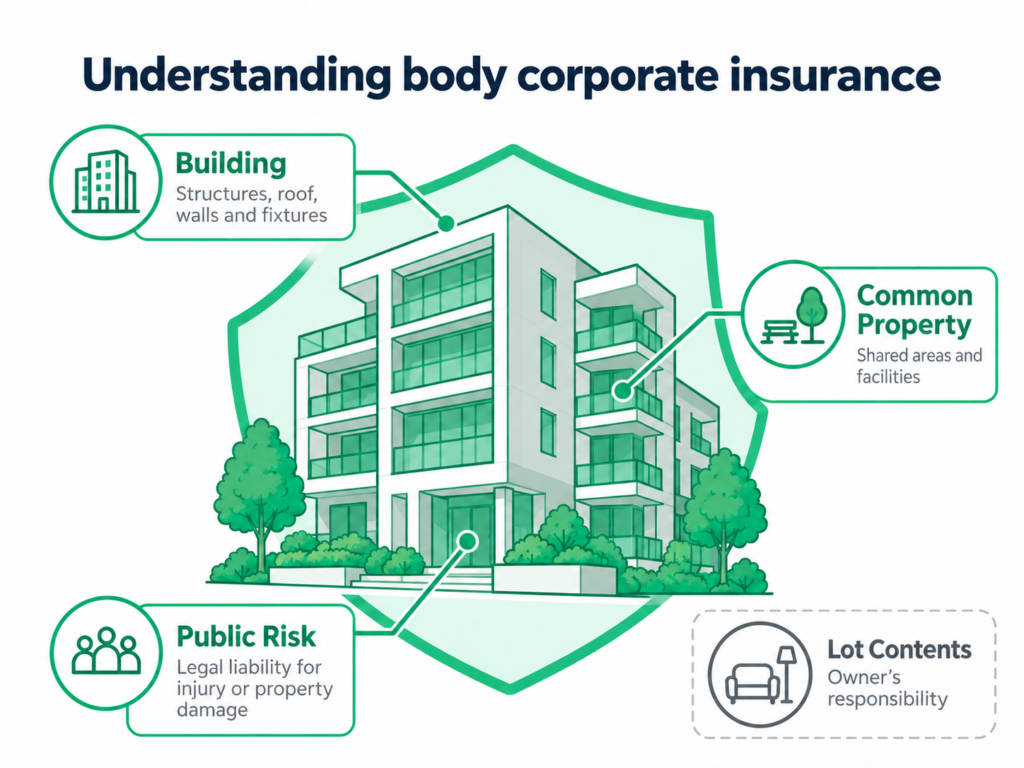
In Queensland, a body corporate is generally required to insure:
- common property
- body corporate assets
- protect the public against risk on the property
- any building that contains a lot if required under legislation
What is included in “common property” depends on the type of body corporate. The common property many encompass the boundaries of all the lots, such as a highrise or industrial complex. These are building format plan schemes. Legislation requires the body corporate insure the buildings if the scheme is a building format plan.
If the scheme is townhouse development or residential neighbourhood the scheme may be a standard format plan. If the body corporate is a standard format plan the common property does not include the exterior of strucutres. However, if the lots have adjoining walls, then legislation requires the body corporate insure the buildings.
If the lots are freestanding then owners will be required to insure their own structures. The body corporate will insure common property only.
Owners are required to insure their own contents.
The building must be insured for replacement value
Where the body corporate is required to insure a building, the legislation generally requires insurance for its full replacement value.
The policy must cover damage and the associated costs of reinstating or replacing the insured building, including costs such as debris removal and relevant professional fees.
The body corporate must also obtain an independent insurance valuation at least every five years for buildings it is required to insure.
The valuation is not a property-market valuation.
Its purpose is to estimate what it would cost to reinstate the insured building.
That distinction is important when reviewing body corporate records. A building may have a market value of one amount and an insurance replacement value of something entirely different.
What should you look for in an insurance valuation?
For a pre purchase strata report, the valuation is useful for more than confirming that one exists.
Questions include:
- When was the valuation completed?
- What replacement value was recommended?
- Has the insurance cover been updated to reflect it?
- Is another valuation becoming due?
- Has there been substantial building work since the valuation?
- Has the replacement value increased significantly?
An old valuation is not automatically evidence of a problem, but the five-year requirement provides a useful benchmark when reviewing the records.
Body corporate insurance premiums can tell a story
- recent claims
- changes in insurers
- increasing excesses
- building defects
- risk-reduction requirements
- valuation increases
- difficulty obtaining cover
- exclusions or special conditions.
Insurance claims and maintenance are not the same thing
This is an important distinction.
Insurance generally responds to insured damage. It does not replace the body corporate’s responsibility to maintain the property. For example, a storm may cause water damage inside a building and that resulting damage may form part of an insurance claim.
But if water entered because an ageing waterproofing membrane has failed, repairing the underlying membrane may still be a maintenance issue.
The insurance claim and the building defect are therefore two related but different threads.
This distinction is particularly important in records involving:
- water ingress
- roof leaks
- burst pipes
- storm damage
- fire
- structural damage
- repeated claims.
A claim being accepted does not necessarily mean the underlying problem has been resolved.
Repeated body corporate insurance claims deserve a closer look
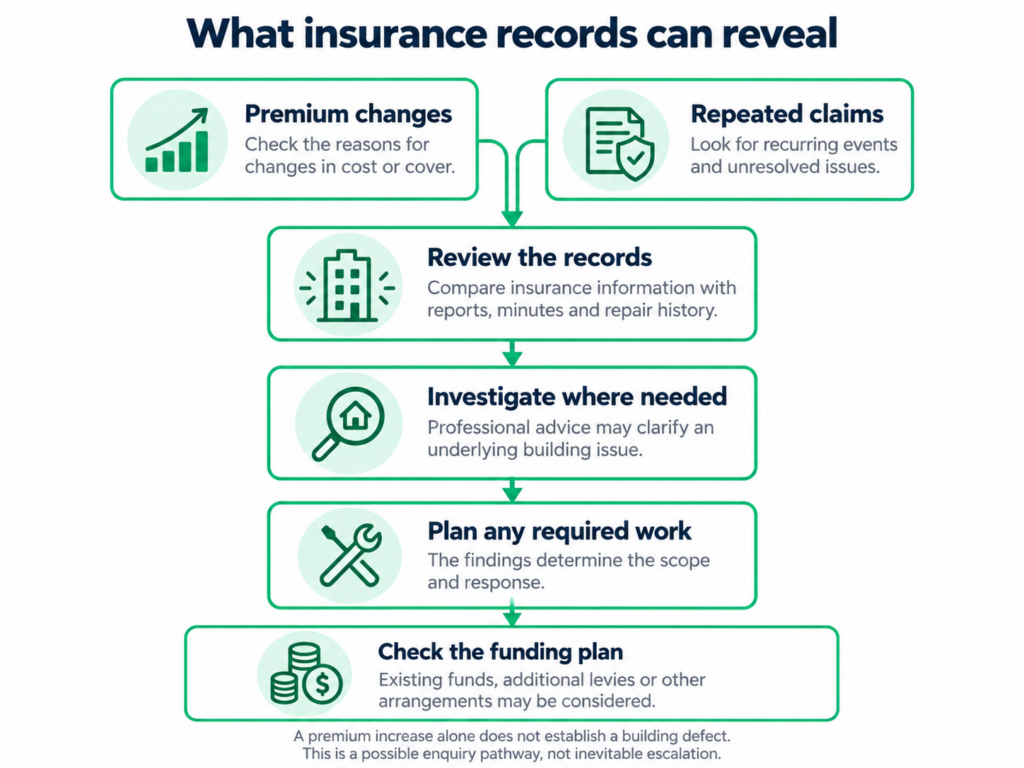
One insurance claim may simply reflect an isolated event. Repeated claims relating to similar damage can be more significant.
If several claims refer to water entering the same area, for example, ask:
- Is this one continuing problem?
- Has the source been identified?
- Were repairs completed?
- Did the problem recur?
- Is the insurer requiring further work?
- Has the excess changed?
- Is the issue affecting future cover or premiums?
This is where insurance connects directly with the Body Corporate Blueprint approach.
The insurance records may identify the consequence, while engineering reports, minutes, quotations and invoices reveal the underlying cause and the body corporate’s response.
What about insurance excesses?
An excess is the amount that must be paid towards an insurance claim before the insurer meets the balance of the covered loss.
Who pays the excess depends on the circumstances.
Queensland guidance notes that, broadly, an excess affecting only one lot will commonly be paid by that lot owner unless it would be unreasonable, while claims affecting multiple lots or common property will more commonly involve the body corporate paying the excess. The circumstances of the damage can affect that outcome.
For records review, large or increasing excesses can also be worth noting. An excess of $10,000 for water ingress claims indicates there may have been many claims made recently.
The existence of an excess is normal. What matters is whether the amount or the circumstances around it create a material issue for owners.
Public risk and other insurance
Bodies corporate are also required to hold public risk insurance for common property and relevant body corporate assets. Under the current Queensland regulations, the minimum required cover is $10 million for a single event and for the policy period.
A body corporate may also choose to hold additional forms of insurance, such as cover for committee members or other risks, depending on the circumstances of the scheme.
These additional policies can be useful, but they should not distract from the main questions about building cover, claims and risk.
Insurance information in body corporate records
Insurance appears in several places within the records.
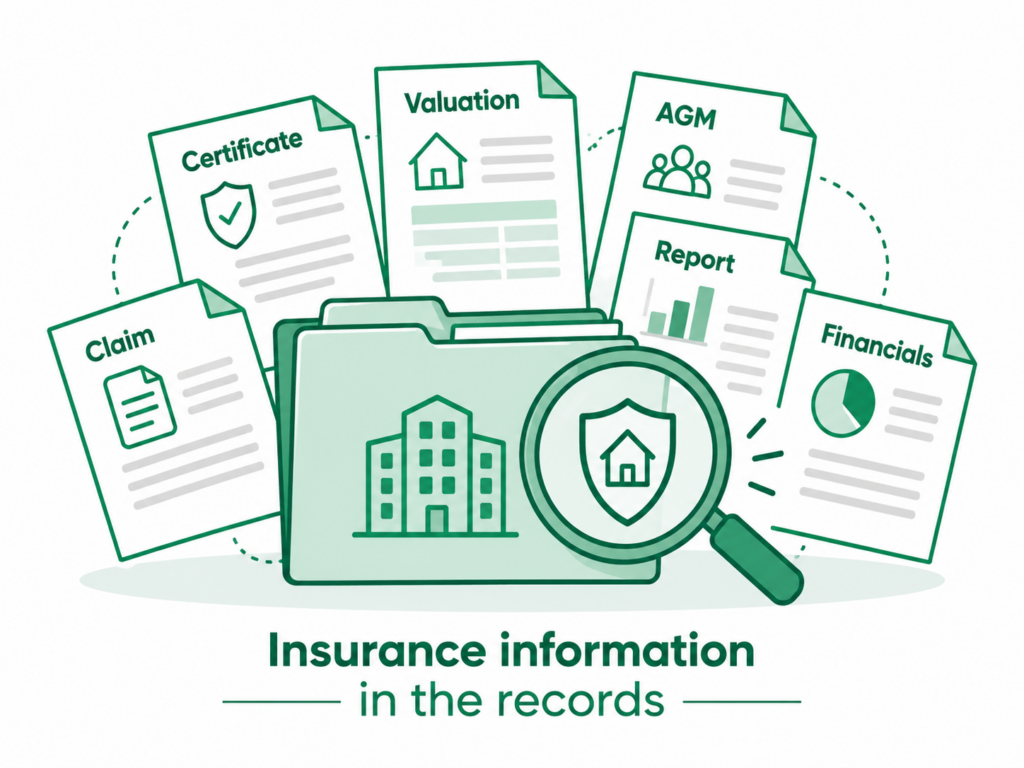
You may find information in:
- certificates of currency
- annual general meeting papers
- financial statements
- insurance valuations
- committee minutes
- claim correspondence
- assessor reports
- engineering or building reports
- invoices
- insurance renewal proposals.
No single document necessarily tells the whole story.
For example, the certificate of currency may show that insurance exists, while committee minutes reveal a significant claim, an engineering report identifies the cause, and the financial statements show the resulting excess or repair costs.
That is why insurance should be reviewed as a thread, rather than simply as a document to tick off.
Are there conditions, exclusions or other matters that deserve further investigation?
These questions help distinguish routine insurance administration from insurance records that may point to a larger issue.
Follow the issue beyond the insurance claim
Insurance is often not the beginning of a thread and it is not always the end.
A water-ingress claim may lead back to a waterproofing defect.
A large premium increase may lead back to repeated claims.
An insurer’s requirement may lead forward to major rectification works.
Those works may then lead to additional contributions or a special levy.
So when insurance appears in body corporate records, the most useful question is often:
What caused this — and what happened next?
That is where the insurance information becomes particularly useful in understanding the overall position of the body corporate.
This article provides general information only. It is not legal, financial, engineering or building advice. The circumstances of every body corporate are different. Obtain advice from an appropriately qualified professional where necessary.