

a serious body corporate defect

Lisa Rutland

Body corporate specialist

6 minutes read

A Serious Defect Has Been Identified: What Now?

Terms such as structural defect, waterproofing failure, concrete spalling, fire safety defect or major water ingress naturally attract attention. A serious body corporate defects identified is only the beginning of the story.

A defect may already have been thoroughly investigated, funded and scheduled for rectification. Another may have been discussed for years without the cause, cost or pathway forward being established.

The important question is therefore not simply:

Is there a serious defect?

It is: What do the records show has happened since the defect was identified?

A serious body corporate defect should be considered in context

An engineering or building report can provide important evidence about a problem, but one document rarely tells the whole story. The surrounding body corporate records may show:
  • when the issue was first identified;
  • what investigations have been undertaken;
  • whether the cause and extent have been established;
  • what rectification work has been recommended;
  • whether quotations or scopes of work have been obtained;
  • what decisions the body corporate has made;
  • how the proposed works will be funded;
  • whether another party may be involved in rectification or recovery; and
  • whether the matter has progressed, stalled or been completed.

Those pieces of information may appear across reports, meeting minutes, correspondence, quotations, financial records, insurance documents and other records over a considerable period of time. That is why a reference to a defect should not usually be considered in isolation.
A serious body corporate defect has been identified

What is actually known about the problem?

The first question is what the available records establish about the defect itself. Sometimes the initial reference is little more than a symptom. Water entering a lot, cracking to a wall, rust staining, movement or deterioration may indicate that further investigation is required. The visible problem is not necessarily the underlying cause. Later records may contain specialist reports identifying the cause and extent of the problem. Alternatively, they may show that investigations are continuing or that different professionals have reached different views. For someone reviewing the records, there is an important distinction between:
  • a problem being reported and
  • the problem being understood.
Where further investigation has been recommended, the eventual scope and cost of rectification may not yet be known.

Is there a pathway to rectification?

Once a defect has been investigated, attention usually turns to what happens next. The records may refer to:
  • further technical investigations;
  • preparation of a scope of works;
  • obtaining quotations or tenders;
  • selection of a contractor;
  • approval of proposed works;
  • funding arrangements;
  • commencement of works; or
  • inspection or testing following completion.
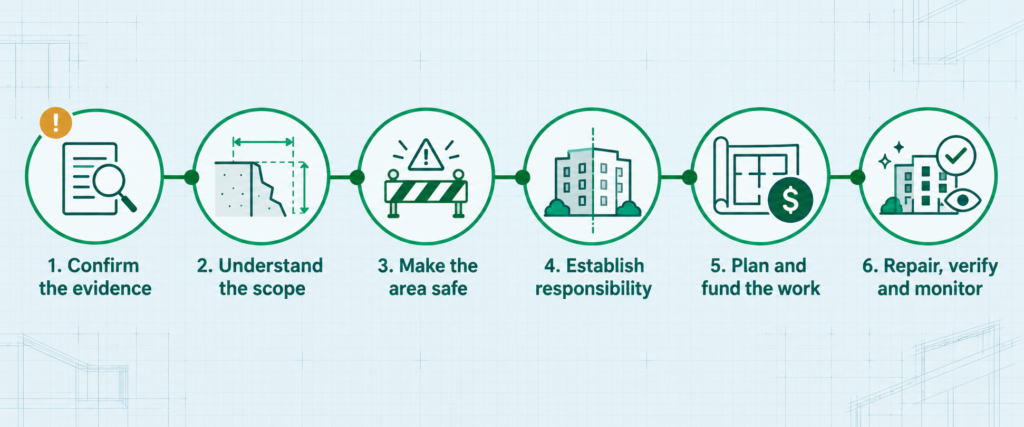
The presence of these records can help show how far the matter has progressed. Importantly, obtaining a report or quotation does not mean the defect has been rectified. Likewise, completion of repair work does not always establish that the underlying problem has been resolved. Depending on the nature of the defect, later inspections, testing or further periods of observation may be relevant.
Patheway for rectifying defects in common property

What will the works cost?

For owners, the financial consequences of a significant defect can be just as important as the technical problem. Early estimates can change as investigations progress. A preliminary quotation may be based on limited information. Later testing may identify additional areas requiring work, or a more detailed scope may produce a substantially different cost. The records may therefore contain several estimates or quotations prepared at different stages. The latest figure should be considered together with information about:
  • the scope on which it was based;
  • when it was prepared;
  • whether further investigations remain outstanding; and
  • whether funding for the proposed works has been addressed.
A large quotation does not automatically mean owners will be asked to pay that amount immediately. Existing funds, future contributions, special contributions, borrowing, insurance or recovery from another party may all be referred to in the records. What matters is what the records actually establish about the proposed funding.

Are recovery options being pursued?

Some defects involve a builder, developer, contractor, insurer or another party.

The records may refer to a warranty claim, QBCC process, insurance claim, legal advice or other attempts to recover the cost of rectification.

The existence of a possible recovery process should not be confused with a confirmed outcome.

There can be a considerable difference between:

  • a potential claim being discussed;
  • a claim having been commenced; and
  • money or rectification actually being received.

Where recovery is referred to, later records may provide useful information about how that process has progressed.

If no later outcome is available, it may be that its not been recorded or remains unresolved.

Progress over time can be important

One of the clearest pictures often emerges from looking at the same issue across several years.

For example, the records might show:

problem identified → engineering investigation → scope prepared → quotations obtained → works approved → rectification completed

That tells a very different story from:

problem identified → report obtained → quotation obtained → decision deferred → further report → new quotation → matter remains outstanding

Neither sequence by itself tells a buyer what decision to make.

It does, however, provide important context about the current position of the defect and the body’s corporate response to it.

This is also why delays can matter.

As time passes, the condition of a building may change, quotations may become outdated and new expenditure may arise. The records may also show why progress has been delayed—for example because further investigation was required, responsibility was disputed or funding needed to be arranged.

The chronology provides context.

Questions to consider when a serious defect appears in the records

Rather than stopping at the description of the defect, it can be useful to ask:
  • What exactly has been identified?
  • Has the cause and extent been investigated?
  • Are further investigations required?
  • What rectification work has been proposed?
  • Has a scope of works been prepared?
  • What cost information is available?
  • How is the work proposed to be funded?
  • Do the records refer to recovery from another party?
  • What decisions has the body corporate made?
  • What has actually happened since the problem was first identified?
  • What remains unresolved or is not sighted in records inspected?
These questions do not provide a conclusion about whether a property should or should not be purchased. They help put the available evidence into context.

Records are evidence, not conclusions

Body corporate records record what has been documented.

They do not necessarily contain every conversation, event or action that has occurred.

A report may be referred to but not supplied. Work may have been completed without later minutes recording the outcome. A claim may be managed by another party with limited information retained in the body’s corporate records.

For that reason, an absence of information should be described carefully.

There is an important difference between saying:

“The body corporate has not arranged funding.”

and:

“Funding arrangements were not sighted in records inspected.”

The second statement describes what the records establish without assuming what may have occurred outside them.

Records may not provide the complete picture, but they give us a place to begin.

Look for the whole thread

A serious defect is rarely just a maintenance issue.

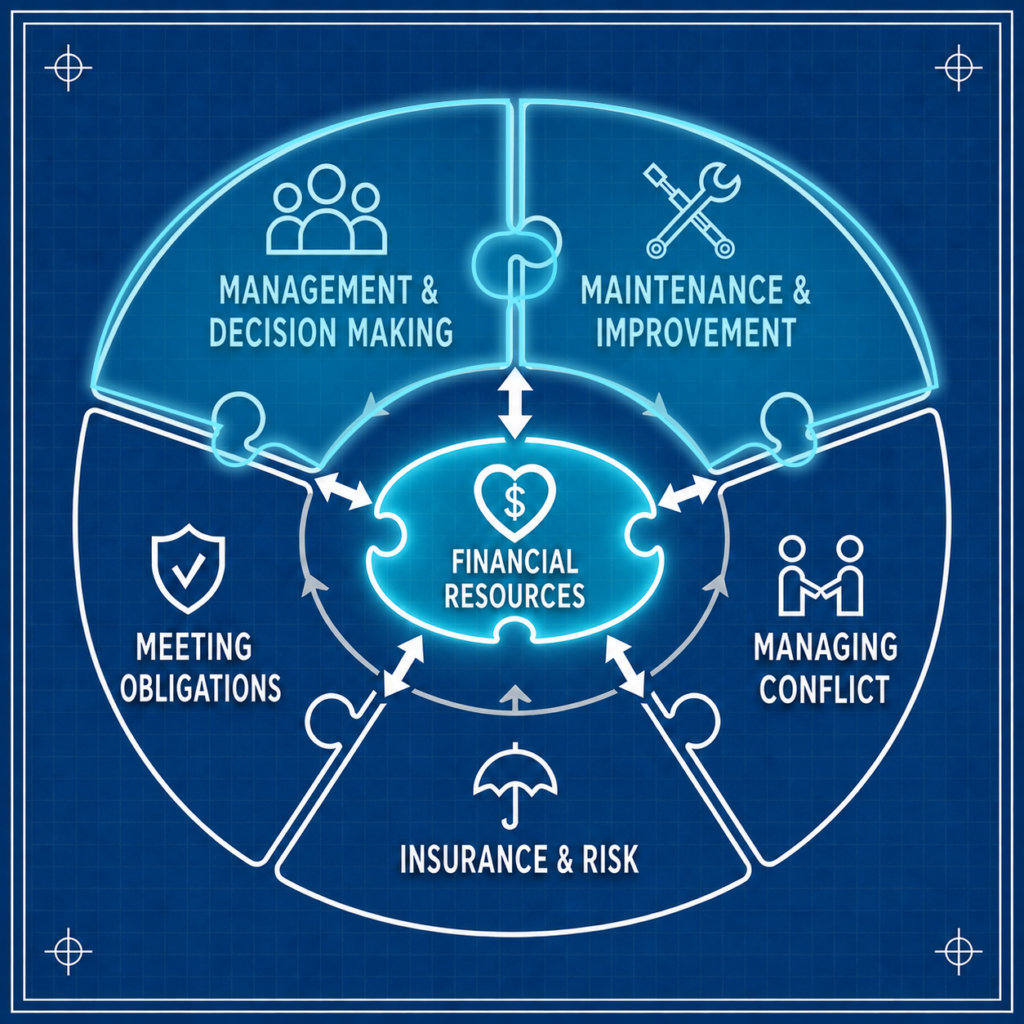
Depending on what happens next, it may also connect with financial resources, insurance, decision-making, disputes and the body’s corporate future maintenance obligations.

That is one of the reasons we use the Body Corporate Blueprint when looking at body corporate records.

The aim is not simply to identify isolated problems.

It is to understand how information contained across the records connects, what has happened over time and what matters remain unresolved.

This article provides general information only. It is not legal, financial, engineering or building advice. The circumstances of every body corporate are different. Obtain advice from an appropriately qualified professional where necessary.

guest

0 Comments
Oldest
Newest Most Voted

Ask a Body Corporate Question Terms

  1. Purpose of the form

The Ask a Body Corporate Question form allows readers to submit general questions that may be answered through existing or future Body Corporate Blueprint content.

The form is intended to help identify subjects that buyers, owners and other readers would like to understand. It is not intended to provide advice about a particular body corporate, property, dispute or transaction.

  1. General information only

Information provided in response to a question, or published in the Body Corporate Blueprint, is general educational information.

It does not constitute legal, financial, engineering, building, insurance or other professional advice. You should obtain appropriate professional advice about your particular circumstances before acting or relying on general information.

  1. No professional engagement

Submitting a question does not engage MyBodyCorpReport to inspect records, investigate a matter, prepare a report or provide professional advice.

No client or professional relationship is created by submitting a question or receiving a response.

  1. No guaranteed response

Submission of a question does not guarantee that it will be answered individually or used in published content.

Questions may be declined, edited, combined with similar questions or held for possible future use. It may not be possible to respond to questions that require examination of body corporate records, contracts, plans, reports or other supporting information.

This form should not be used for urgent, time-sensitive or transaction-specific enquiries.

  1. Protecting privacy and confidentiality

Please do not include:

• the name or address of a body corporate or property
• a community titles scheme number or lot number
• the names or contact details of other people
• confidential correspondence or records
• allegations identifying a particular person or organisation
• sensitive personal, financial, medical or legal information.

MyBodyCorpReport may remove identifying information from a question. However, you are responsible for ensuring that information you submit is appropriate to share.

  1. Use of submitted questions

By submitting a question, you give MyBodyCorpReport permission to:

• consider it for an individual response
• use it to identify possible article or resource topics
• edit it for clarity and relevance
• combine it with similar questions
• reproduce or discuss it anonymously in general educational content.

Your name, email address and other identifying information will not be published with the question without your permission.

  1. Personal information

Any name and email address supplied through the form will be used to administer the submission, contact you about your question where appropriate and notify you if relevant content is published.

Personal information will be handled in accordance with the MyBodyCorpReport Privacy Policy.

Submitting a question will not automatically add you to a marketing mailing list. Any consent to receive newsletters or promotional communications will be requested separately.

  1. Questions requiring individual assessment

A general question may help explain what a document, event or warning sign could mean. Determining what it means for a particular body corporate usually requires consideration of its records and individual circumstances.

If you require an assessment of a particular scheme, a body corporate records search or another appropriate professional service may be required.