
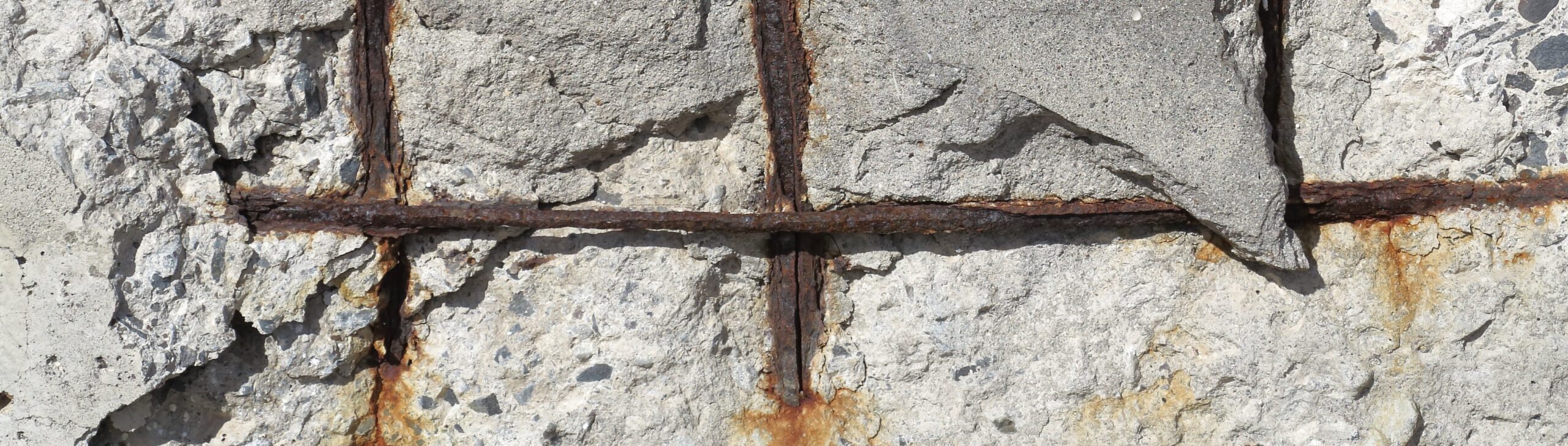

Concrete spalling in a body corporate can be a small, manageable repair or evidence of a wider deterioration problem. The difference lies in the cause, extent and quality of the body corporate’s response.
Concrete spalling—often called concrete cancer—is common in reinforced concrete buildings, particularly in coastal environments. It may appear as a small patch of flaking concrete, a rust-coloured stain or a crack along the edge of a balcony. What is visible at the surface, however, may be only part of the problem.
For owners and buyers, the presence of concrete spalling is not automatically a reason to panic. Concrete can be repaired and many bodies corporate manage localised repairs as part of ordinary maintenance or a larger repainting project. The important questions are why the spalling occurred, how far it extends and whether the response deals with the cause as well as the visible damage.
What is concrete spalling
Reinforced concrete combines two materials with complementary properties. Concrete performs well under compression but is relatively weak in tension. Steel reinforcement adds tensile strength and ductility.
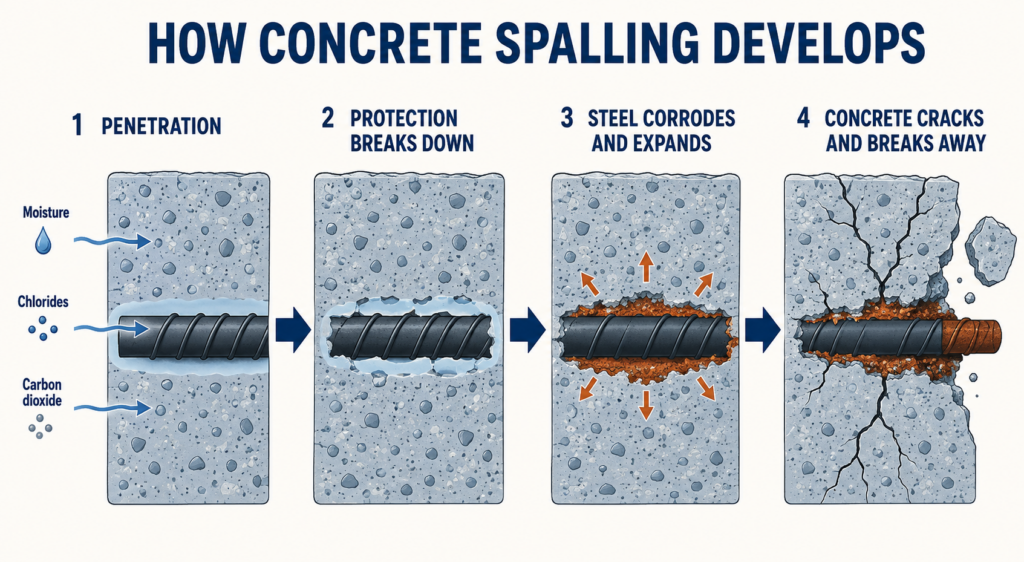
The concrete surrounding the reinforcing steel would ordinarily help protect it from corrosion. When that protection is lost moisture and oxygen can reach the steel. The internal reinforcement begins to corrode, and the rust products occupy more space than the original steel.
That expansion places pressure on the surrounding concrete. Cracks form, the surface may bulge or delaminate, and pieces of concrete eventually flake or break away. Once the steel is exposed, deterioration can accelerate because it is no longer protected from the environment.
What causes it?
Water is central to the corrosion process, but simply describing spalling as “water ingress” can hide the more useful question: how did the protective environment around the steel break down?
Contributing factors may include:
- cracks that allow moisture and contaminants into the concrete
- chlorides from salt air, sea spray or other sources—an important concern for coastal buildings
- carbonation, a gradual chemical change that reduces concrete’s ability to protect the reinforcement
- insufficient concrete cover over the reinforcing steel
- poor construction, curing, detailing or material quality
- failed waterproofing, joints, sealants or protective coatings
- leaking balconies, planter boxes, podiums, roofs or plumbing
- building movement or damage that has opened pathways into the concrete.
The cause matters because a cosmetic patch will not provide a durable solution if moisture, chlorides or a failed waterproofing system continue to affect the area.
How do you recognise concrete spalling?
Possible warning signs include:
- flaking, pitting or pieces of concrete breaking away
- cracks running along the line of reinforcement
- rust-coloured staining or rust marks emerging through paint
- bulging, drummy or hollow-sounding concrete
- bubbling, blistering or peeling coatings
- exposed or visibly corroded reinforcing steel
- repeated patch repairs in the same area.
Spalling can occur in balcony slabs and edges, façades, awnings, columns, beams, basement walls and soffits, podiums, driveways and other reinforced concrete elements. Falling concrete can create an immediate safety risk. Loose concrete over entrances, footpaths, balconies, roads or occupied areas should be isolated and assessed promptly by a suitably qualified professional.
Why does it matter to a body corporate?
Concrete spalling matters for three connected reasons: safety, deterioration and cost.
A loose fragment can injure someone or damage property. Corrosion can continue behind apparently sound surfaces and reduce the cross-section of the reinforcing steel. If deterioration becomes widespread or affects structural elements, the investigation and rectification may become a major project.
Cost is influenced by much more than the size of the visible patch. Access may require scaffolding, swing stages, elevated work platforms or rope access. The project may also involve engineering, testing, waterproofing, balustrades, painting, traffic control, resident access and making good surrounding finishes.
The former Iluka high-rise in Surfers Paradise is an extreme example of what long-term deterioration can mean: the building was demolished in 2013 after concrete cancer was reported to have compromised its structural integrity. Most spalling matters will never reach that point, but the example explains why delay and inadequate surface treatment are poor risk-management strategies.
What usually happens next?
Once spalling is suspected, the body corporate should obtain advice appropriate to the apparent risk. A structural engineer or experienced remedial building consultant may investigate the cause and extent, identify any immediate safety measures and prepare recommendations or a scope of works.
A typical repair may involve removing unsound concrete, exposing the affected reinforcement, cleaning and assessing the steel, replacing or supplementing reinforcement where necessary, applying appropriate corrosion protection, reinstating the concrete with a compatible repair system and restoring protective coatings or waterproofing. The exact method should be designed for the particular structure and exposure conditions.
Importantly, the full extent may not be visible before work begins. Contractors commonly include provisional quantities or rates because additional delaminated concrete can be discovered once the surface is opened. This does not necessarily indicate poor planning, but the body corporate should understand how variations will be measured, authorised and funded.
Routine repair or emerging major project?
The phrase “concrete spalling” does not reveal the scale of the risk. A small, isolated area that is promptly investigated and repaired is very different from recurring spalling across balcony edges, façades, columns or basement structures.
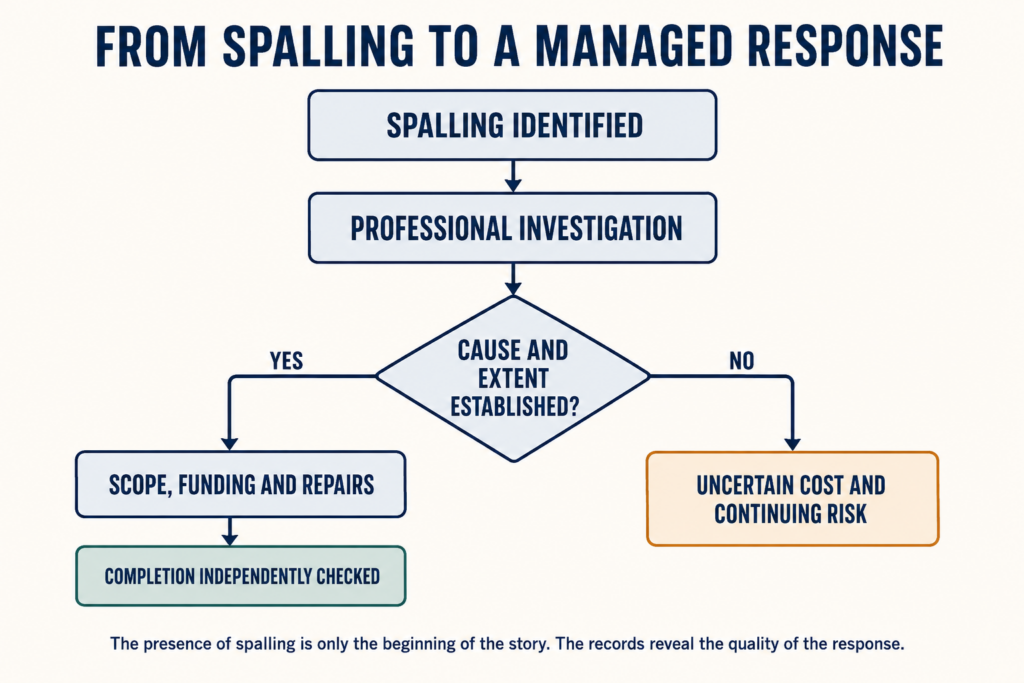
Signs that the issue may be under control
- The affected locations and likely cause are clearly recorded.
- Immediate falling-concrete risks have been made safe.
- A suitably qualified professional has assessed the issue.
- The repair scope deals with both damaged concrete and the source of deterioration.
- The body corporate has obtained realistic allowances for access and latent conditions.
- Repairs are completed, documented and independently inspected where appropriate.
- Ongoing inspection and maintenance requirements are included in future planning.
Signs that deserve closer investigation
- Spalling is repeatedly mentioned but there is no corresponding investigation or repair.
- Concrete has been patched or painted without evidence that corrosion and its cause were treated.
- New areas continue to appear after earlier repair programs.
- The damage is widespread or affects structural elements, balcony edges, awnings or high façades.
- Reports refer to chloride contamination, low concrete cover, extensive carbonation or significant steel loss.
- The scope is uncertain and the financial allowance is based only on visible quantities.
- Access, waterproofing, balustrade or façade works materially increase the project.
- There is no clear funding plan, or the body corporate is considering a substantial special levy or loan.
What inexperienced readers often miss
Concrete spalling is often a consequence of another problem, not a stand-alone event. It may be mentioned only briefly in a waterproofing report, balcony quotation, repainting tender or façade project. Searching only for the words “concrete cancer” may therefore miss important evidence.
It is also easy to equate fresh paint with successful rectification. Protective coatings can form part of a repair system, but paint alone does not restore corroded reinforcement or remove unsound concrete. Look for evidence that the steel, damaged concrete and underlying moisture or contamination pathway were all addressed.
Finally, the first quotation may not show the final cost. Once access is installed and concrete is sounded or opened, the repair quantity may grow. The quality of the investigation, contract allowances, variation controls and available funds can be as important as the initial price.
What documents tell the story?
Read across the records rather than relying on a single meeting minute. Useful documents include:
- structural engineering, façade, safety and maintenance reports
- waterproofing, balcony, balustrade and water-ingress investigations
- scopes of works, specifications, tenders and quotations
- committee and general meeting minutes recording decisions and progress
- variation reports, progress claims, completion reports and warranties
- independent inspection or certification of completed work
- capital works forecasts, budgets, special levies and loan proposals
- insurance, safety and council correspondence where relevant.
The practical question for an owner or buyer
Do not ask only, “Does the building have concrete spalling?” Ask:
- Where is it, and could loose concrete create an immediate safety risk?
- What caused it and has the full extent been investigated?
- Is it isolated, widespread or recurring?
- Does the scope treat the cause as well as the visible damage?
- What access and related works will be required?
- How much uncertainty remains in the repair quantity and cost?
- Has completed work been independently checked?
- How will current and future repairs be funded?
Concrete spalling can be manageable when it is identified early, properly investigated, competently repaired and incorporated into long-term maintenance planning. The greater risk is not the name “concrete cancer”; it is deterioration that is hidden, repeatedly patched, poorly understood or left without a credible response.
Title Photo By TeWeBs – Own work, CC BY-SA 4.0, https://commons.wikimedia.org/w/index.php?curid=179739868
This article provides general information only. It is not legal, financial, engineering or building advice. The circumstances of every body corporate are different. Obtain advice from an appropriately qualified professional where necessary.