


A body corporate QBCC claim is evidence of a building defect dispute – not, by itself, proof that owners face a disaster. The important question is what the records show happened next.
A reference to a Queensland Building and Construction Commission (QBCC) claim in body corporate records can sound alarming, particularly when you are considering buying into a newer building. It confirms that defective building work has been alleged and the issue has progressed beyond an ordinary maintenance item.
But the existence of a QBCC matter does not tell you whether the defect is minor or serious, whether the builder accepted responsibility, whether repairs were completed, or whether owners will ultimately have to fund the work. To understand the risk, you need to follow the entire sequence—not stop at the words “QBCC claim”.
What does "QBCC claim" mean?
In body corporate minutes, correspondence and reports, “QBCC claim” is often used loosely. The records may actually refer to:
- a defective-work complaint lodged with the QBCC
- the QBCC’s dispute-resolution or inspection process
- a Direction to Rectify issued to a contractor
- a possible claim under the Queensland Home Warranty Scheme
- or a later building dispute that may proceed to the Queensland Civil and Administrative Tribunal (QCAT).
Those stages are not interchangeable. A complaint is the beginning of a process. A Direction to Rectify means the QBCC has taken a formal step requiring defective work to be fixed. A home warranty claim is a separate question of insurance eligibility if the dispute is not satisfactorily resolved.
How the process usually starts
The body corporate may become aware of defects through resident complaints, committee and caretaker inspections, or professional investigation. Matters can relate to water ingress, cracking, failed finishes, or fire-safety concerns.
If the work is under warranty then the body corporate should first notify the relevant contractor in writing, identify each disputed item and provide a reasonable opportunity to inspect and rectify it.
If the contractor disputes the matter and it remains unresolved, an authorised body corporate representative may lodge a defective-work complaint concerning common property. The QBCC reviews eligibility and supporting information, contacts the parties and may try to facilitate an agreement.
If agreement is not reached, a QBCC building inspector may inspect the items and decide what action is appropriate.
What the QBCC process does - and does not - establish
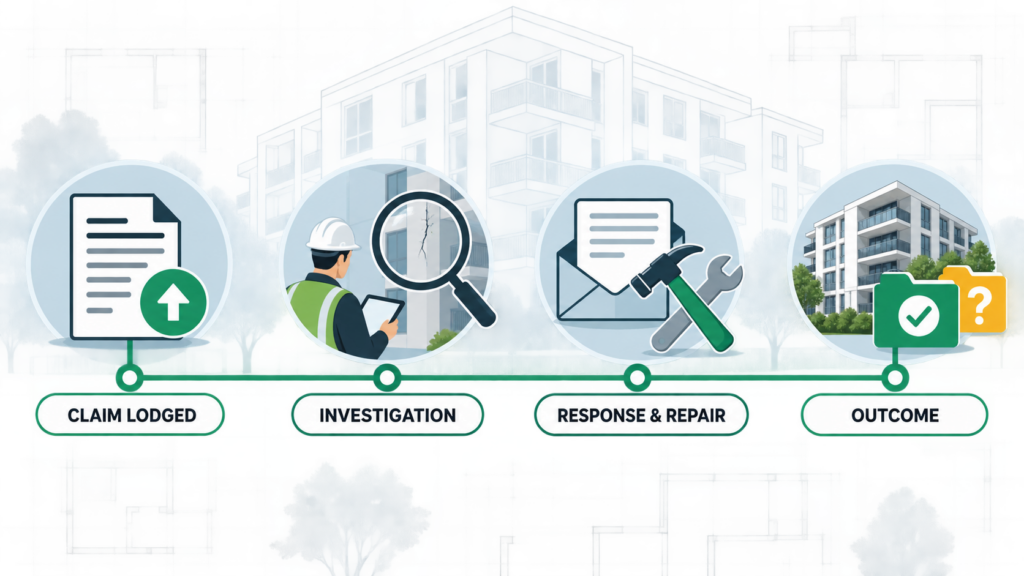
A QBCC inspection can be valuable because it may determine that particular building work is defective and can lead to a Direction to Rectify. The QBCC currently states that a Direction to Rectify will generally allow 35 days for the work to be fixed and will appear on the contractor’s public licence history.
However, the QBCC explains that its building inspection is visual and does not involve invasive investigation to determine the cause of an alleged defect. The QBCC also does not supervise the repairs, fix the work itself, require a party to pay compensation or decide every contractual dispute.
This is why an engineer’s report, building consultant’s report, waterproofing investigation or other specialist evidence may still be critical. A QBCC outcome should be read alongside the body corporate’s own technical evidence—not treated as a substitute for it.
Should buyers be worried
Concern is appropriate, but the level of concern depends on the evidence. A QBCC matter may show that the committee identified a problem and acted promptly to protect owners. That can be a positive sign of active management.
The risk increases when the records show a serious or widespread defect, delay, unclear responsibility, an uncooperative or insolvent builder, an expired timeframe, incomplete investigations, failed rectification work or no credible funding plan.
Signs that the risk may be contained
- The defect is clearly described and its extent has been investigated.
- The body corporate notified the contractor promptly and met the relevant QBCC requirements.
- The builder or contractor is engaging constructively.
- A clear scope of works and repair program exist.
- Repairs have been completed and independently checked.
- The body corporate has documented who paid and whether any related damage remains.
Signs that deserve closer investigation
- Minutes repeatedly refer to defects without showing measurable progress.
- The complaint concerns water ingress, structural movement, fire safety, façades, roofing, balconies or multiple areas of the building.
- The builder disputes responsibility or has stopped responding.
- The QBCC did not issue a Direction to Rectify, but the technical problem remains unresolved.
- A Direction to Rectify was issued but there is no evidence of compliant completion.
- Repairs were attempted more than once or new symptoms appeared after the work.
- Experts disagree about the cause, responsibility or appropriate scope.
- The body corporate is considering legal action, a large special levy or borrowing.
- Important reports, correspondence, scopes, quotes or outcomes are missing from the records.
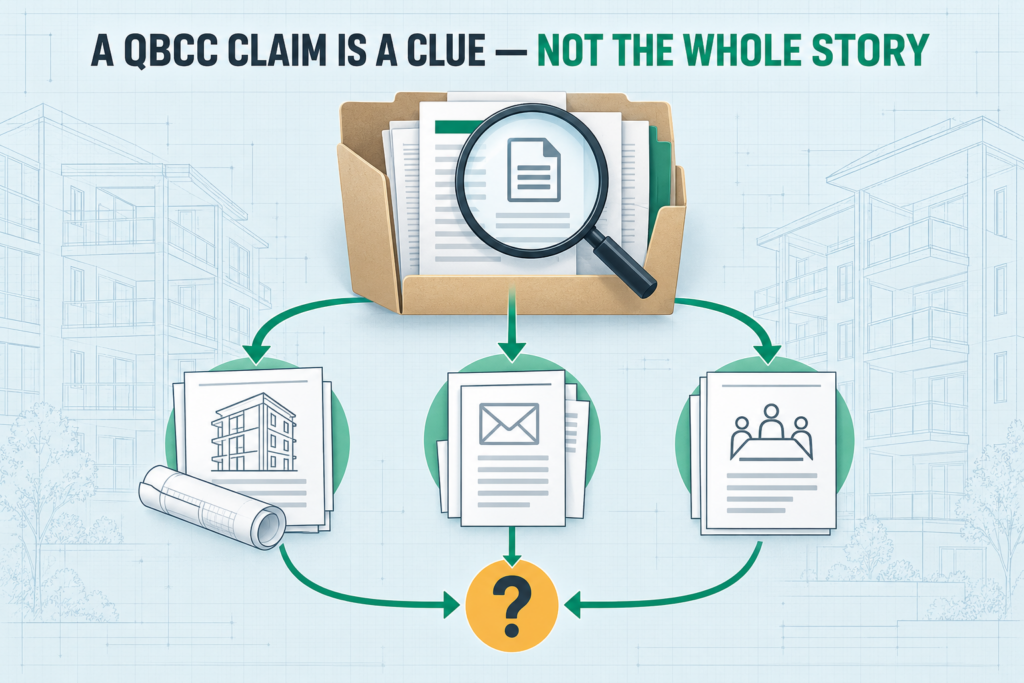
What document tell the story?
- the original defect list and written notice to the builder or contractor
- engineers’ and building consultants’ reports, including photographs and testing
- QBCC complaint acknowledgements, inspection correspondence and decisions
- any Direction to Rectify and evidence of compliance—or failure to comply
- builder, developer and subcontractor correspondence
- scopes of works, tenders, quotations and contracts for rectification
- meeting minutes and resolutions authorising action and expenditure
- legal advice or QCAT documents, where disclosed in the records
- insurance correspondence and any Queensland Home Warranty Scheme material
- invoices, special levies, forecasts and evidence that repairs were independently verified.
What inexperienced readers often miss
The most common mistake is treating the outcome of the QBCC process as the outcome of the defect itself. A file may be closed, or no Direction to Rectify may be issued, while the building still has a physical problem that the body corporate must investigate and resolve. This will fall to the owners to fund the work.
It is also easy to focus on who should pay and overlook what must be done. Responsibility, technical rectification and funding are connected but separate questions. Even when a builder is responsible, owners may still face delay, professional fees, access issues, consequential damage or interim expenditure.
Finally, do not assume that the last document in the file proves the work succeeded. Completion should ideally be supported by an inspection, certification, testing or other independent evidence appropriate to the defect.
The practical question for an owner or buyer
Do not ask only, “Is there a QBCC claim?” Ask:
- What is the defect and how serious is it?
- Has its cause and full extent been established?
- What stage has the QBCC process reached?
- What did the QBCC actually decide?
- Has an adequate repair scope been prepared and carried out?
- Who has paid so far, and what costs could still fall to owners?

A well-managed QBCC matter can be evidence that the body corporate is responding appropriately to defects. An unresolved matter with missing evidence, weak follow-through or uncertain funding may point to a much larger risk. The difference is found in the records.
Important timing point
QBCC complaint and home warranty timeframes can be strict and depend on the work and circumstances. The QBCC currently warns that, to preserve possible Queensland Home Warranty Scheme options, a defective-work complaint should be lodged within three months of noticing structural defects and within seven months of completion for non-structural defects. The body corporate should obtain current professional advice rather than rely on a general article or wait for the next meeting.
This article provides general information only. It is not legal, financial, engineering or building advice. The circumstances of every body corporate are different. Obtain advice from an appropriately qualified professional where necessary.