



When buying a unit the seller should give you a form 2 seller disclosure statement which includes a form 33 body corporate certificate. What a form 33 tells you about a body corporate is limited.
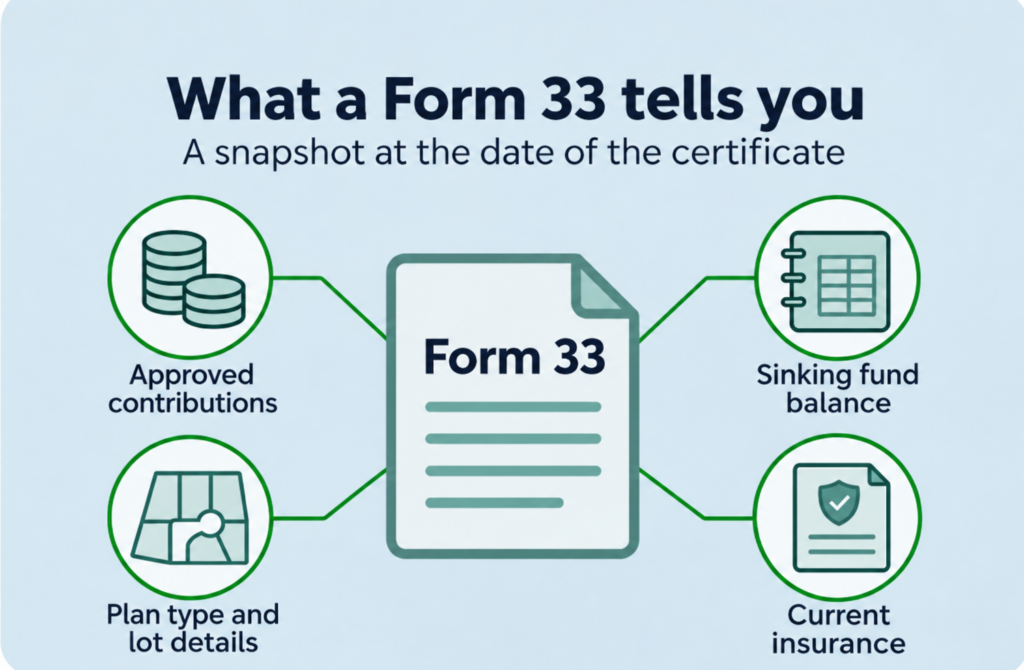
The form 33 shows what the currently approved levies are, what funds are in the sinking fund and whether or not a special levy is approved.
Just because there is no special levy approved does not necessarily mean that one is not pending. The form 33 itself specifically notes on the first page that the certificate does not include information about phyiscial defects, expenses and and liabilities not approved, disputes, orders or problems that might impact a buyer.
What is a Form 33 body corporate certificate
The Property Law Act 2023 requires most property sales in Queensland to be preceeded by a form 2 seller disclosure statement.
If the property in question is a lot in a body corporate the form 2 seller disclosure statement must include a form 33 body corporate certificate for the lot. The form 33 contains information about the body corporate including the current yearly contributions and whether or not a special levy has been issued.
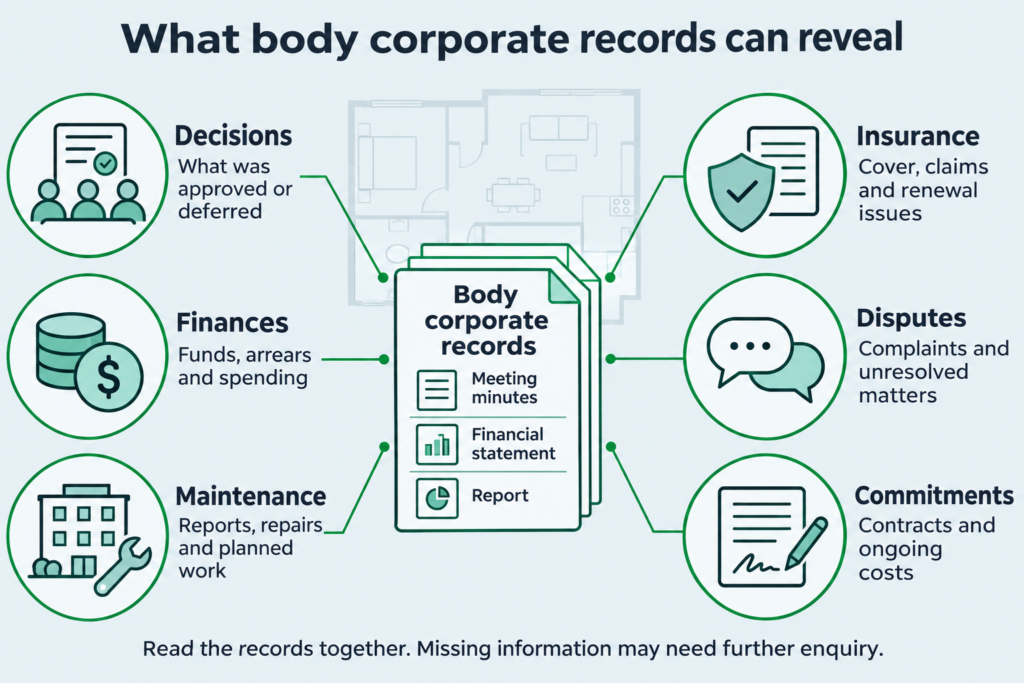
Form 33 gives you a useful starting point: facts about the lot, the scheme and its finances at the date of the certificate. It doesn’t give you a running account of what owners have been discussing, what the committee is investigating or what decisions are still to come.
What can you learn from the certificate?
What a form 33 tells you is limited but it does include some important details:
How the property is set up
There are several “settings” that tell you about your body corporate and its complexity.
The simplest is plan of subdivision which sets out whether the scheme is standard format, building formate or volumetric format. The type of subdivision gives clues as to who is responsible for what when it comes to maintenance. The plan type gives clues as to where boundaries between lot and common property are measured. A volumetric plan is one for a large space which is then subdivided into smaller lots and mostly applies to commercial schemes.
If the scheme is a layered arrangment this is disclosed in the form 33. A layered arrangement is where one body corporate is contained wholly inside another body corporate. There will only be one set of contributions payable however there will be additional rules and liabilities that attach to the lot because of the principal body corporate.
Another type of shared arrangement is a Building Management Statement. A BMS can be between a body corporate and another body corporate or a body corporate and a lot outside the body corporate. It sets out cost management for any shared areas and is common when there are commercial lots.
What comes with the lot
Exclusive use areas allocated should be recorded in the form 33, or at least whether there are any exclusive use areas allocated to the lot. If there is an allocation it might be listed in the form 33 or you may be referred to the Community Management Statement attached. Look for schedule E which will show the allocation listed. Its also a good idea to look at the exclusive use by-law to get an idea of the terms of the allocation.
Lot entitlements sets out your proportion of the costs (contribution lot entitlements) and valuation (interest lot entitlements) of the scheme, and the total of both. Each lot should have both a contribution and interest entitlement though they may be equal.
Improvements to common property that the lot owner is resonsible for should be listed in the form 2 or by attaching a register setting out what has been approved. Responsibility for the improvement with transfer with the title.
Current contributions approved
The current contributions approved by the body corporate are set out in the Form 33. This will include administrative fund and sinking fund contributions, along with insurance contributions if calculated separately and amounts payable under a special rights by-law.
It will also set out any special levies approved and its due date. It will not tell you what the special levy was raised for.
Each contribution listed should also note when its due and whether or not its been paid. This is valuable information to know, particularly if the contributions are in arrears. Any outstanding balance will be transferred to the buyer at settlement so its important to know what’s payable and ensure it gets paid from settlement funds.
What arrangements are currently in place
The form 33 provides information about current information that will impact the owner including:
Current insurance for the common property and in most cases the lot. A certificate of currency may be provided but if its not the current insurance details in place will be. You may need to find your own certificate of currency for your mortgagee.
If alternative insurance arrangements are in place the form 33 should record this as well. Alternative insurance is needed when the body corporate is struggling to find insurance for the scheme for some reason.
Current sinking fund balance is shown in the form 33. This figure by itself is not that helpful. The balance itself is not nearly as important as what that balance is expected to cover.
Financial statements are not included in the form 33 itself, but should be included as an attachment to the form. A body corporate is only required to prepare one financial statement at financial year end, so these maybe up to 12 months old and remain compliant. However, may strata managers will prepare ongoing statements which show the current position of the scheme. If the financial statements are not include ask for them. They contain valuable information about the schemes outgoings and potentially budgets.
What if I have a Form 18 certificate instead?
If the scheme is managed under the BUGT Act then rather than a form 33 the lot with have a form 18.
There are several similarities between a form 18 and form 33 including exclusive use (found in the by-laws rather than CMS), improvements to common property for which the buyer will be responsible, current contributions payable and their paid to date, sinking fund balance, and insurance details (alternative insurance does not apply to a BUGT Act scheme).
The primary differences relate to plan types and lot entitlements.
The plan will be either a Building Unit Plan (BUP) or a Group Titles Plan (GTP). This does roughly equate to whether the scheme is building format plan or standard format plan however there are differences in the way the plans can be handled.
There will also be a development act in addition to the BUGT Act with additional rules applying.
Lot entitlements differ in that there will be one entitlement that covers both contribution payable and percentage of ownership.
What information is missing?
If your question is “What are the current levies for this lot?”, start with the Form 33.
If your question is “Is there likely to be a levy increase or special levy in the immediate future?”, you’ll need to do additional due diligence searches. Luckily once you enter a contract you become an “interested party” and are able to access the body corporate records.
Some information may be provided to you by the seller as an implied warranty statement which may help you answer questions about the mainteance and management of the body corporate. But it may also generate more questions.
If not, to understand what is happening in the common property and how that might impact the contributions, you have the option to carry out a search of records.
That is something we can help you with. Our pre purchase strata report is a search of records and review of documents by strata professionals.
Conclusion
The form 33 body corporate certificate, and the wider form 2 seller disclosure contains important information. The information provided however is not all the information that will be available to buyers.
Review the body corporate records to more comprehensively understand what is happening in your chose body corporate.
This article provides general information only. It is not legal, financial, engineering or building advice. The circumstances of every body corporate are different. Obtain advice from an appropriately qualified professional where necessary.