
The Body Corporate Blueprint
The Blueprint brings together the records, warning signs, decisions and connections that help owners understand how a body corporate is functioning
My job is to read body corporate records and identify potential risk factors so buyers and current owners can make informed decisions.
Through that work, I have accumulated an extensive collection of recurring issues and warning signs: how they arise, how they interact and what they may mean for owners.
The Body Corporate Blueprint is my attempt to take those recurring issues, patterns and connections out of my head and turn them into a practical framework that buyers and owners can use.
My intention is to help readers understand how a body corporate functions, recognise connections between issues and assess how effectively the scheme is responding.
It is supported by a growing collection of interconnected articles explaining the documents, concepts, strengths, problems and warning signs that may appear in the body corporate records. The articles help readers understand the available evidence, identify what else to look for and consider what the current position may mean, what pressures or consequences may arise and what an effective response looks like.
This is a Queensland-focused resource. It primarily uses terminology drawn from Queensland’s community titles legislation, while also considering bodies corporate governed under other frameworks. Many of the underlying principles will also be relevant to other forms of shared-property ownership, although the legislation, terminology and specific obligations may differ.
Common Property Stewardship

Before we can decide whether a body corporate is functioning well, we need to understand what it is there to do.
Under Queensland’s main community titles framework, a body corporate is the legal entity made up of all the lot owners. It allows those owners to collectively administer and manage the property, assets and obligations they share.
Other shared-property arrangements may operate under different legal structures. Whether a scheme contains only two lots, forms part of a sprawling master-planned community or occupies a towering high-rise, the underlying challenge remains: people must make collective decisions about shared property and shared responsibilities.
The applicable legislation and governing documents provide the framework for that collective management. They establish responsibilities, decision-making processes and requirements that must be met. Within that framework, each scheme must decide how it will identify problems, establish priorities, raise funds and carry out the necessary work.
I use common property stewardship as a practical description of this collective responsibility. The precise legal responsibilities depend on the type of scheme, but stewardship is not merely repairing and maintaining physical property. It includes planning, funding, complying with obligations, managing risk, resolving disagreements and ensuring that decisions produce effective results.
Body corporate records provide the evidence
One important aspect of body corporate administration is creating and keeping records.
These records include minutes, financial statements, reports, photos, quotations, contracts, insurance documents and correspondence. Depending on why its held it may even include video footage.
The records may contain documented evidence of the problems the body corporate has encountered, the decisions it has made, the resources it has committed and what happened next.
They may also show effective action, completed work and other strengths that help protect owners.
For the Body Corporate Blueprint, the records provide the main documented source of evidence about how the body corporate has been functioning. The six connected areas provide a structure for organising and interpreting what those records reveal.
Body corporate records do not necessarily provide a complete picture, but they give us a place to begin.
Six Connected Areas
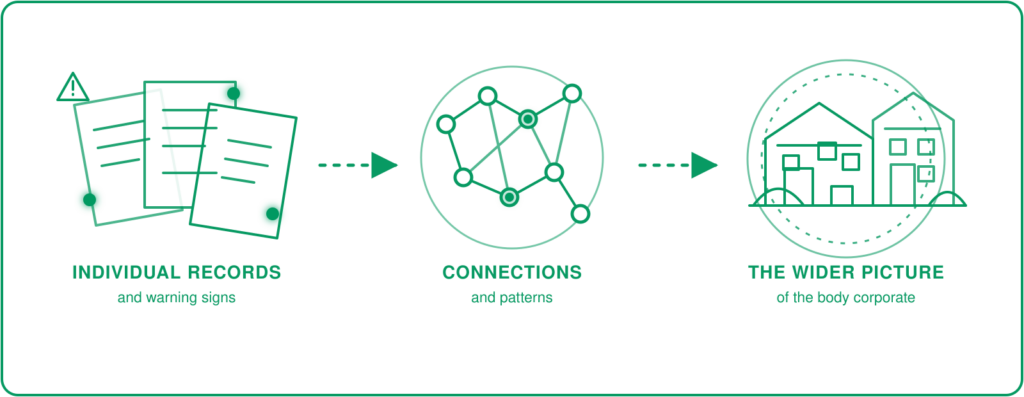
A complaint about the cleanliness of the pool, another about a negative interaction over by-laws, and committee minutes expressing frustration with reported issues may not be particularly concerning when considered separately. Considered together, they may point to a developing issue with the caretaker or the way caretaking services are being managed.
That evidence may be scattered across large volumes of records and mixed with many unrelated matters. I think of these details, good or bad, as threads to tug. The skill lies in knowing which threads to follow to gain a clearer view of what is happening.
To find those threads, it helps to organise the available information into smaller analytical areas. We can examine the evidence within each area, identify strengths, weaknesses and gaps, and then reconnect the findings to understand how the scheme appears to be functioning as a whole.
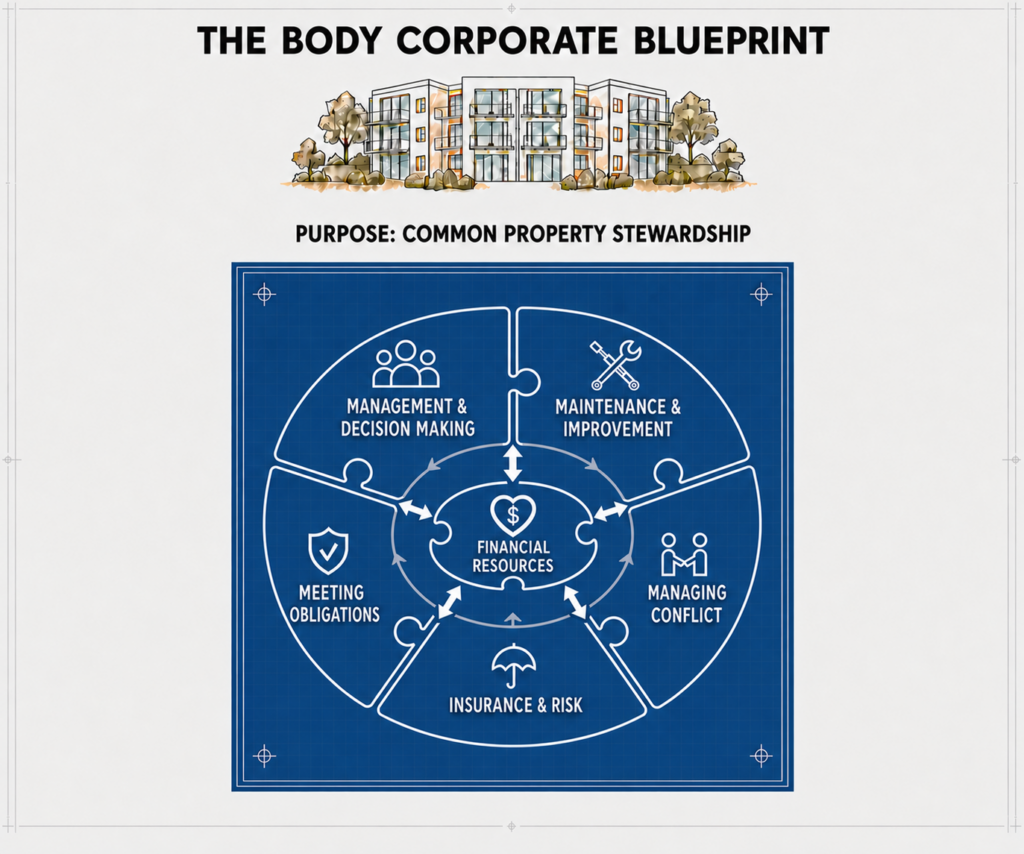
The Body Corporate Blueprint organises that analysis through the following six connected areas: Maintenance & Improvement, Management & Decision Making, Meeting Obligations, Managing Conflict, Insurance & Risk and at the heart of the system, powering everything, Financial Resources.
Maintenance & Improvement
What work is required to care for, repair and improve the common property and body corporate assets?
This area includes:
- Cleaning, gardening and routine servicing
- Preventive maintenance, repairs and replacement
- Responsibility for maintaining particular property
- Building defects and deterioration
- Water ingress
- Concrete spalling
- Structural problems
- Roofs
- Windows and walls
- Balconies
- Lifts
- Shared facilities
- Inspections and maintenance reports
- Technical investigations
- Scopes of work, quotations and completed repairs
- Capital works and improvements
Management & Decision Making
How are issues recognised, considered, decided, and followed through – and whom by?
This area includes:
- The committee and its role
- The body corporate manager
- Caretaking and Letting Agreements
- Service contractors and other providers
- Roles, authority and delegation
- Contracts and supervision of service providers
- Obtaining advice, reports and quotations
- Preparing and considering motions
- Decision-making by the committee or owners
- Communication, recordkeeping and administrative systems
- Implementing and monitoring decisions
- Following up unfinished matters
- Management performance and dysfunction
Meeting Obligations
What the body corporate must do and have those requirement that apply been met for the particular scheme?
This area includes:
- General meeting and committee meeting requirements
- Notices and agendas
- Motions, voting and quorum requirements
- Legislative timeframes
- Elections and appointment requirements
- Recordkeeping and access obligations
- Financial and reporting requirements
- Fire safety and cladding obligations
- Workplace health and safety requirements
- Local government requirements and heritage restrictions
- Statutory inspections and reports
- Statutory registrations
- Other applicable legal and regulatory obligations
Managing Conflict
What is disputed, how is it managed, and what does the conflict delay or cost?
This area includes:
- Disputes between owners
- Disputes between owners and the body corporate
- By-law enforcement
- Disagreements about maintenance responsibility
- Committee conflict
- Disputes involving caretakers or body corporate managers
- Claims against developers, builders or contractors
- Neighbouring property disputes
- Early communication and attempted resolution
- Conciliation and adjudication
- Tribunal or court proceedings, legal advice and legal costs
- Settlement, enforcement and the effect of unresolved conflict on decisions and necessary work
Insurance & Risk
What exposure exists and what protection is available?
This area includes:
- Required body corporate insurance
- Building and public liability insurance
- Reinstatement valuations
- Premiums and excesses
- Claims, claims history and denied claims
- Policy exclusions, restrictions and limitations
- Underinsurance or uninsured exposure
- Insurer requirements
- Difficulty obtaining or renewing insurance
- Disclosure of known defects or circumstances
- Risk surveys and insurer recommendations
- The effect of defects, uses or activities on insurance
Financial Resources
Can the body corporate fund its current and future liabilities?
This area includes:
- Administrative and sinking fund budgets
- Owner contributions
- Cash flow and reserves
- Financial statements
- Sinking fund forecasts and capacity to fund planned work
- Contribution arrears and debt recovery
- Special levies
- Body corporate loans and other funding options
- Planned and unplanned expenditure
- Insurance premiums and funding
- Major works funding
- Cost allocation between owners
These areas do not operate separately!
The six areas are connected analytical lenses rather than rigid compartments. An issue may begin in one area and then affect several others.
A common property defect may expose weaknesses in management. Delayed action may affect insurance. The cost of the eventual work may create financial pressure. Owners may then disagree about responsibility or funding.
The Blueprint provides a framework for organising the available evidence into smaller, easier to understand bites. When each area is understood connections can be noted and then the overall picture considered.
A healthy body corporate is not necessarily one without defects, disagreements or unexpected expenses. Buildings require maintenance, owners sometimes disagree and insurance claims occur, even in well-run schemes.
The more useful measure of health is how effectively the body corporate responds to issues – including investigating, funding and resolving them where necessary.
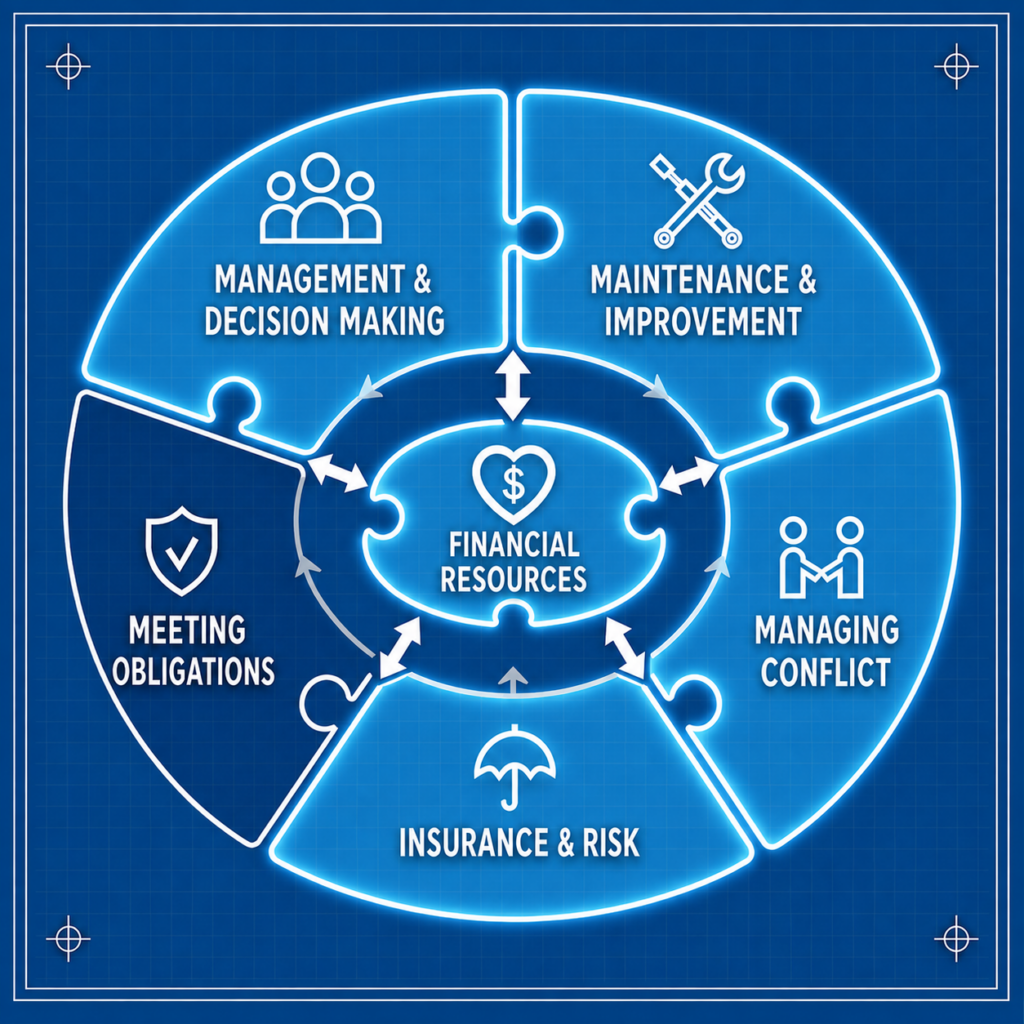
The Blueprint provides a framework for organising available evidence into smaller, easier to understand bites before following connections and considering how the scheme appears to be functioning overall
How the Body Corporate Blueprint works
The Body Corporate Blueprint is a growing network of interconnected articles. It is not designed to be read from beginning to end. You can start with the question, document or problem in front of you and explore from there.
Some articles explain a single document, concept or problem. Others follow a pattern across several connected areas. The Blueprint visual highlights the area – or areas – most relevant to the discussion, while
links lead to related subjects and help readers trace the wider effects.
You can stay focused on the information you need or follow the connections to build a broader understanding of what may be happening, why it matters and what else should be investigated.
More articles and connections will be added over time, and existing articles will be updated as the Blueprint develops.
Explore the Blueprint
Search the records
Have a question?
Find information about a document, problem or warning sign.
Discover what the records reveal about a particular body corporate.
Tell me what you are trying to understand?